Symbol Design: Global Standards Explained
Safety symbols are visual tools that communicate hazards, required actions, or emergency information without relying on text. They are especially useful in workplaces with diverse languages. International standards like ISO 7010 and ISO 3864 ensure these symbols are consistent and easily recognised worldwide. For example, ISO 7010 categorises symbols into five groups – prohibition, mandatory, warning, emergency, and fire safety – using specific shapes and colours for clarity. Australia aligns with these standards, ensuring compliance with local workplace safety laws. This approach helps reduce accidents and improves safety communication across industries.
International Standards for Safety Symbol Design
ISO 7010: Safety Sign Pictograms
ISO 7010 provides a globally recognised library of safety pictograms. Released as ISO 7010:2019, it includes over 200 symbols divided into five categories: Prohibition (P), Warning (W), Mandatory (M), Emergency (E), and Fire Equipment (F). Each symbol is assigned a unique identifier to ensure consistent use across diverse environments like factories, hospitals, and construction sites.
This comprehensive document spans 298 pages. By early 2026, ISO 7010:2019 had undergone 11 amendments, introducing new symbols and updating existing ones to address modern workplace hazards [4]. A fourth edition (ISO/DIS 7010) is currently in development as of March 2026, reflecting ongoing efforts to align with contemporary safety needs [5]. To complement the pictograms, ISO 3864 defines the visual parameters that enhance their effectiveness.
ISO 3864: Safety Colours and Design Rules
While ISO 7010 delivers the finished pictograms, ISO 3864 sets the design rules that underpin their creation. For over four decades, this standard has outlined how colours, shapes, and layouts combine to create effective safety symbols [2]. It specifies exact RAL colour values to ensure visibility and consistency:
- Signal Yellow (RAL 1003): Used for warnings
- Signal Red (RAL 3001): Signifies prohibitions and fire equipment
- Signal Blue (RAL 5005): Indicates mandatory actions
- Signal Green (RAL 6032): Represents safe conditions [2]
ISO 3864 is divided into four parts, covering sign design, graphical symbols, and the precise colour and light properties needed for visibility under various lighting conditions [2]. A notable feature is the mathematical formula it provides for determining sign size based on viewing distance: h = L / Z, where "L" is the viewing distance and "Z" adjusts for lighting quality [6]. This ensures signs are appropriately scaled for their environment, enhancing communication.
Additionally, the standard defines safety markings, such as 45° alternating coloured stripes (e.g., Yellow/Black for hazard areas), and standardises arrow designs for directional purposes [2]. In Europe, these principles are further adapted through EN ISO 7010 to meet regional regulatory needs.
EN ISO 7010: Regional Updates
EN ISO 7010 serves as the European adaptation of the international ISO 7010 standard, adopted with identical content [6]. This harmonisation enables countries within the European Union to integrate the standard into their local regulations while accommodating unique regional requirements.
For instance, some countries expand on the standard to address specific local needs. France uses NF ISO 7010, and the Netherlands employs NEN 3011, both of which include additional symbols for items like underground fire hydrants or emergency response resources relevant to their contexts [1]. This flexibility allows international standards to maintain universal recognition while catering to regional priorities.
sbb-itb-9950c92
03 – ISO 7010 SAFETY SYMBOLS
Design Rules and Symbol Categories in ISO 7010
ISO 7010 Safety Symbol Categories: Shapes, Colors and Examples
Building on the earlier overview of ISO 7010 standards, this section delves into the design principles and symbol categories that provide global uniformity.
5 Main Symbol Categories
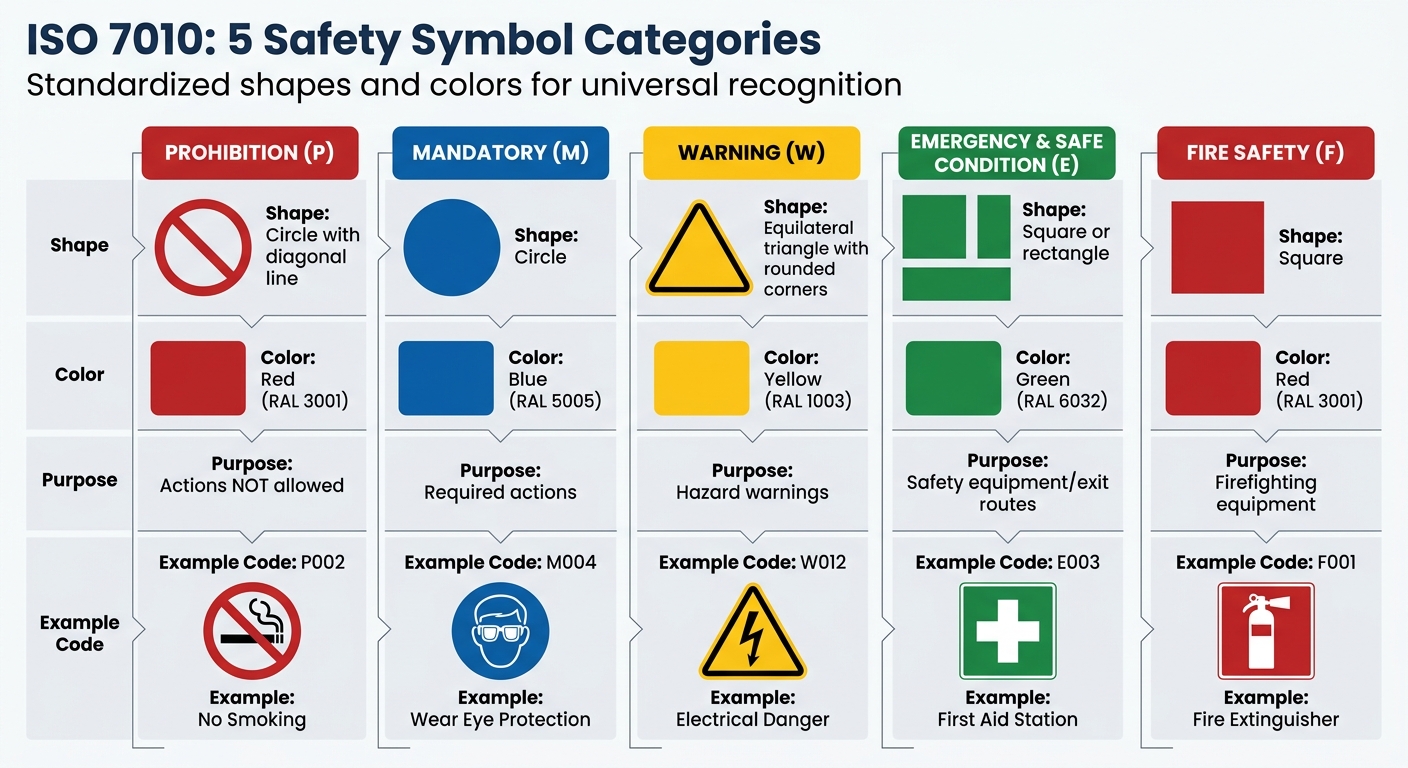
ISO 7010 groups safety symbols into five main categories, each defined by a letter prefix and a distinct colour-shape combination:
- Prohibition signs (P): These feature a red circle with a diagonal line, indicating actions that are not allowed. For example, P002 represents "no smoking."
- Mandatory signs (M): Displayed as blue circles, these symbols indicate required actions, such as M004 for "wearing eye protection."
- Warning signs (W): Yellow equilateral triangles with rounded corners are used to warn of hazards, like W012 for "electrical dangers."
- Emergency and safe condition signs (E): Green squares or rectangles identify safety equipment or exit routes, such as E003 for "first aid stations."
- Fire safety signs (F): Red squares signify firefighting equipment, with F001 marking "fire extinguishers" [1][7].
For unique situations where no specific pictogram exists, the standard advises using general category symbols like M001, P001, or W001, alongside additional text [1]. It also allows for cultural adjustments, such as replacing the first aid cross with a crescent in Muslim-majority regions [1]. These categories highlight the importance of a universal, language-free design approach.
Language-Free Design
The core principle of ISO 7010 is to communicate safety information with minimal reliance on text [1]. This is especially important in multilingual workplaces, where text-based instructions may not be effective [8]. By using universally recognisable shapes, colours, and icons, these symbols overcome language barriers, ensuring they are understandable to people regardless of their literacy or native language.
Every symbol is assigned a unique ISO 7010 code – such as F001 for a fire extinguisher – ensuring worldwide recognition [1]. This standardisation allows workers familiar with these symbols in one country to understand them instantly in another, creating a shared safety language. The strict adherence to colour and shape criteria further enhances clarity and recognition.
Colour and Shape Standards
The success of ISO 7010 symbols lies in their precise colour and shape specifications, derived from ISO 3864 standards. These guidelines ensure the symbols remain highly visible and recognisable under various lighting conditions, even in challenging environments.
Colours and shapes work together to convey meaning instantly. For instance, warning signs are required to use yellow equilateral triangles with rounded corners, adhering to ISO 3864-4 design rules [1]. This combination of colour and geometry provides an immediate visual cue, allowing people to grasp the type of information being presented before even interpreting the pictogram itself.
Australian Compliance with Global Symbol Standards
Australian Workplace Safety Regulations
Australia follows the ISO 7010:2019 standard for workplace safety signs, ensuring consistency with global practices. This 298-page document is available through Standards Australia for $484.42 AUD (GST included) [9].
To comply, workplaces must also adhere to ISO 3864-1 (covering sign shapes and colours) and ISO 3864-3 (focused on graphical symbol design) [9]. These standards aim to improve safety by providing clear visual communication for accident prevention, fire safety, health hazards, and emergency evacuations [10]. With Australia’s diverse workforce, the emphasis on pictorial safety information ensures accessibility for all.
The international colour-coding system is widely applied in Australia. Key colours include Signal Yellow (RAL 1003) for warnings, Signal Red (RAL 3001) for prohibitions and fire equipment, Signal Blue (RAL 5005) for mandatory actions, and Signal Green (RAL 6032) for safe conditions [2]. Risk levels are also categorised: yellow backgrounds signal "Caution" for low risk, orange indicates "Warning" for medium risk, and red conveys "Danger" for high risk [2]. These guidelines influence how Australian businesses choose compliant safety signage.
PXP Safety‘s Compliance Standards
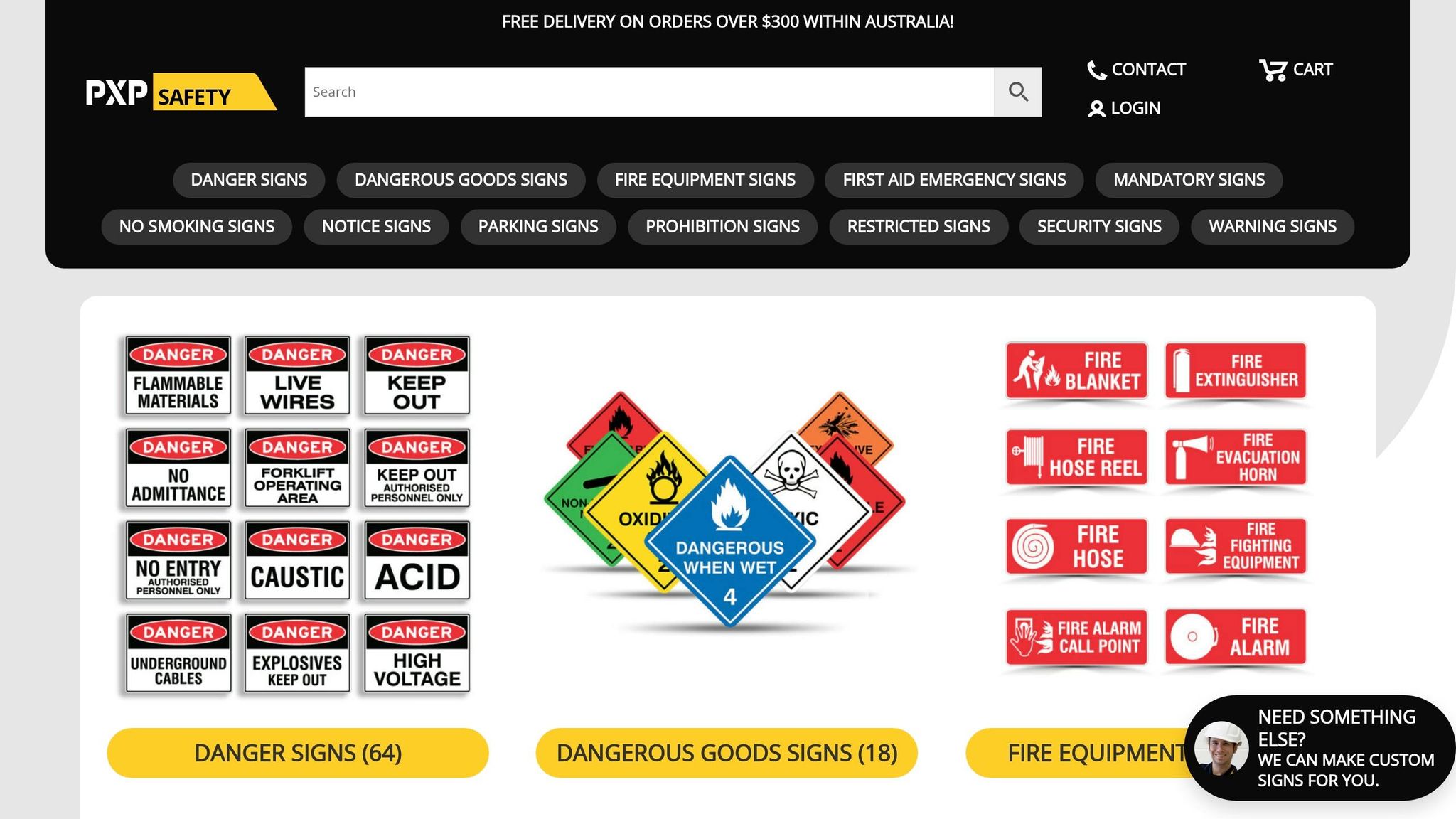
PXP Safety ensures its products meet these strict regulations by offering durable signage made from robust aluminium and UV-protected outdoor printing. This guarantees that the colours specified under ISO 3864-4 remain vibrant and recognisable, even in harsh outdoor conditions.
The company provides pre-designed signs featuring ISO 7010-compliant pictograms, as well as custom options for workplaces with unique needs. When specific ISO 7010 symbols are unavailable, PXP Safety creates custom signs using general symbols (like W001) paired with additional text [1]. This approach balances compliance with the practical requirements of Australian workplaces.
Conclusion
Main Points
Safety symbols that follow global standards bridge communication gaps across different languages. With nearly 7,000 languages spoken globally, relying on words for safety communication simply isn’t effective in diverse workplaces [3]. ISO 7010 and ISO 3864 address this by creating a universal visual system that uses standardised shapes, colours, and pictograms instead of text.
The system is designed for instant recognition. Each of the five sign categories – prohibition, mandatory, warning, safe condition, and fire safety – uses specific combinations of shapes and colours that workers can quickly identify [1][2]. This consistency eliminates the confusion caused by different symbol variations for the same message [3].
These standards continue to adapt, incorporating new hazards and evolving workplace needs to stay relevant and effective [4].
How PXP Safety Supports Compliance
PXP Safety aligns with these global standards to ensure Australian workplaces meet compliance requirements. Their signs are built to strict ISO specifications, featuring durable materials that preserve colour accuracy and visibility, even in tough conditions.
They offer both pre-designed ISO 7010-compliant signs and custom solutions to address unique workplace hazards. If a specific symbol isn’t part of the ISO 7010 library, PXP Safety creates custom signs by combining a general symbol (like W001 for warnings) with additional text [1]. This allows Australian businesses to stay compliant while addressing site-specific safety needs effectively.
FAQs
Which ISO standard should I use: ISO 7010 or ISO 3864?
ISO 7010 offers a collection of ready-made safety signs featuring standardised shapes, colours, and symbols. These are crafted to ensure quick and easy recognition. On the other hand, ISO 3864 lays out the foundational design principles and colour guidelines essential for creating these safety signs.
Put simply, ISO 3864 sets the design framework, while ISO 7010 focuses on applying these rules to practical, specific safety signs.
How do I choose the right sign size for a viewing distance?
When choosing a sign size, think about how easily it can be seen and read from where people will view it. The text and symbols should stay clear and easy to understand, even from the farthest viewing point. Bigger signs usually work better for longer distances. You can use tools like visibility checkers to make sure the sign fits well within its surroundings and serves its purpose effectively.
When can I add text or customise an ISO 7010 symbol?
When designing or printing safety signs, you have the option to add text or customise an ISO 7010 symbol. This flexibility allows you to adapt signs to meet specific requirements while still adhering to safety standards. However, it’s crucial that any changes stay true to the original symbol’s purpose and intent. Misinterpretations or reduced clarity could compromise the effectiveness of the safety message.
Related Blog Posts
You may also be interested in
FAQs About Workplace Safety Signs in Australia
AS 1319 sign types, placement, materials and maintenance for workplace safety and WHS compliance in Australia.
Restricted Area Signs vs. No Entry Signs
Compare No Entry and Restricted Area signs in Australian workplaces — meanings, design differences and AS 1319 compliance.
How to Spot Workplace Signage Gaps
Audit your workplace for missing, faded or non‑compliant signs under AS 1319 to reduce incidents and avoid WHS fines.
Hazard Sign Visibility Planner
Plan hazard sign placement for max visibility with our free tool. Ensure safety by finding the best spot, height, and angle—try it now!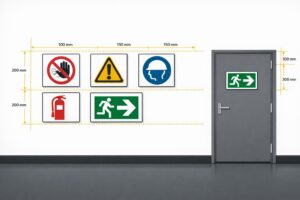
Australian Safety Sign Compliance Guide
Ensure your workplace meets Australian safety sign standards with our easy guide. Get tailored signage advice for compliance today!