Best Practices for Fire Assembly Point Signage
Fire assembly point signs are essential for workplace safety in Australia. They help guide people to safe locations during emergencies, assist with headcounts, and ensure compliance with safety standards like AS 3745-2010 and AS 1319-1994. Proper signage reduces confusion, supports quick evacuations, and meets legal obligations under Regulation 43 of the WHS Act.
Key points include:
- Design: Green background with white text/pictograms for visibility.
- Placement: Mounted at 1.2–1.6 metres from the floor on unobstructed surfaces.
- Specifications: Text and symbols sized for readability, increased by 50% in low-light conditions.
- Durability: Materials like aluminium are recommended for outdoor use due to Australia’s harsh climate.
- Integration: Signs should align with evacuation diagrams to ensure clear guidance.
Regular inspections, annual fire drills, and updates to signage ensure they remain effective and compliant. Clear, durable, and well-placed signage is a critical component of any emergency response plan.
How Do You Designate Emergency Assembly Points For Workplace Safety? – SecurityFirstCorp.com

Legal and Compliance Requirements
Fire Assembly Point Sign Specifications and Requirements Guide Australia
Adhering to legal standards is essential to safeguard your workforce and avoid penalties. In Australia, two key standards are particularly relevant: AS 1319-1994 (Safety signs for the occupational environment) and AS 3745-2010 (Planning for emergencies in facilities). These standards are designed to ensure that safety signs are clear, consistent, and visible, especially during emergencies.
Under Regulation 43, employers are required to implement, maintain, and test emergency plans. As highlighted by New Signs, "Non-compliance can lead to fines, legal penalties, or increased liability in the event of an emergency." While AS 3745-2010 is not always explicitly cited in legislation, it is widely regarded as a best practice guideline for evacuation planning.
Next, let’s review the specific requirements for fire assembly point signs.
Required Signage Specifications
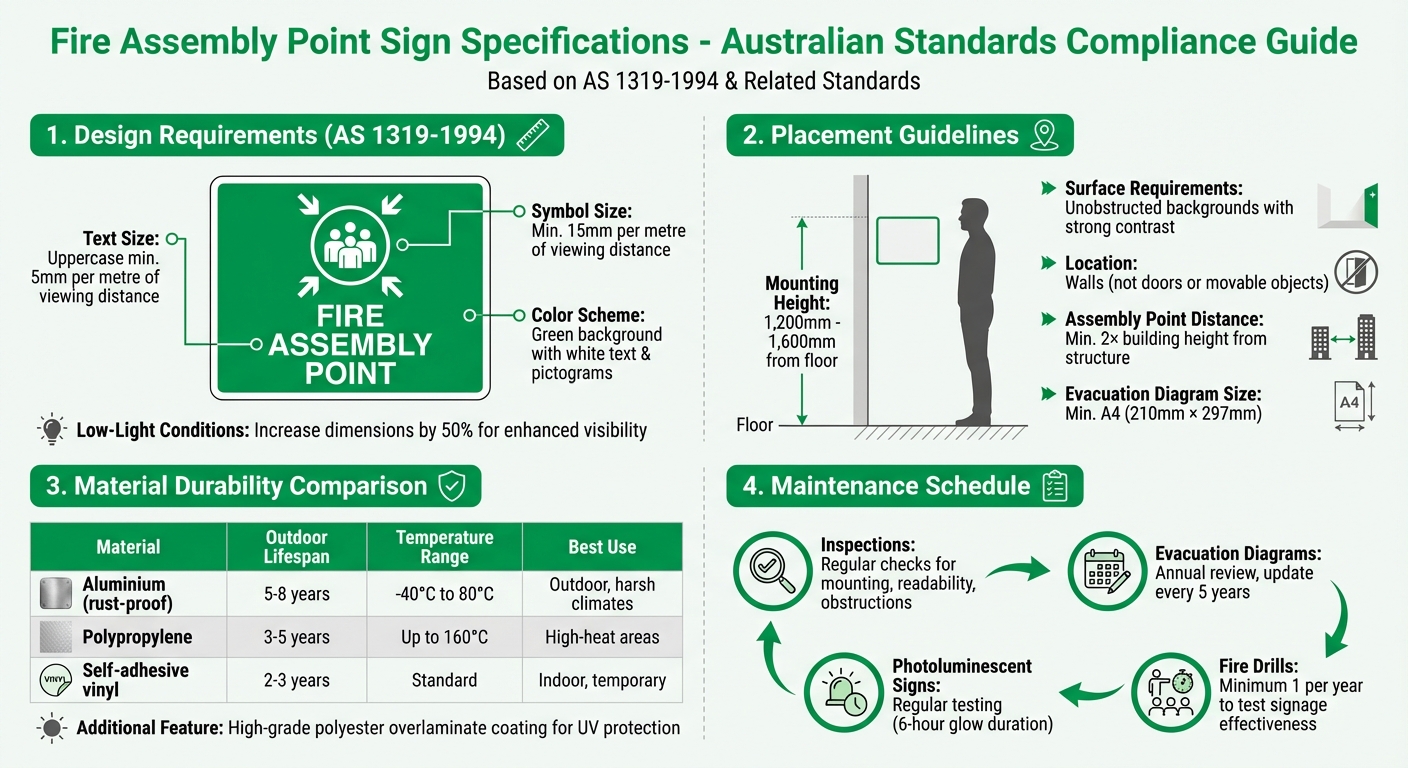
Fire assembly point signs are classified as Emergency Information Signs under AS 1319-1994. These signs must have a green background with white text and pictograms to ensure they are easily recognisable. The standard also specifies visibility requirements:
- Symbols must measure at least 15 mm for every metre of viewing distance.
- Uppercase text must be at least 5 mm for every metre of viewing distance.
- In low-light conditions, these dimensions should be increased by 50% to maintain readability.
WorkSafe ACT explains that the purpose of AS 1319-1994 is to "regulate and control safety-related behaviour, warn of hazards, and provide emergency information, including fire protection information."
Placement and Regulatory Guidelines
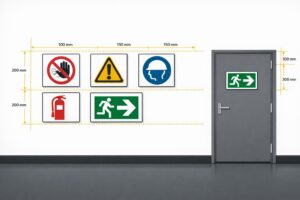
To ensure visibility and compliance, fire assembly point signs should be mounted between 1,200 mm and 1,600 mm from the floor on unobstructed backgrounds that provide strong contrast. Signs should be affixed to walls, not doors or movable objects, to prevent obstruction. Avoid placing signs on low-contrast surfaces, as this diminishes their visibility.
If you plan to mount signs on fire or smoke doors, consult a professional first. Using screws or adhesives may compromise the door’s fire-resistance rating, potentially violating the Building Code of Australia.
Evacuation diagrams, which display assembly areas, must be correctly oriented to match the building’s layout and align with the "You Are Here" marker. The smallest acceptable size for an evacuation diagram containing only mandatory elements is A4 (210 mm × 297 mm), with the pictorial floor plan measuring at least 200 mm × 150 mm.
Sign Placement and Visibility
Where to Place Signs
To guide people effectively during evacuations, signs need to be strategically placed along all decision points of the evacuation route. This includes intersections, stairwells, hallways, and primary exit paths [1]. Every exit route should feature clear signage that directs occupants to the designated assembly area.
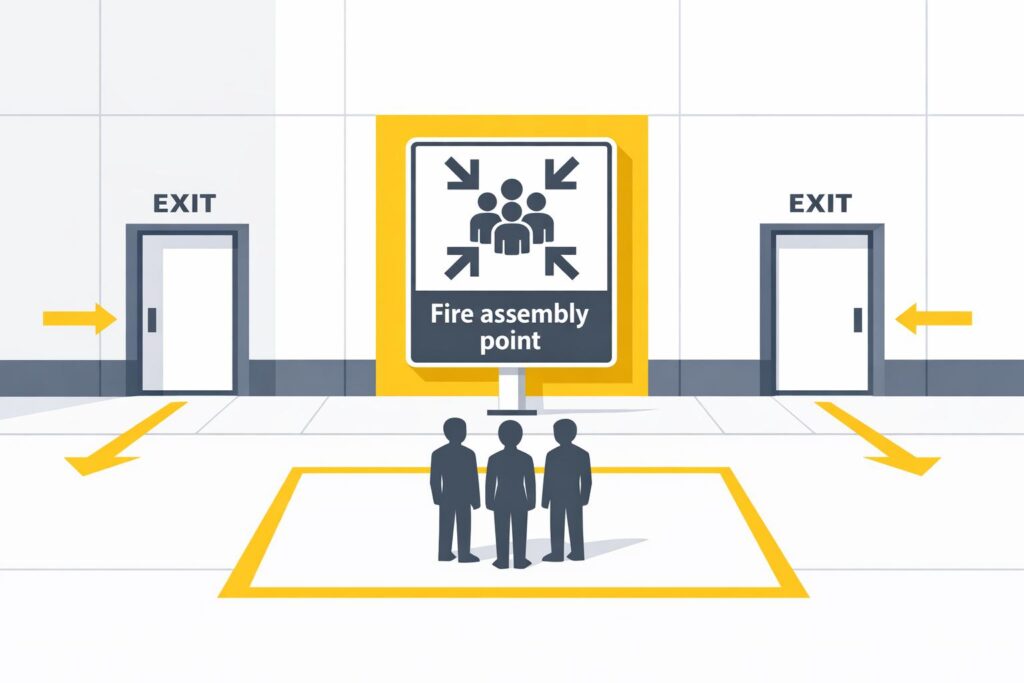
Mount signs at a height of 1.2–1.6 metres to ensure they are easily visible, even for individuals using mobility aids [6]. In areas prone to crowding, consider placing signs slightly higher so they remain visible above people’s heads. The assembly point itself should be located at a safe distance from the building – ideally at least twice the building’s height – to protect evacuees from potential hazards like falling debris [4].
"To help reassure occupants who are unfamiliar with the building layout, each fire assembly point sign should be positioned in a high-up location. Just above head level is ideal so that it is visible in a crowd or at a distance." – Fire Protection Online
It’s important to regularly inspect evacuation routes to ensure signs remain unobstructed. Changes such as new furniture, equipment, or even seasonal plant growth can block visibility [8]. In larger facilities with multiple assembly points, consider using numbered or lettered signs to help wardens perform accurate headcounts [4]. Regular checks are essential to maintain clarity and effectiveness during emergencies.
Lighting and Visibility Options
Proper placement is just the beginning – signs must also remain visible in all conditions, including power outages or smoky environments. Photoluminescent (glow-in-the-dark) materials are a reliable option, as they can stay illuminated for up to six hours after absorbing light. Alternatively, positioning signs near emergency lighting fixtures ensures they remain visible during evacuations [8].
In low-light or challenging conditions, increase the size of symbols and text by 50% to improve readability [3]. For outdoor assembly points, choose durable, weather-resistant materials like aluminium, which can last 7–10 years. In contrast, self-adhesive vinyl may fade within 2–3 years, making it less suitable for long-term use [8].
Sign Design and Durability
Design Features for Clear Communication
Fire assembly point signs in Australia must adhere to AS 1319:2004 standards to ensure uniformity and clarity in workplaces. These signs have a mandatory green background with white symbols or text[3], making them easily distinguishable from fire equipment signs, which use red backgrounds.
Recognised symbols play a critical role in ensuring quick and effective communication during emergencies[5]. Contrast is just as important – placing a green sign on a green wall, for instance, can render it almost invisible during an evacuation[3]. For outdoor assembly points, especially those used at night, reflective sheeting is recommended to maintain visibility in low-light conditions[9].
Materials for Long-Lasting Signs
A clear design is only effective if paired with materials that can endure Australia’s tough climate. Rust-proof aluminium signs are a popular choice, lasting 5–8 years outdoors, while polypropylene signs typically last 3–5 years[10]. Aluminium signs can handle temperatures ranging from –40°C to 80°C, whereas polypropylene can endure up to 160°C[10].
To further protect outdoor signs, a high-grade polyester overlaminate coating is essential. This layer shields the sign from UV rays, weather damage, abrasion, and chemical exposure[10]. Without this coating, signs are prone to fading under Australia’s intense sunlight[10].
For assembly points in open spaces like car parks, mounting signs on posts ensures they are visible from all directions[9]. Adding zone numbers or company logos can also assist wardens in efficiently managing headcounts during evacuations[9].
At PXP Safety, our fire assembly point signs are crafted to meet these exacting standards, offering clear communication, long-term durability, and full compliance with Australian safety regulations.
sbb-itb-9950c92
Connecting Signage with Emergency Response Plans
Aligning Signs with Evacuation Diagrams
Fire assembly point signs need to work hand-in-hand with evacuation diagrams to create a cohesive emergency response system. According to AS 3745-2010, evacuation diagrams must clearly indicate the location of assembly areas, either through text or visuals[13][11]. The physical sign serves as the tangible marker for the "Assembly Area" highlighted on the diagram, ensuring that the evacuation route leads to a clearly identified destination[6].
"The fire evacuation diagram will typically also show the Site Plan (showing the Assembly area and egress paths from the building) as well as the Emergency Procedures to follow." – FCF National[6]
Each evacuation diagram must be oriented to the "YOU ARE HERE" point, ensuring the assembly area aligns with the viewer’s current perspective during an emergency[14][7]. For instance, if someone is facing a particular direction while viewing the diagram, the assembly point should match that orientation to provide clear guidance. The Emergency Planning Committee (EPC) is tasked with choosing the best locations for these diagrams, ensuring they are visible and accessible throughout the premises[12][7]. This coordination between diagrams and signage strengthens the overall emergency response system.
Supporting Safe Evacuations
Combining clear signage with accurate evacuation diagrams plays a crucial role in reducing confusion and improving safety during emergencies. Easy-to-read signage helps both staff and visitors – especially those unfamiliar with the facility – navigate their way calmly and efficiently[6]. During an evacuation, individuals move from following the diagram to locating the actual assembly point sign, making it essential for these signs to be placed in prominent, elevated positions where they remain visible, even in crowded situations[4][6].
While evacuation diagrams are valid for up to five years[12], physical signage requires more frequent inspections to ensure effectiveness. Conducting at least one evacuation drill each year helps confirm that occupants can seamlessly transition from the diagram to the assembly point sign[14]. This approach not only tests the efficacy of the system but also reinforces earlier efforts in signage placement and design, further enhancing emergency preparedness.
Maintaining and Auditing Signage
Inspection and Maintenance
Regular inspections of fire assembly point signs are essential to ensure they remain effective and compliant. Building owners and facility managers should check that signs are securely mounted, level, and easy to read, with no peeling edges or faded text [16]. WorkSafe ACT advises, "For maximum effectiveness, safety signs should be maintained in good condition, kept clean and well illuminated" [3]. This involves routine cleaning and ensuring signs are mounted at a height of 1,200–1,600 mm for optimal visibility [3]. These steps align with established guidelines for proper sign design and placement.
Outdoor signs need extra attention due to exposure to the elements. Make sure they remain legible and clear of any obstructions like overgrown vegetation, stored materials, or construction debris [3]. In poorly lit areas, using symbols that are at least 50% larger than standard sizes can help maintain visibility [3]. Photoluminescent signs should also be tested regularly to ensure they work as expected during power outages or in smoke-filled environments [5].
Evacuation diagrams require similar care. They should be reviewed annually and updated every five years, even if there haven’t been any changes, to ensure they reflect the current layout and assembly point locations accurately [2]. Any updates to the building layout, staffing, or emergency procedures should trigger an immediate review. Keeping detailed logbooks and test reports is essential for demonstrating compliance during fire safety inspections [15]. Regular audits of signage not only ensure compliance but also enhance readiness during emergencies.
Testing During Fire Drills
Fire drills are a practical way to test the effectiveness of signage and evacuation diagrams. Conducting at least one evacuation drill each year helps confirm that occupants and visitors can easily locate the assembly point using the provided signage [2]. During these drills, check that ‘You Are Here’ markers on evacuation diagrams correctly indicate the direction to the assembly point [2].
Drills often reveal issues that routine inspections might miss. For instance, assess whether the assembly point sign is clearly visible from the building’s exit, remains unobstructed during crowded situations, or if new obstacles have appeared since the last inspection. Fire Block Plans highlights the importance of ongoing diligence: "Compliance is not a one-off box-ticking task… your workplace is responsible for remembering to update signage whenever the building layout, staff arrangements, or emergency procedures change" [2]. Observations made during drills should be used to update and improve signage and emergency plans promptly. By addressing any issues identified, you ensure that both the signage and the overall emergency response system remain effective and dependable. Regular drills and audits are key components of a robust emergency preparedness strategy.
Conclusion
Fire assembly point signage plays a crucial role in safeguarding lives by ensuring it is compliant, easy to spot, and built to last. As New Signs highlights, "Fire signage plays a critical role in fire safety, helping to guide occupants to safety, identify fire-fighting equipment, and provide clear emergency instructions" [5]. Adhering to Australian Standards guarantees a dependable safety framework.
The practical measures discussed earlier align with these principles. Installing signs at eye level (1,200–1,600 mm), using a clear green-and-white design, and opting for durable materials ensure the signage is effective when it’s most needed. Pairing evacuation diagrams with well-placed signage makes it easier for everyone to quickly locate the assembly point.
Regular upkeep and annual fire drills are key to maintaining the effectiveness of these signs. Over time, signage can fade, become blocked from view, or no longer suit the layout of a building. Ensuring ongoing compliance is a shared responsibility, reinforcing the need to keep signage updated and clearly visible [2].
FAQs
What are the best materials for outdoor fire assembly point signs in Australia?
For outdoor fire assembly point signs in Australia, aluminium composite panels (ACP) are a standout option thanks to their strength, weather resistance, and ability to endure over time. These signs are built with a polyethylene core sandwiched between aluminium sheets, featuring UV-protected graphics and a tough laminate. This combination makes them well-suited to handle Australia’s diverse and often harsh weather conditions.
For situations where a temporary or short-term solution is needed, corflute (corrugated polypropylene) is a lightweight and budget-friendly alternative, perfect for construction sites or other temporary outdoor setups. Another versatile option is UV-protected vinyl stickers, which provide a durable yet removable signage solution, ideal for surfaces that may need flexibility.
All these materials meet the requirements of Australian standards (AS 1319), ensuring that signage remains durable and easy to read for its intended purpose. PXP Safety offers top-notch fire assembly point signs in these materials, delivering dependable performance and clear visibility for workplaces across Australia.
How can fire assembly point signs be effectively integrated with evacuation diagrams in Australian workplaces?
Fire assembly point signs play a crucial role in reinforcing evacuation diagrams, ensuring everyone can easily follow the same orientation and route to the designated muster area. To meet AS 3745:2010 requirements, evacuation diagrams must clearly show the assembly point, nearest exits, and include a well-defined legend. The signs that accompany these diagrams should match their symbols and colour-coding. For example, green is used for exits, while blue indicates mandatory actions. Additionally, signs should be mounted at a height of 1.2–1.6 metres above the floor to ensure they’re easily visible.
Strategically position signs at key decision points, such as near the "YOU ARE HERE" markers or along the exit paths shown in the diagrams. Avoid placing them on fire-resistant surfaces like fire or smoke doors, and ensure evacuation diagrams remain unobstructed. To create a cohesive and recognisable safety system, use consistent typography, UV-protected materials for durability, and ensure the graphic standards of signs and diagrams align seamlessly.
For workplaces needing customised solutions, PXP Safety offers fire assembly point signs tailored to Australian standards. Their durable aluminium options integrate seamlessly with evacuation plans, making them a reliable choice for enhancing workplace safety.
What are the consequences of not complying with fire assembly point signage requirements?
Failing to comply with fire assembly point signage standards can have serious repercussions for businesses across Australia. Non-compliance can attract hefty fines under Work Health and Safety (WHS) laws and heighten the risk of legal liability during emergencies.
By ensuring the correct signage is in place, businesses not only steer clear of penalties but also showcase their dedication to maintaining a safe and compliant workplace – safeguarding both employees and visitors.
Related Blog Posts
You may also be interested in
FAQs About Workplace Safety Signs in Australia
AS 1319 sign types, placement, materials and maintenance for workplace safety and WHS compliance in Australia.
Restricted Area Signs vs. No Entry Signs
Compare No Entry and Restricted Area signs in Australian workplaces — meanings, design differences and AS 1319 compliance.
How to Spot Workplace Signage Gaps
Audit your workplace for missing, faded or non‑compliant signs under AS 1319 to reduce incidents and avoid WHS fines.
Symbol Design: Global Standards Explained
Explains ISO 7010 and ISO 3864: standard symbols, colours and sizing for clear, language‑free safety signage and AU compliance.
Hazard Sign Visibility Planner
Plan hazard sign placement for max visibility with our free tool. Ensure safety by finding the best spot, height, and angle—try it now!