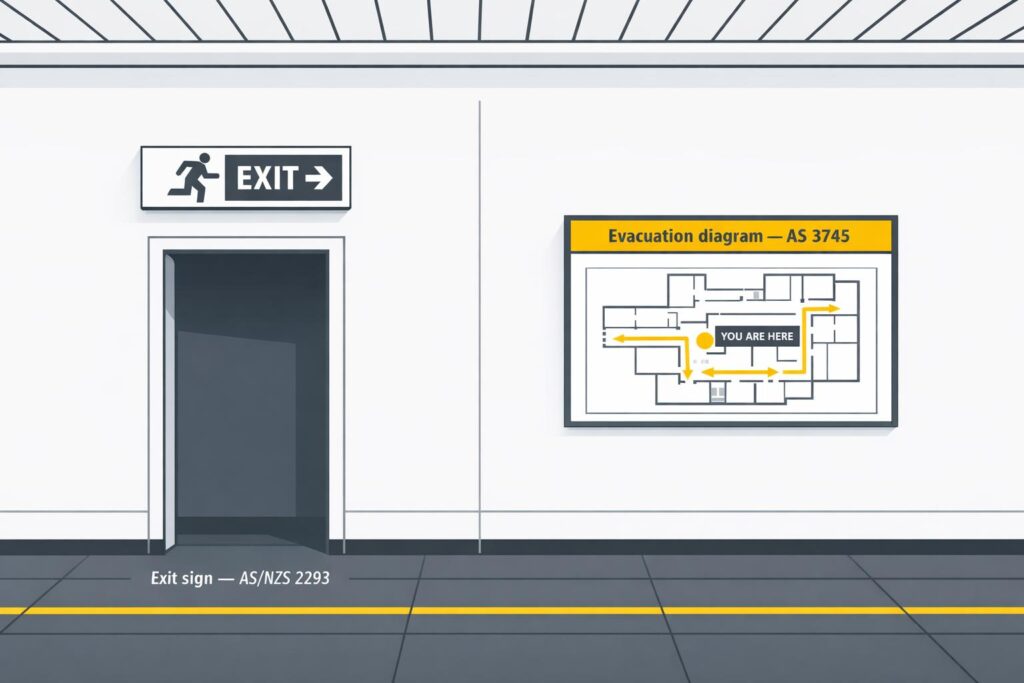
Exit Signs vs. Evacuation Route Signs: Key Differences
In emergencies, clear signage saves lives. Exit signs point directly to exits, while evacuation route signs map out paths to those exits, often including "You are here" markers and assembly points. Both are critical for guiding people to safety, especially in transport hubs like airports and train stations. Here’s a quick breakdown:
- Exit Signs: Indicate exit locations, visible even in power outages. Installed above or near doors.
- Evacuation Route Signs: Provide detailed floor plans, showing paths to exits and safety equipment locations. Mounted at eye level in high-traffic areas.
Both types are required under essential safety signs required under Australian regulations like AS/NZS 2293 and AS 3745, ensuring safety compliance and reducing confusion during evacuations.
Means of Egress Explained – What are means of egress and why are they important?
sbb-itb-9950c92
What Are Exit Signs?
Exit signs are pictograms designed to guide people to the nearest exit and discharge point in a building or other structure. They play a critical role during emergencies, pointing occupants towards the closest exit, even when visibility is limited or artificial lighting fails [6][4].
These signs are especially crucial during power outages, as they remain operational for at least 90 minutes, ensuring safe evacuation in the absence of regular lighting [10]. Below, we explore the key functions and design elements that make exit signs reliable during emergencies.
What Exit Signs Do
Exit signs are essential wayfinding tools found in buildings, ships, aircraft, and other structures. They are particularly important in high-traffic areas like transport hubs, where they help reduce confusion and panic during emergencies, allowing for orderly evacuations [6][4].
To meet diverse needs, exit signs come in various forms:
- Internally illuminated signs: These use built-in light sources, such as LEDs, to remain visible at all times [6][4].
- Photoluminescent signs: These glow in the dark without requiring electricity and must adhere to NCC Specification 25 [6][10].
- Tactile and braille signs: Designed for accessibility, these signs include raised text and braille, with specific requirements like a minimum 30% contrast against their background. Braille components must be positioned 8 mm below the tactile text [9][10].
Design and Visibility Requirements
The design and placement of exit signs are critical to their effectiveness. To comply with Australian standards like AS/NZS 2293.1 (Design and Installation) and AS/NZS 2293.3 (Product Specifications), as well as the National Construction Code (NCC), exit signs must be clearly visible to anyone legally allowed in the building [12][13].
Typically, exit signs are installed between 2 m and 2.7 m above the floor or directly above doors, ensuring a viewing distance up to eight times the letter height. This makes them legible even in smoke-filled conditions [13]. For accessibility, tactile and braille signs should be positioned between 1,200 mm and 1,600 mm above the floor, with tactile characters ideally placed between 1,250 mm and 1,350 mm [9].
Exit signs must activate immediately when normal lighting fails, staying illuminated for at least 90 minutes via a battery or central power system [10]. A "charge indicator" visible from all angles confirms that the battery is functioning [14]. To ensure visibility in smoke, exit signs are required to use a prescribed green chromaticity. In New South Wales, neglecting exit sign maintenance can lead to fines of up to $66,000 [12].
Where to Place Exit Signs in Transport Facilities
Exit signs should be installed on, above, or beside every door leading to an evacuation area, typically on walls facing people approaching the exit [9][8].
In transport facilities, where long corridors and expansive lobbies are common, additional directional signage is essential when exits are not immediately visible. This includes areas like enclosed stairways, ramps, passageways, and horizontal exits. Signs should be positioned directly along the travel path and at every point where the escape route changes direction, ensuring a continuous line of visibility [8][13].
"Exit signs must hang over every required egress door and at points where an escape path changes direction." – Fire Factory [13]
For braille and tactile signs, placement is key – they should be installed on the latch side of doors, between 50 mm and 300 mm from the architrave [9]. Transport facilities, often classified as Class 6 or 9b buildings, face stricter requirements due to high public occupancy and the likelihood that visitors may be unfamiliar with the layout [8].
What Are Evacuation Route Signs?
Evacuation route signs provide a detailed map of a facility, showing the safest path to an exit. Unlike workplace safety signs that simply point to door locations, these diagrams offer a comprehensive view of the building’s layout. They highlight key features like fire safety equipment (extinguishers, hose reels, alarms) and the designated assembly area outside the building for emergencies [2] [16].
In transport hubs, where visitors may be unfamiliar with the surroundings, these signs are especially crucial. They help reduce panic and minimise the risk of injury by offering clear, easy-to-follow directions. This becomes particularly important in large, complex spaces like terminals and stations, where navigating corridors and lobbies can be overwhelming during an emergency.
"Evacuation signs and fire evacuation diagrams play an important role in providing clear, simple to read information when it’s needed most." – FCF Fire and Electrical [2]
What Evacuation Route Signs Do
Evacuation route signs guide people from their current location to the nearest exit. They map out the full evacuation route and point to the designated assembly area outside [2] [18]. In spots where exits aren’t immediately visible, directional signs with arrows are used to eliminate confusion [8]. The orientation of the diagram must align with the actual layout so users can easily follow the path [2] [5].
Design Elements and Directional Markers
The design of evacuation diagrams is critical for ensuring clarity during emergencies. According to AS 3745-2010, these diagrams must include:
- A pictorial representation of the floor plan
- The title "Evacuation Diagram"
- A validity date
- A "You are Here" marker
- A legend explaining all symbols used [2] [18]
For a basic diagram, the minimum size is A4 (210 mm × 297 mm), with the floor plan itself taking up at least 200 mm × 150 mm. If additional details, like first aid locations or warden information, are added, the diagram should be scaled up to A3 size [2] [17].
Standard colours ensure the diagrams are universally understood. Green is used for exits and evacuation paths, while red highlights firefighting equipment such as extinguishers and hydrants, as outlined in AS 3745-2010 [16]. To remain visible during power outages, emergency lighting or photoluminescent materials are often incorporated [1] [7] [8].
Where to Place Evacuation Route Signs
Strategic placement of evacuation route signs ensures they work seamlessly with exit signs to form a complete emergency guidance system. These diagrams should be mounted at eye level, between 1,200 mm and 1,600 mm from the floor, and secured to walls or doors in prominent locations [2] [16] [17]. The Emergency Planning Committee (EPC) is typically responsible for determining the number and placement of these diagrams, ensuring all evacuation routes are clearly marked [2] [16].
In transport facilities, diagrams should be placed in high-traffic areas such as corridors, hallways, lobbies, and foyers. They are particularly important at decision points where an exit might not be immediately visible [8] [19] [5]. In Queensland, non-compliance with evacuation sign regulations can result in fines of up to 30 penalty units [5].
"Individual evacuation diagrams shall have the correct orientation with regard to the direction of egress and its location to the ‘YOU ARE HERE’ point." – Australian Standard 3745-2010 [16]
Main Differences Between Exit Signs and Evacuation Route Signs
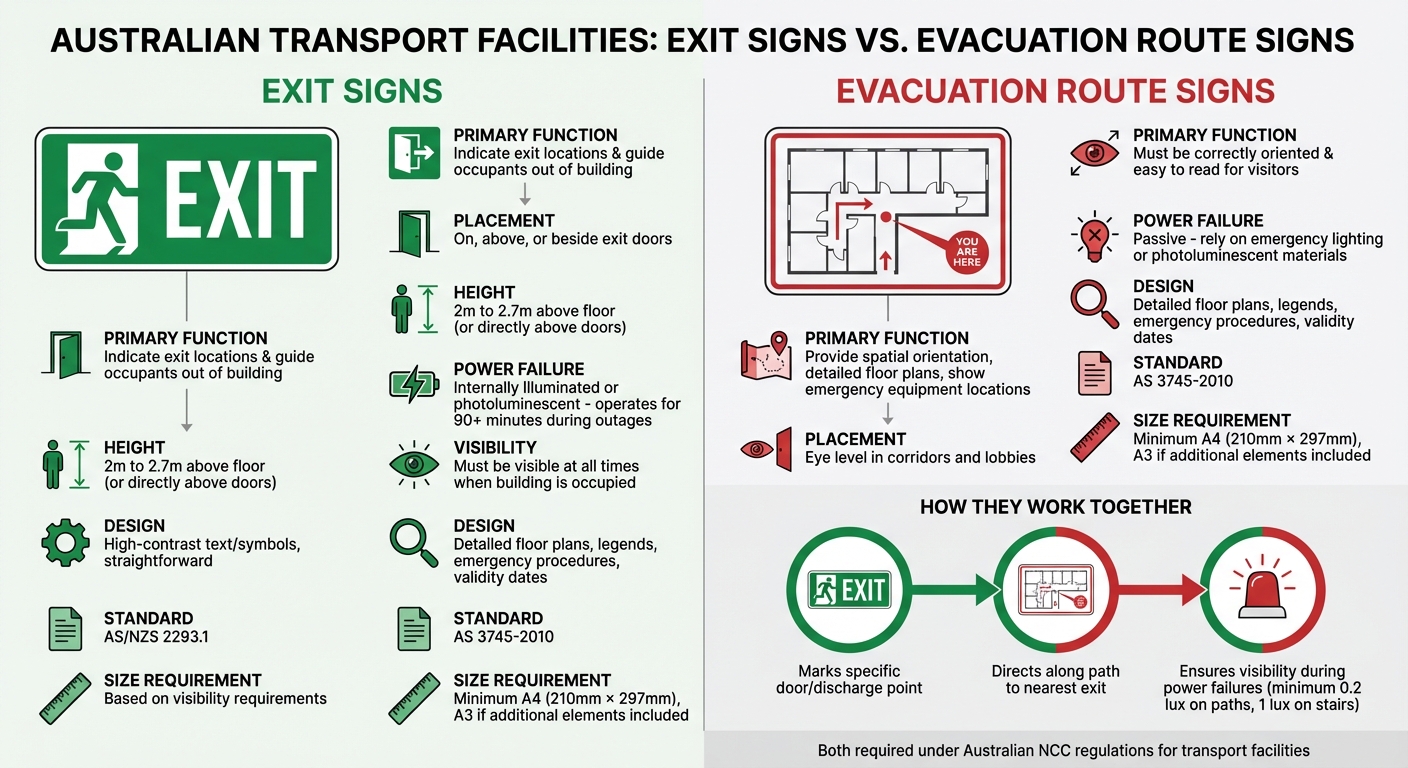
Exit Signs vs Evacuation Route Signs: Key Differences Comparison
Exit signs and evacuation route signs serve distinct purposes in emergency situations. Exit signs are designed to provide immediate guidance by clearly marking the location of exits and directing people out of a building [6][8]. On the other hand, evacuation route signs – often referred to as evacuation diagrams – offer a broader scope of information. They show the user’s current location with a "You are here" marker, map out the path to the nearest exit, and identify the locations of emergency equipment [2].
Placement Requirements
The placement of these signs is tailored to their specific roles. Exit signs are installed on, above, or next to doors leading to stairways, passageways, or external exits. Their visibility from a distance is crucial [7][8]. In contrast, evacuation route signs are mounted at eye level – between 1,200 mm and 1,600 mm from the floor – making them easy to read in detail. These are typically placed in areas like corridors or lobbies where exits may not be immediately visible [2][19].
Design and Standards
The design of these signs also highlights their different purposes. Exit signs are straightforward, featuring high-contrast text or symbols that comply with AS/NZS 2293.1 standards [7][8]. They are often internally illuminated or made with photoluminescent materials to ensure visibility during power outages [1]. Evacuation route signs, however, are much more detailed. They include comprehensive floor plans, legends, emergency procedures, and validity dates. As per AS 3745-2010, these diagrams must be at least A4 in size, with the floor plan itself covering a minimum of 200 mm × 150 mm [2].
"To facilitate safe evacuation in an emergency, a building must be provided with a system that ensures a level of visibility sufficient to enable exits, paths of travel to exits and any obstacles along a path of travel to an exit to be identified." – National Construction Code (NCC), EP4.1 [6]
Comparison Table
| Feature | Exit Signs | Evacuation Route Signs (Diagrams) |
|---|---|---|
| Function | Indicate exit locations and guide occupants out of the building [6] | Provide spatial orientation, detailed floor plans, and show locations of emergency equipment [2] |
| Placement | Positioned on, above, or beside exit doors [7][8] | Mounted at eye level (1,200–1,600 mm) in corridors and lobbies [2][19] |
| Visibility Standards | Must remain visible at all times when the building is occupied [8] | Must be oriented correctly and easy to read for visitors [2] |
| Power Failure Performance | Internally illuminated or photoluminescent for operation during outages [1][6] | Generally passive; rely on nearby emergency lighting or photoluminescent materials [2] |
| Governing Standard | AS/NZS 2293.1 [8] | AS 3745-2010 [2] |
| Minimum Size | Based on visibility requirements under AS/NZS 2293.1 [8] | A4 minimum, increasing to A3 if optional elements are included [2] |
Recognising these differences is key when considering the specific regulatory requirements for transport facilities in Australia.
Australian Regulations for Transport Facilities
Standards and Compliance Requirements
Transport facilities in Australia must adhere to Part E4 of the National Construction Code (NCC) 2022 Volume One and the AS/NZS 2293 series. Together, these regulations set out the requirements for emergency visibility, exit identification, and the technical details of lighting and signage systems [11][15][21].
"The Objective of this Part is, in an emergency, to safeguard occupants from injury by – having adequate visibility; and having adequate identification of exits and paths of travel to exits; and being made aware of the emergency." – National Construction Code [11]
The AS/NZS 2293 series is divided into three parts:
- Part 1 focuses on system design and installation.
- Part 2 outlines routine service and maintenance requirements.
- Part 3 specifies the technical standards for emergency luminaires and exit signs [15][21].
These regulations require exit signs to be installed at every egress point, with additional directional signage placed where exits are not immediately visible [8][10].
Emergency lighting must operate for at least 90 minutes during power outages, providing a minimum of 0.2 lux along evacuation paths and 1 lux on stairways [10][24]. The system must achieve 10% of its required illumination within one second and 100% within 60 seconds of activation [24]. For spaces requiring Braille and tactile signage under NCC Specification 15, these must be mounted on the latch-side wall of doors, at a height between 1,200 mm and 1,600 mm, with at least 30% luminance contrast between the characters and background [10].
Transport facilities must also address additional compliance measures tailored to their unique operational needs.
Additional Requirements for Transport Facilities
Transport facilities face added challenges, as many occupants are unfamiliar with evacuation routes, much like in cinemas or shopping centres [11]. To address this, the NCC mandates more prominent and illuminated signage systems compared to workplaces where staff are familiar with the layout [11]. Emergency lighting is required on every level of a Class 5–9 building where the floor area exceeds 300 m² [8].
Routine maintenance is equally critical. Physical inspections and discharge tests for self-contained emergency luminaires and exit signs must be conducted every six months according to AS 2293.2, with results recorded in a maintenance log book [20]. Additionally, many manufacturers advise replacing emergency lighting and exit signs after 10 years, marking this as the recommended replacement period [20].
Transport facilities must also integrate building safety standards with traffic management needs, especially in areas where pedestrian and vehicle interactions occur, such as loading zones and bus interchanges [22][23].
These regulations ensure that emergency signage and lighting systems in transport facilities remain effective and reliable, safeguarding occupants during emergencies.
How Exit and Evacuation Route Signs Work Together
How These Signs Support Each Other
Exit and evacuation route signs work hand-in-hand to create a seamless path to safety. Exit signs point to the final exit – the door or discharge point that leads directly to safety. In contrast, evacuation route signs provide directional guidance through hallways, lobbies, or corridors when the exit isn’t immediately visible. Together, they form what the National Construction Code describes as a "continuous and unobstructed path" from any location in a building to a safe area [3].
In transport facilities, where people are often unfamiliar with their surroundings, this system is especially critical. Clear signage reduces confusion and hesitation, helping individuals navigate safely and calmly during emergencies. These signs not only minimise panic but also support an orderly evacuation. The table below outlines the roles and placement requirements for each component in the safety system.
| Component | Primary Role in Safety System | Placement Requirements |
|---|---|---|
| Exit Sign | Marks the specific door or discharge point leading to safety [6][8] | Positioned on, above, or next to every required exit door [8][7] |
| Evacuation Route Sign | Directs occupants along the path to the nearest exit [8][3] | Located in hallways, lobbies, and corridors where exits aren’t obvious [8] |
| Emergency Lighting | Ensures visibility of signs and paths during power failures [6][1] | Required in all fire-isolated exits and along evacuation paths [8][7] |
The Role of Emergency Lighting
Emergency lighting plays a crucial role in supporting both exit and evacuation route signs. It activates instantly during a power outage, ensuring that signs and evacuation paths remain visible. According to the Building Code of Australia, emergency lighting must provide enough illumination to identify exits, paths, and any obstacles along the way [6]. Additionally, exit signs must be lit to a surface value of at least 54 lux by a reliable light source [3].
Proper lighting along evacuation routes not only enhances safety but also reduces evacuation time. By ensuring visibility even during power failures, emergency lighting helps occupants move confidently and in an orderly manner, preventing unnecessary delays or confusion.
Conclusion
Exit signs and evacuation route signs play distinct yet complementary roles in ensuring safety within transport facilities. Exit signs offer immediate, high-visibility identification of doors leading directly to safety, while evacuation route signs, often presented as diagrams, provide a broader perspective. These diagrams help occupants understand their current location, the route to follow, and the placement of emergency equipment. In transport facilities, where visitors are often unfamiliar with the layout, this dual system reduces confusion and supports orderly evacuations, all while adhering to Australian safety standards.
Both types of signage are required under Australian regulations, ensuring that exits are clearly marked and evacuation paths remain visible, even during power outages. This combined system is essential in maintaining a compliant, uninterrupted path to safety.
"To facilitate evacuation, suitable signs or other means of identification must… be provided to identify the location of exits; and guide occupants to exits; and be clearly visible to occupants." – National Construction Code (NCC) [6]
When paired with emergency lighting, exit signs and evacuation diagrams form a cohesive safety system. Together, they create what the NCC defines as a continuous and unobstructed path to safety. This integrated approach is crucial for managing large numbers of people during emergencies, offering both guidance and reassurance.
FAQs
Do I need both exit signs and evacuation diagrams?
Exit signs and evacuation diagrams serve distinct but complementary purposes in ensuring safety during emergencies. Exit signs indicate the location of emergency exits, helping people navigate to safety quickly. On the other hand, evacuation diagrams provide a detailed guide, showing routes to these exits and other critical safety information.
In Australia, it’s a requirement under the Australian Standards for evacuation diagrams to be displayed in all facilities. This not only improves safety but also ensures compliance with regulations.
How often must exit signs and emergency lighting be tested?
In Australia, it’s mandatory to test exit signs and emergency lighting every six months. This involves discharge tests carried out by qualified technicians to ensure they meet safety regulations. Routine testing ensures these systems remain functional and comply with Australian standards.
Where should evacuation diagrams be placed in stations and terminals?
Evacuation diagrams need to be positioned in spots where they can be easily seen and accessed. Ideal locations include along evacuation routes, close to exits, and in shared spaces like foyers or waiting areas. These diagrams should be accurately oriented to match the real-world layout and must feature key details such as ‘You Are Here’ markers, exits, locations of firefighting equipment, and designated assembly points. This ensures they meet the requirements of Australian standards (AS 3745-2010) and support safe evacuations during emergencies.
Related Blog Posts
You may also be interested in
FAQs About Workplace Safety Signs in Australia
AS 1319 sign types, placement, materials and maintenance for workplace safety and WHS compliance in Australia.
Restricted Area Signs vs. No Entry Signs
Compare No Entry and Restricted Area signs in Australian workplaces — meanings, design differences and AS 1319 compliance.
How to Spot Workplace Signage Gaps
Audit your workplace for missing, faded or non‑compliant signs under AS 1319 to reduce incidents and avoid WHS fines.
Symbol Design: Global Standards Explained
Explains ISO 7010 and ISO 3864: standard symbols, colours and sizing for clear, language‑free safety signage and AU compliance.
Hazard Sign Visibility Planner
Plan hazard sign placement for max visibility with our free tool. Ensure safety by finding the best spot, height, and angle—try it now!