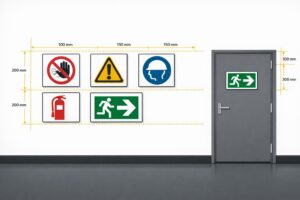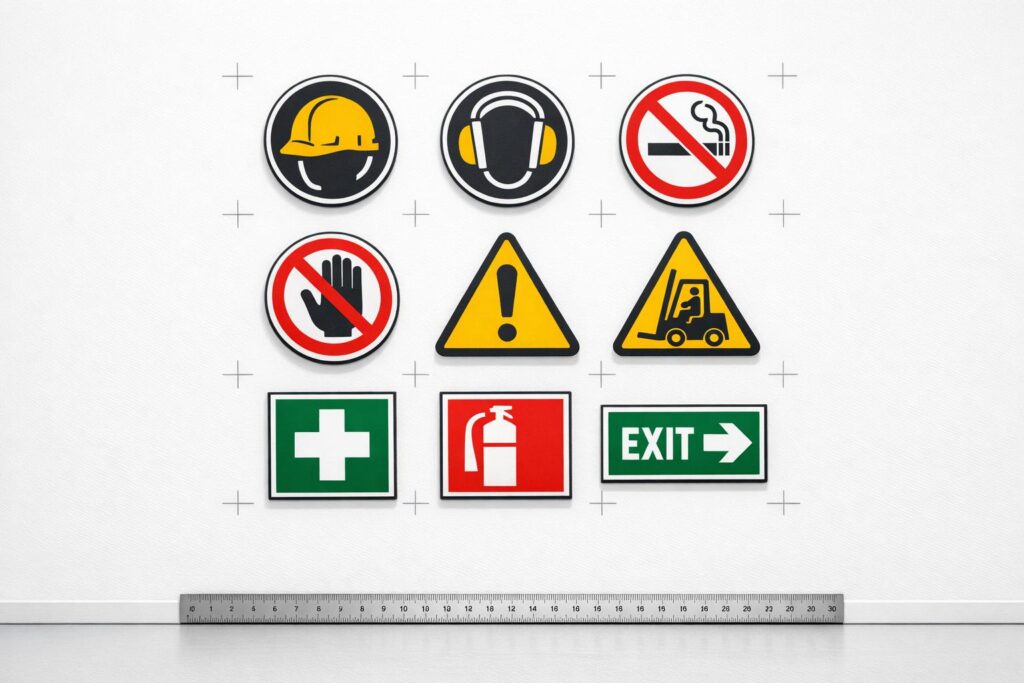
Ultimate Guide to Safety Sign Training in Australia
Safety sign training in Australia is essential for ensuring workplace safety and compliance with regulations. It helps workers understand the meaning of safety signs, reducing risks and preventing accidents. This guide covers everything from the types of safety signs to creating effective training programs and maintaining compliance with Australian standards.
Key Points:
- Purpose of Safety Signs: Communicate hazards, required actions, and emergency information clearly, especially in diverse workplaces.
- Types of Safety Signs: Includes Danger, Warning, Mandatory, Prohibition, Emergency, and Fire signs, each with specific designs and purposes.
- Regulations: The Work Health and Safety Act 2011 and AS 1319-1994 outline legal requirements for safety signage and training.
- Training Programs: Should focus on sign recognition, hazard identification, and emergency procedures, tailored to different roles.
- Sign Maintenance: Regular audits, proper placement, and timely replacement ensure signs remain effective and compliant.
Understanding and implementing proper safety sign training not only meets legal obligations but also creates a safer environment for everyone.
Safety Signs in Australia
Main Types of Safety Signs in Australia
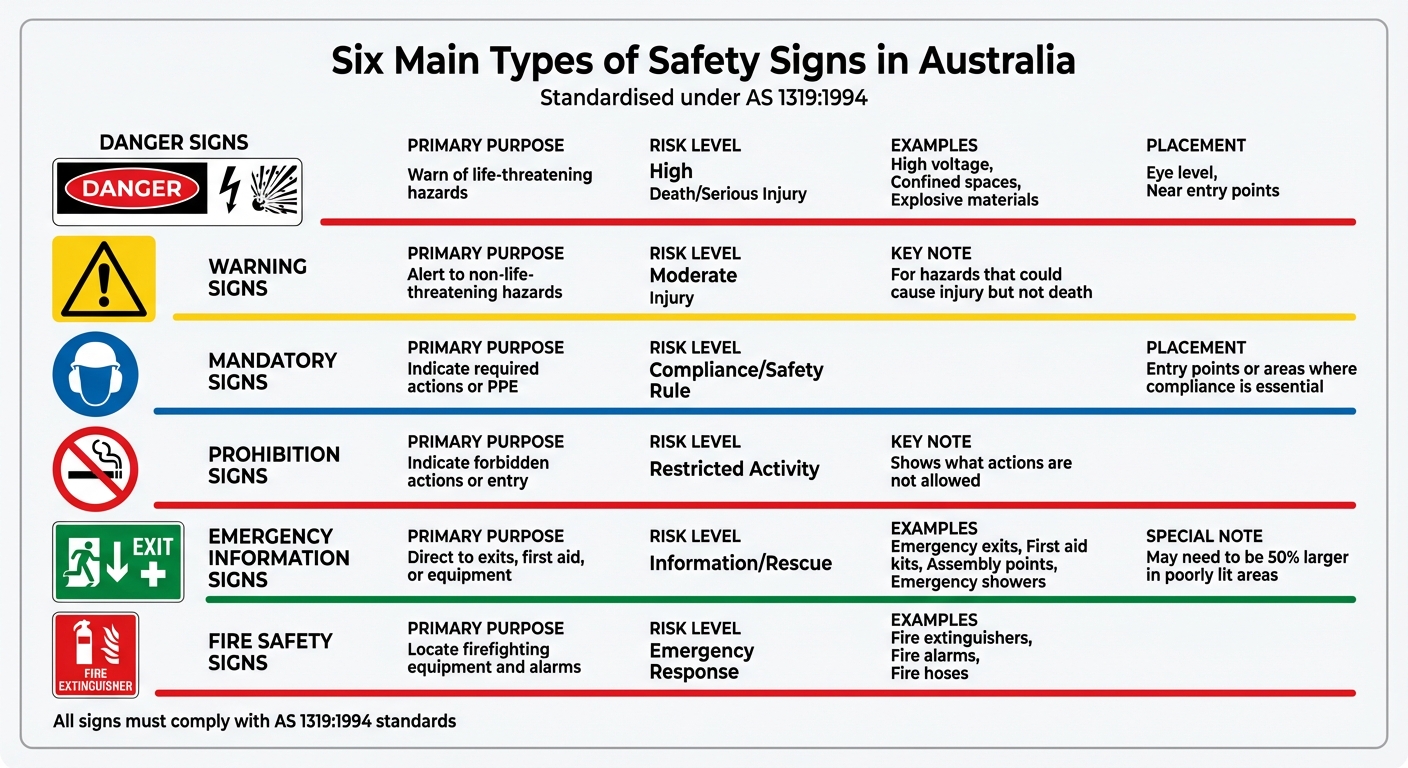
Six Main Types of Safety Signs in Australia – Visual Guide
In Australia, safety signs are standardised under AS 1319:1994, ensuring they use consistent colours, shapes, and symbols to communicate hazards effectively [4]. Here’s a breakdown of the six main types, including their designs, purposes, and associated risks.
| Sign Category | Design Features | Primary Purpose | Risk Level |
|---|---|---|---|
| Danger | Red oval inside a black rectangle with "DANGER" in white text | Warn of life-threatening hazards | High (Death/Serious Injury) |
| Warning | Yellow background with a black triangle and symbol | Alert to non-life-threatening hazards | Moderate (Injury) |
| Mandatory | Blue circle with a white symbol on a white background | Indicate required actions or PPE | Compliance/Safety Rule |
| Prohibition | Red circle with a diagonal slash over a black pictogram | Indicate forbidden actions or entry | Restricted Activity |
| Emergency | Green background with white symbols or text | Direct to exits, first aid, or equipment | Information/Rescue |
| Fire | Red background with white symbols or text | Locate firefighting equipment and alarms | Emergency Response |
Danger Signs
Danger signs are used to highlight hazards that could lead to death or serious injury if ignored [4]. These signs are instantly recognisable, featuring a red oval with the word "DANGER" in white text set against a black rectangle. Common examples include warnings for high voltage areas, confined spaces, and explosive materials.
"The failure to follow a Danger sign could result in death or serious injury." – AS 1319:1994 [4]
It’s important to avoid overusing danger signs, as this can reduce their impact and desensitise workers to critical risks. For maximum visibility, install these signs at eye level and near entry points [3].
Mandatory Signs
Mandatory signs are designed to enforce specific safety actions, such as wearing personal protective equipment (PPE). They feature a white symbol on a solid blue circular background, making them easy to identify. These signs are typically placed at entry points or areas where compliance is essential [3][4].
Emergency Information Signs
Emergency information signs are crucial for guiding individuals to safety resources during high-stress situations. With a green background and white symbols or text, they point to emergency exits, first aid kits, assembly points, and emergency showers. Their bright colour ensures they stand out, even in chaotic scenarios.
For better visibility, these signs should be mounted at uniform heights and kept free from obstructions. In poorly lit areas, reflective materials or larger dimensions – up to 50% bigger – are recommended [2].
How to Create a Safety Sign Training Program
Creating a safety sign training program starts with understanding your legal responsibilities under Australia’s WHS laws. As a PCBU, you’re required to ensure workers receive essential safety training and supervision [6]. The program should be tailored to address the specific risks your employees face, providing a clear structure that includes key content, effective delivery methods, and role-specific training adjustments.
What to Include in Your Training Program
Your training program must cover the six standard Australian safety sign categories as per AS 1319-1994: Prohibition, Mandatory, Danger, Warning, Emergency Information, and Fire Safety signs [1][2]. Employees should be able to quickly recognise each category and understand the actions required, such as wearing PPE or responding to evacuation signals.
In addition to sign recognition, include hazard identification training. This helps workers identify risks associated with specific symbols, such as electrical hazards, toxic chemicals, or falling objects [1]. Employees must also be aware of their responsibilities, including following sign instructions and reporting damaged, obscured, or dirty signs [2].
Emergency procedures are another essential component. Workers should be trained to locate and use first aid kits, fire extinguishers, and emergency exits during evacuations [1][5]. Proper training ensures that employees can act swiftly and appropriately in critical situations.
Training Delivery Methods
A mix of formal and informal training approaches works best [6]. Formal training is compulsory for high-risk roles such as operating forklifts, working on construction sites, or handling tower cranes. These sessions often involve classroom-based learning followed by practical assessments [6][7].
Informal training is ideal for lower-risk tasks and can include "buddy" systems, on-the-job demonstrations, and immediate feedback [6]. For instance, toolbox talks can incorporate quick walkthroughs or "spot the issue" exercises to reinforce safety sign recognition in the workplace [3].
"Workers must complete supervised, practical training before beginning tasks." – Safe Work Australia [7]
For employees with limited English proficiency, use visual aids, task demonstrations, and translated materials to ensure the information is "clear and easily understood" [6]. Induction checklists are useful for both new and returning workers, covering hazards, safe work procedures, and emergency equipment locations [8]. Retain signed checklists as formal records of completed training [8].
The next step involves tailoring the training to different workplace roles.
Adapting Training for Different Roles
The depth of training should align with the risk levels associated with each role [6]. Site workers, for example, need in-depth training on high-risk hazards like UV exposure, heat stress, overhead loads, and dust. They must also understand PPE requirements and demonstrate safe task execution under supervision before working independently [1][7].
Office workers, in contrast, require only basic training on general safety signs, emergency exits, and first aid locations [1]. A brief induction walkthrough is often enough, though they still need to know how to locate safety equipment and evacuate safely.
Managers and safety officers require more advanced training. Their focus should be on regulatory compliance, ensuring proper sign placement, and maintaining signage [1][3].
"Non-compliance with OHS laws – including inadequate signage – can result in severe penalties and personal liability." – Signsmart [5]
Young or inexperienced workers often lack the ability to identify and respond to risks effectively. Provide them with more comprehensive training and closer supervision [6]. Remember, training isn’t a one-off event – regular refresher sessions are crucial to address changes in workplace layout, the introduction of new hazards, or updated procedures [6][3].
sbb-itb-9950c92
Installing and Maintaining Safety Signs
To ensure safety signs are effective, they need to be clearly visible, comply with AS 1319-1994, and undergo regular upkeep. This involves identifying workplace hazards, placing signs where they are easily seen, and performing routine checks.
How to Assess Workplace Hazards
Start by thoroughly evaluating the site to locate hazards and determine the types of signs required. Hazards might include electrical equipment, chemicals, confined spaces, overhead loads, or emergency exits. Different hazards call for specific sign categories: Danger signs for life-threatening risks, Warning signs for non-life-threatening hazards, Mandatory signs for required actions (like wearing PPE), and Emergency Information signs for exits or first aid areas.
Using a site map to mark where signs are needed can help ensure comprehensive coverage and serve as a reference for future audits. Also, consider the viewing distance for each sign. AS 1319-1994 provides guidelines for dimensions, which should be increased by 50% in areas with poor lighting [9]. These assessments are key to following best practices for sign installation.
Sign Installation Best Practices
Install signs at eye level, approximately 1,500 mm above the ground, ensuring they fall within the standard viewing range of 1.5 to 2.1 metres. Secure them to fixed surfaces like walls or fences rather than doors or moveable equipment [12]. Position signs close to the observer’s line of sight and against a contrasting background to improve visibility.
Choose materials suited to the environment. For indoor use on clean, dry surfaces, self-adhesive vinyl can last over 8 years indoors or up to 7 years outdoors. For harsher outdoor conditions, Colorbond metal offers durability for 5–8 years. Temporary sites might benefit from Corflute, which is lightweight, cost-effective, and lasts up to 3 years. For low-light or nighttime environments, Class 2 reflective sheeting or reflective aluminium ensures better visibility [10].
Keep the area around signs free of obstructions and ensure adequate lighting. For reliable Australian-made options, PXP Safety provides aluminium safety signs with UV protection and outdoor-grade printing, designed to meet compliance standards.
Inspecting and Replacing Signs
Conduct signage audits twice a year or after any workplace changes [12]. During inspections, check for legibility, physical damage, fading, and proper placement within the recommended viewing range. Test readability under various lighting conditions, from bright daylight to low-light settings.
Maintain an audit log to document compliance during WHS inspections. Replace faded or damaged signs immediately with products that meet AS 1319 standards. Common compliance issues arise from faded print, poor placement, or outdated symbols, so regular cleaning and timely replacement are crucial.
Remove outdated signs to avoid confusion. Plan replacements based on material lifespans – self-adhesive vinyl lasts up to 7 years outdoors, polypropylene lasts 3 to 5 years, and Colorbond metal lasts 5 to 8 years [10]. By staying proactive, you can ensure safety signage remains clear and compliant.
Maintaining Compliance and Training Effectiveness
Compliance doesn’t end with putting up signs and conducting initial training. To ensure workplace safety remains a priority, Australian workplaces must consistently adhere to AS 1319-1994. This involves regular training, frequent audits, and fostering a safety-first mindset. Here’s how to keep these practices effective.
Refresher Training and Updates
Safety sign training isn’t something you do once and forget about. Under WHS laws, PCBUs are required to provide ongoing training and supervision to ensure workers continue to understand and follow safety procedures [6]. As Safe Work Australia highlights:
"Regular refresher training will help your workers remain informed about workplace health and safety, including any changes in work practices or procedures" [6].
Refresher sessions should be scheduled whenever there are changes to workplace layouts, equipment, or procedures. Toolbox talks are a practical way to reinforce safety signage awareness and address new challenges in an informal setting [13]. Keep detailed records of all training sessions to demonstrate compliance during WHS inspections and to identify workers who may need additional support [13]. Regularly consult workers to assess their understanding of signage and address any gaps in training [6]. Pair these reviews with structured audits to maintain high safety standards.
Conducting Safety Sign Audits
Audits are essential and should be conducted at least twice a year or whenever workplace changes occur [12]. Set up a six-month audit cycle and assign a dedicated officer to maintain the signage logbook and handle the replacement of damaged or non-compliant signs [12].
Each audit should verify that signs meet AS 1319 standards for mounting height, symbol sizes, and text legibility [2][12]. Check for physical damage, fading, and ensure signs are visible under both daylight and low-light conditions [12]. Document all findings, including any non-compliant signs or areas requiring attention, and remove outdated or duplicate signs that could cause confusion [12]. Many Australian workplaces struggle with compliance due to issues like faded signs, blocked views, or signage that doesn’t meet AS 1319 requirements. Thorough documentation helps track and resolve these issues effectively [12].
Building Safety Signage into Workplace Culture
Compliance is more than just ticking boxes – it’s about making safety an integral part of everyday work. Use audit findings and training updates as part of regular team discussions to promote ongoing safety awareness. Include safety signage in team meetings, new employee inductions, and pre-shift briefings. Encourage workers to report damaged or unclear signs and act on their feedback promptly.
Make safety signage relevant to the tasks workers perform daily. For instance, when discussing confined space entry procedures, refer to the mandatory signs associated with those tasks and explain their placement. This approach helps workers understand the purpose behind the signage, not just its function.
Additionally, ensure inclusivity by considering workers with disabilities, those from diverse backgrounds, or those for whom English is a second language. Use diagrams, translations, or multilingual signs wherever necessary to ensure everyone can easily understand the safety information [6][13].
Conclusion
Safety sign training goes beyond ticking off legal requirements – it’s about equipping workers to quickly recognise hazards and respond effectively. Experts highlight that a well-implemented safety sign system can reduce response times, lighten mental strain, and ensure compliance with legal duties [3]. Familiarity with AS 1319:1994 plays a key role in hazard recognition, enabling prompt and effective actions.
The success of a safety signage program relies on three main factors: correct placement, ongoing training, and regular upkeep. Signs need to be installed at decision points and at eye level to ensure visibility. Training, whether through inductions or toolbox talks, helps workers understand and respond to signage. Meanwhile, consistent maintenance prevents faded or damaged signs from compromising the system. These elements work together – clear signs enhance training, and trained employees can spot when signage needs attention. This creates a system that not only complies with standards but actively promotes a safer workplace.
A well-executed safety sign program also demonstrates a commitment to protecting workers while minimising the risk of legal consequences [5].
Safety signs act as silent guardians [11], conveying crucial information even in the absence of supervisors. By weaving signage education into your workplace’s broader safety initiatives, involving workers in evaluating its effectiveness, and tailoring training to accommodate diverse needs, you foster a culture where everyone plays a part in ensuring safety – for themselves and their colleagues.
These strategies can help you develop a compliant and effective safety sign training program that aligns with Australian standards. More importantly, it builds a safer workplace every day. The goal is straightforward: empower individuals with the knowledge and tools to keep themselves and others out of harm’s way [5].
FAQs
What are the safety sign training requirements in Australia?
In Australia, safety sign training falls under the Work Health and Safety (WHS) Regulations 2011. Employers are required to provide workers with proper training, information, and guidance about the safety signs used in their workplace. This training must address the nature of the tasks performed, potential hazards, and the control measures designed to mitigate risks.
The Australian Standard AS 1319-1994 sets the guidelines for the design and application of safety signs. These signs are crucial for effectively conveying warnings, instructions, and safety-related information. Training should include an understanding of the different types of signs, such as danger, warning, mandatory, and prohibition signs, ensuring workers can interpret and act on them appropriately. Adhering to these standards is a key step in fostering a safe and compliant work environment.
How can I customise safety sign training for different roles in the workplace?
To make safety sign training effective, it’s crucial to tailor it to the specific hazards and signs relevant to each role. For instance, construction workers should focus on recognising hazard and danger signs, while healthcare staff might need to concentrate more on emergency and first aid signs.
Training should comply with Australian standards like AS 1319, ensuring that safety signs are used correctly across various settings. By aligning the training with the tasks and risks specific to each role, employees can better identify, understand, and respond to safety signs. This approach promotes a safer workplace for everyone involved.
What are the best ways to maintain and audit workplace safety signs in Australia?
Maintaining and auditing safety signs plays a crucial role in ensuring workplace safety and meeting compliance requirements in Australia. Regular inspections are key – check that signs remain clearly visible, easy to read, and free from damage like fading, peeling, or cracking caused by exposure to the elements. If a sign no longer effectively communicates its message, it’s time to replace it.
Auditing goes beyond inspections. It involves verifying that all signs adhere to the Australian Standard AS 1319-1994. Make sure every mandatory sign is in place, correctly positioned near hazards, and fully compliant with current safety regulations. Signs should use clear symbols and bold colours to ensure they stand out and are easy to understand, even for workers who may have limited English proficiency.
These practices not only help create a safer workplace but also minimise legal risks and ensure adherence to Australian safety standards.
Related Blog Posts
You may also be interested in
FAQs About Workplace Safety Signs in Australia
AS 1319 sign types, placement, materials and maintenance for workplace safety and WHS compliance in Australia.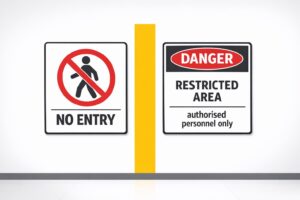
Restricted Area Signs vs. No Entry Signs
Compare No Entry and Restricted Area signs in Australian workplaces — meanings, design differences and AS 1319 compliance.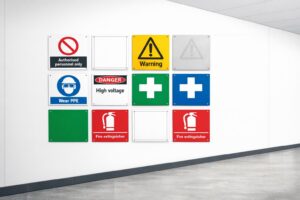
How to Spot Workplace Signage Gaps
Audit your workplace for missing, faded or non‑compliant signs under AS 1319 to reduce incidents and avoid WHS fines.
Symbol Design: Global Standards Explained
Explains ISO 7010 and ISO 3864: standard symbols, colours and sizing for clear, language‑free safety signage and AU compliance.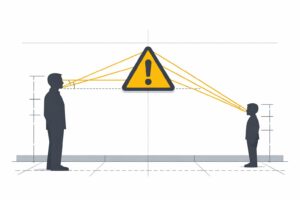
Hazard Sign Visibility Planner
Plan hazard sign placement for max visibility with our free tool. Ensure safety by finding the best spot, height, and angle—try it now!