Mandatory Signs in Risk Management Frameworks
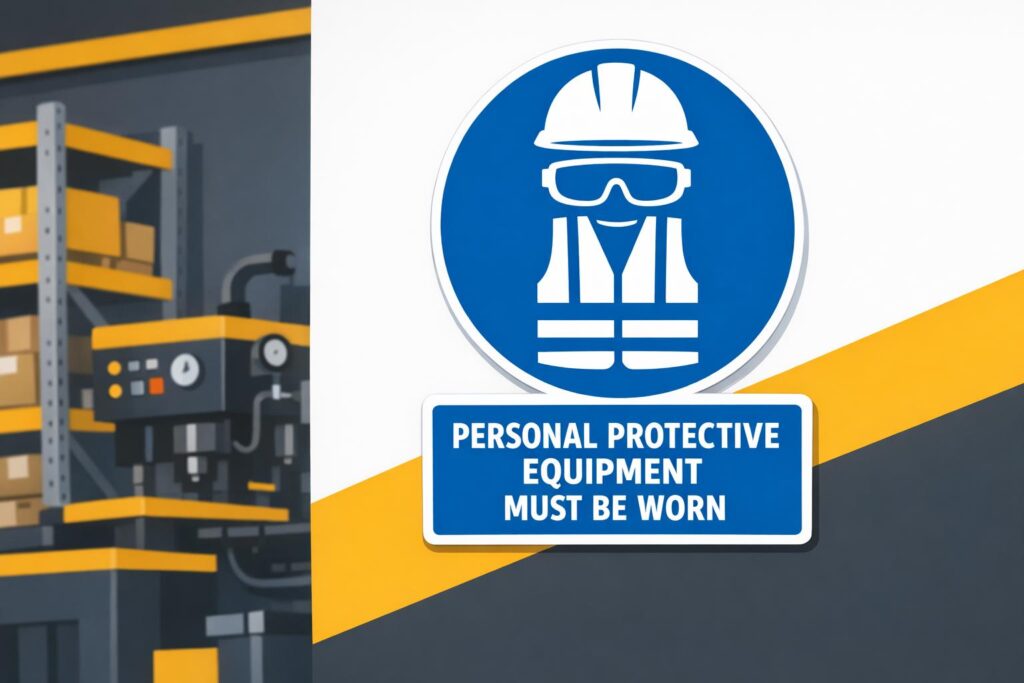
Mandatory signs are a critical part of workplace safety in Australia. These signs provide clear instructions to reduce risks, ensure compliance with laws like the WHS Act 2011, and meet AS 1319-1994 standards. Designed with universal symbols on a blue background, they help workers and visitors understand necessary actions, such as wearing PPE. Failure to use proper signage can lead to fines exceeding $100,000, denied insurance claims, and increased workplace hazards.
Key Points:
- Purpose: Reduce risks, guide actions, and meet legal requirements.
- Design: Blue circular background with white symbols; text size and visibility standards apply.
- Legal Compliance: Required under WHS laws and AS 1319-1994 for hazards like chemicals and confined spaces.
- Risks of Missing Signs: Increased accidents, legal penalties, and financial losses.
- Best Practices: Use durable materials, ensure visibility, and maintain compliance with regular checks.
Proper signage not only protects workers but also helps businesses avoid legal and financial repercussions. Investing in compliant, durable signs is essential for effective risk management.
Mandatory Safety Signs with explanation + Voice ; Photos & Videos
Workplace Risks When Mandatory Signs Are Missing
The absence or poor placement of mandatory signs in the workplace can lead to serious and immediate dangers. For instance, workers might unknowingly enter confined spaces without the necessary permits, exposing themselves to hazardous environments. Similarly, chemical storage areas lacking proper signage can result in mishandling or mismanagement of dangerous substances[3]. Without the clear guidance of blue circular mandatory signs, workers may skip using essential personal protective equipment (PPE) like safety goggles, helmets, or hearing protection[1].
When signs are obscured – whether by poor lighting or stored materials – they fail to communicate hazards effectively. This lack of visibility undermines the quick recognition that standardised colour-coded signs are designed to provide. As a result, workers may miss critical safety instructions at the very moment they need them most. These risks highlight the necessity of placing mandatory signs where they are both highly visible and easy to interpret.
Real Incidents Caused by Missing Signs
Improper communication of hazards ranks as the second most frequently cited workplace violation and is the third leading cause of workplace injuries and fatalities[5]. In Australia’s construction sector – where one in five workplace injuries occurs on-site – the absence of adequate signage plays a direct role in many of these incidents[5].
For example, unauthorised entry into confined spaces can expose workers to life-threatening conditions such as toxic gases, engulfment hazards, or oxygen-deficient environments[2]. Under Section 12F of the WHS Act, businesses face strict liability for these failures, meaning they can be penalised even if no harm has occurred[2][3]. These incidents underscore the critical role of mandatory signs in a well-structured risk management system.
Financial and Reputational Costs of Non-Compliance
Beyond safety risks, failing to display mandatory signs carries financial consequences. Under the WHS Regulations 2011, not displaying signage for hazardous chemicals can result in a Tier E monetary penalty[3], while breaches related to confined space signage attract a Tier G penalty[2]. These are strict liability offences, meaning intent or negligence does not need to be proven for penalties to apply.
In addition to fines, non-compliance can lead to higher workers’ compensation claims when unmanaged hazards cause injuries[4]. Insurance providers may also reject claims if inadequate signage contributed to the incident, leaving businesses to shoulder medical expenses and productivity losses. The reputational impact can be just as damaging – failure to display compliant signage sends a message to employees that their safety is not a priority, which can hurt workplace morale and make attracting or retaining staff more difficult[5].
"Section 12F of the Act provides that strict liability applies to each physical element of each offence under the Act, unless otherwise stated. The reference in section 12F of the Act includes these Regulations." – Work Health and Safety Regulations 2011[3]
Mandatory Signs Under AS 1319 Standards
The AS 1319-1994 standard defines mandatory signs as a distinct type of regulatory sign. Their role is simple yet critical: they indicate actions that must be taken to meet safety requirements [1] [6]. This standard employs a system of specific shapes and colours to ensure safety messages are easily recognisable, even in environments with language barriers or potential hazards [8]. It’s important to note that these signs differ from internal "EXIT" signs governed by AS 2293.1, as AS 1319-1994 focuses exclusively on workplace settings [10] [8]. The following guidelines detail the design and placement of these signs.
Standard Design Elements of Mandatory Signs
Mandatory signs adhering to AS 1319-1994 are instantly recognisable by their blue circular background (or disc), which serves as the primary visual cue [1] [7]. Overlaid on this blue disc is a white pictograph or symbol that depicts the required action [1] [7]. The sign panels themselves feature a white background with black text, often incorporating the word "MUST" to underscore the importance of compliance [1] [7].
While the standard outlines the design and layout, it does not prescribe specific materials or sizes. Instead, it emphasises that the sign should suit its intended purpose, and workers must be informed of its meaning [1]. Visibility is a key requirement: symbols must measure at least 15 mm in height for every metre of viewing distance, and uppercase text should be no smaller than 5 mm per metre. In low-light conditions, these dimensions should be increased by at least 50% [1].
Where to Place Signs for Maximum Visibility
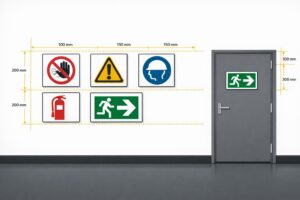
The placement of mandatory signs is just as important as their design. To ensure maximum visibility, signs should be mounted prominently against contrasting backgrounds. They need to be positioned within the observer’s direct line of sight to avoid blending into their surroundings [1]. For example, placing a white-background sign on a white wall would significantly reduce its visibility [1] [9].
"The safety signs must be put up in places where they attract maximum attention." – FCF Fire and Electrical [9]
Ideally, signs should be affixed to permanent fixtures like walls, rather than movable objects such as doors or tools, which could make them harder to notice or interpret [9]. If hanging signs is necessary, they should be high enough to avoid obstructing pedestrian paths but still within the natural line of sight [9]. Care must also be taken to avoid clustering too many signs in one area, as this can overwhelm viewers and diminish the effectiveness of each sign [9]. For hazard-related signs, placement should allow adequate time for workers to notice and act before encountering the danger [9].
Adding Mandatory Signs to Risk Management Systems
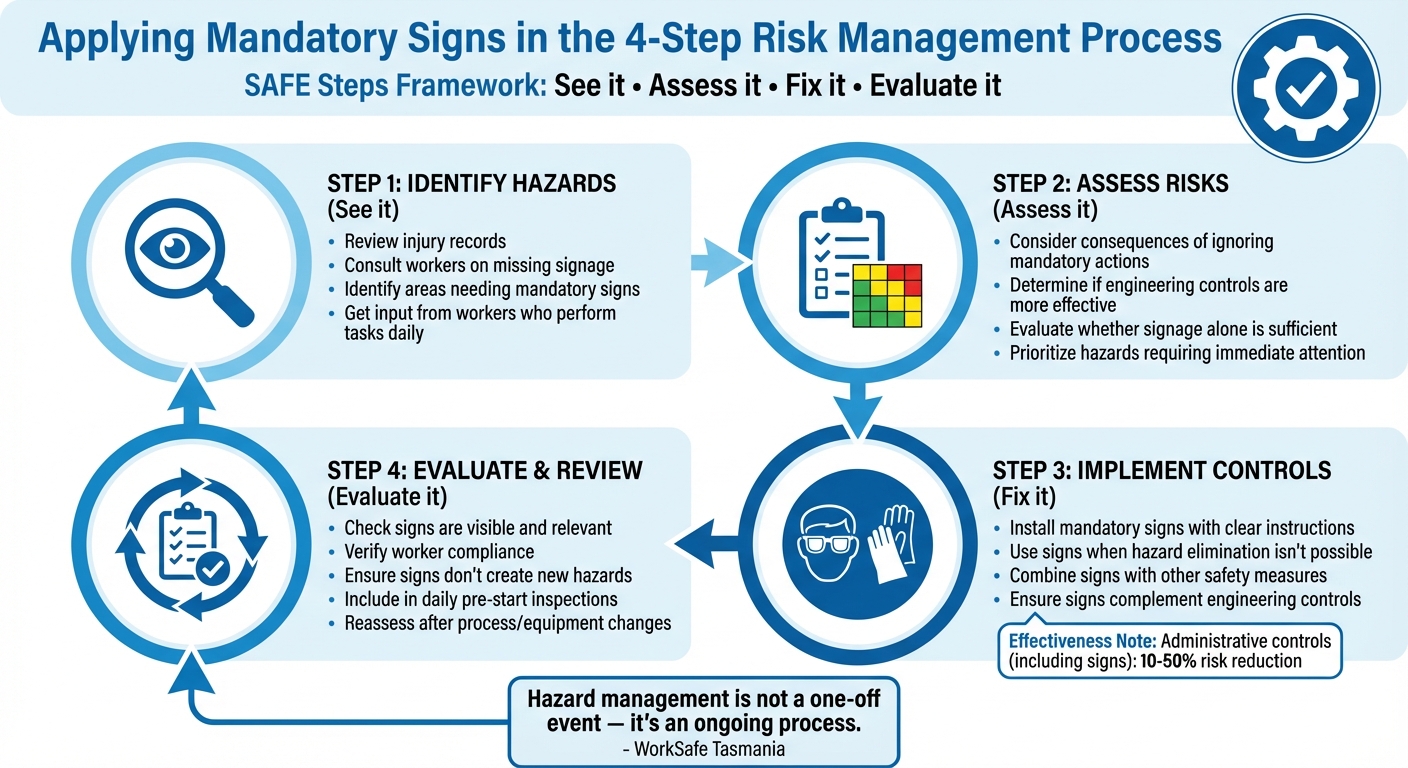
4-Step Risk Management Process for Mandatory Safety Signs
Mandatory signs work best when they’re part of a larger risk management strategy. Instead of standing alone, these signs should act as one piece in a structured system designed to identify and minimise hazards, providing a practical layer of protection.
Using Signs Within the Hierarchy of Controls
In the hierarchy of controls, mandatory signs fall under administrative measures. Unlike engineering controls that tackle hazards at their source – often reducing risks by 70–90% – administrative measures, including mandatory signs, typically lower risks by only 10–50%. Personal protective equipment (PPE), another lower-level measure, is generally no more than 20% effective[13].
"Administrative controls and personal protective equipment (PPE) are the least effective. They do not control the hazard at the source and rely on human behaviour and supervision." – Safe Work Australia [11]
Mandatory signs are most useful when higher-level controls are not feasible or as temporary solutions while more robust safety measures are being developed[14][15]. For example, pairing a machine guard with clear operational signage creates a layered safety approach. By embedding these signs into a structured risk management process, they become an integral part of everyday safety routines.
Applying Signs in the 4-Step Risk Management Process
Mandatory signs fit seamlessly into the SAFE Steps framework: See it (Identify), Assess it, Fix it (Control), and Evaluate it (Review)[13].
- Identify hazards: Begin by reviewing injury records and consulting workers to pinpoint areas where mandatory signs might be missing. Workers who perform tasks daily can offer valuable input on where additional signage is needed.
- Assess risks: Consider the potential consequences of ignoring a mandatory action. This helps determine if alternative measures, like engineering controls (e.g., improved ventilation), might be more effective than relying on signage alone.
- Implement controls: Use mandatory signs to provide clear instructions and warnings, particularly when eliminating or substituting a hazard isn’t possible. Signs should always complement other safety measures for maximum effectiveness.
- Evaluate and review: Regularly check that signs are visible, relevant, and adhered to by workers. Ensure they don’t create new hazards, such as obstructing views. Schedule routine reassessments – especially after changes in work processes or equipment – and include signage checks in daily pre-start inspections to confirm that instructions remain clear and legible.
"Hazard management is not a one-off event – it’s an ongoing process." – WorkSafe Tasmania [12]
sbb-itb-9950c92
Why Quality and Compliance Matter for Mandatory Signs
When it comes to managing risks and protecting workers, durable signs that comply with AS 1319 standards are essential. Signs that fade, crack, or fail to meet these standards lose their ability to provide the clear instructions workers rely on to stay safe. High-quality signage not only helps prevent injuries but also reduces the risk of legal and financial consequences.
Fewer Injuries and Better Safety Outcomes
Mandatory signs are only effective if workers can easily see and understand them. To achieve this, signs must comply with AS 1319 sizing standards, ensuring they are both visible and comprehensible. Signs that fall short of these standards – or that have deteriorated over time – can compromise safety measures and weaken the overall risk management system.
"For maximum effectiveness, safety signs should be maintained in good condition, kept clean and well illuminated." – WorkSafe ACT [1]
Using robust materials is key to maintaining clarity over time. Signs made from durable aluminium, paired with UV-protective film and outdoor-grade printing, stand up to Australia’s harsh weather conditions. This ensures they remain visible and effective for years, even in challenging environments.
Maintaining Compliance Over Time
Beyond improving safety, maintaining the quality of mandatory signs is crucial for meeting legal requirements and upholding risk management responsibilities. While Australian Standards are generally voluntary, they become mandatory when referenced in State or Commonwealth legislation [16]. Courts also regard compliance with AS 1319 as critical evidence when assessing whether businesses have fulfilled their obligations under WHS Acts [16]. Using signs that fail to meet these standards could expose your business to legal risks and undermine your duty of care.
Investing in high-quality, compliant signs from the outset can save both time and money. Non-compliant signs often require costly replacements, especially if identified during inspections or after legislative updates [16]. Regular upkeep, such as cleaning, ensuring proper illumination, and removing obstructions, helps signs remain effective and compliant throughout their lifespan [1].
Getting Mandatory Signs from PXP Safety
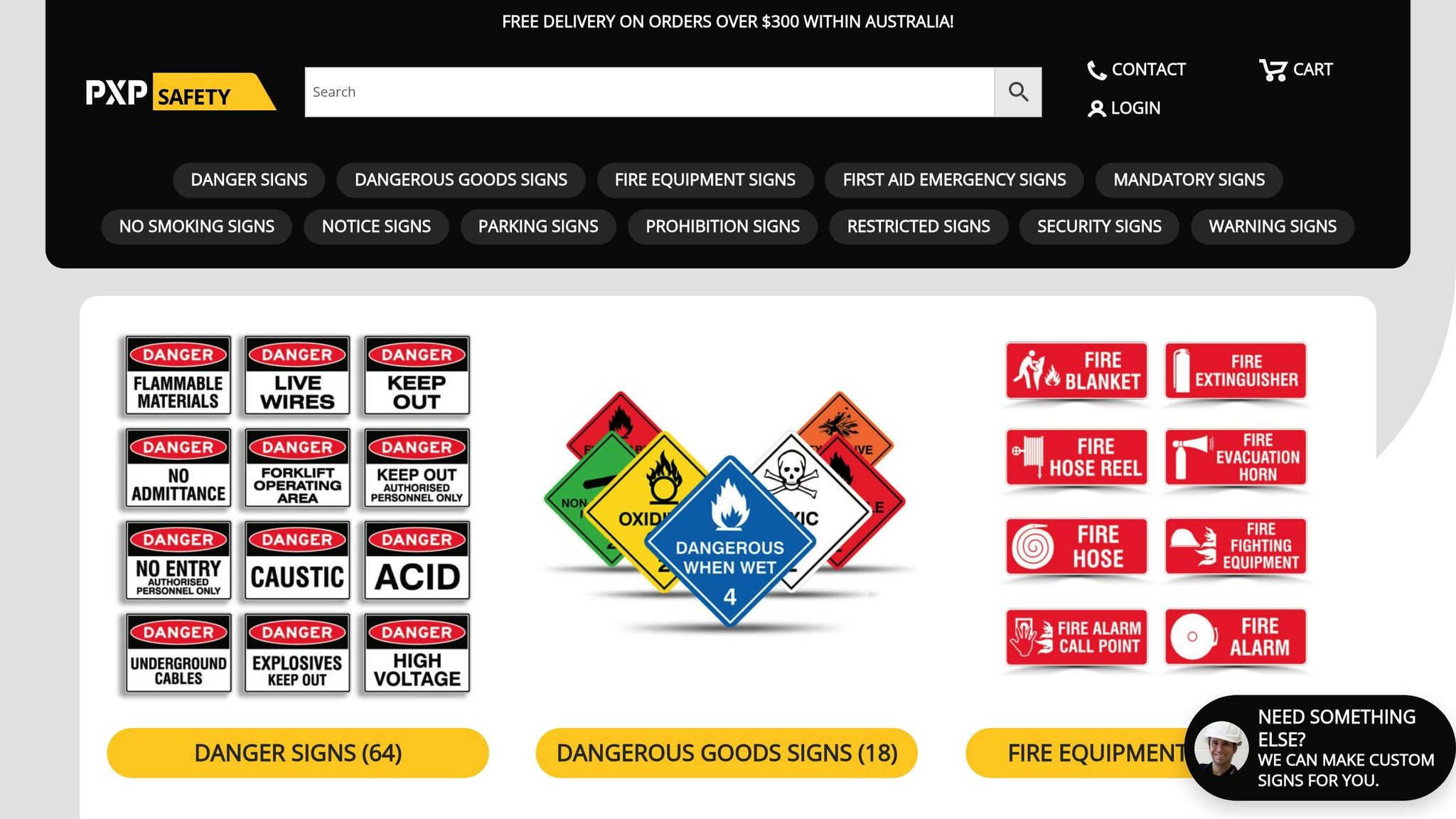
Ensure your workplace stays compliant and safe with mandatory signs from PXP Safety. These signs are designed to meet AS 1319 standards and address the specific hazards of your work environment. Incorporating high-quality signage into your safety strategy strengthens your overall risk management approach.
Custom Signs for Specific Workplace Hazards
While standard mandatory signs cover common safety needs like hearing protection or safety footwear, some workplaces face unique risks that require customised solutions. Custom signs can address specific hazards such as equipment locking procedures, cylinder chaining, or specialised PPE requirements. By combining multiple safety messages into a single sign, you can make safety communication more efficient and clear [17].
All custom signage from PXP Safety complies with AS 1319 standards. To ensure effectiveness, employers are responsible for educating employees about the purpose and proper use of each sign.
Product Features of PXP Safety Mandatory Signs
PXP Safety’s mandatory signs are built to endure tough Australian conditions. Constructed from heavy-duty aluminium and printed with UV-protected, outdoor-grade materials, these signs remain clear and legible even in extreme weather. They meet the requirements of AS 1319-1994, featuring the standard blue circular background with white symbols and high-contrast black text for quick and easy recognition.
Additional features like reflective finishes, anti-graffiti coatings, and lamination enhance durability and visibility, even in low-light conditions.
Pricing starts at approximately $15 ex GST for standard signs, while smaller specialised signs are available from around $8 ex GST [17]. Whether you need ready-made options or tailored solutions, PXP Safety delivers signage designed to meet legal standards and withstand the rigours of industrial settings. This attention to detail ensures your workplace upholds consistent safety practices.
Conclusion
Mandatory signs play a crucial role in delivering clear, non-verbal instructions, forming a key part of any risk management strategy. With their standardised symbols, these signs ensure that everyone, regardless of language or background, can understand safety requirements effectively [1]. While they are considered an administrative control within the risk management hierarchy, their importance cannot be overstated when it comes to reducing risks that cannot be completely eliminated. This clarity not only safeguards workers but also ensures adherence to legal obligations across Australia.
"The aim is to regulate and control safety related behaviour, to warn of hazards and to provide emergency information, including fire protection information." – WorkSafe ACT [1]
By complying with AS 1319-1994, workplaces can demonstrate that they have taken ‘reasonably practicable’ steps to meet Australian WHS laws. Regular upkeep – such as keeping signs clean, well-lit, and correctly placed – is essential to maintain their effectiveness over time.
Choosing durable materials, like heavy-duty aluminium with UV protection, ensures that signs can endure Australia’s harsh weather conditions. This not only reduces the need for frequent replacements but also helps maintain their visibility and legibility. For unique workplace hazards, custom signage provides precise safety communication, enhancing the overall risk management framework.
For those in need of compliant and durable mandatory signage, PXP Safety offers solutions tailored to Australian standards and industrial demands. Whether you require off-the-shelf options or custom designs for specific hazards, integrating high-quality mandatory signage is an indispensable step in building a comprehensive and effective risk management plan.
FAQs
What are the legal risks of not displaying mandatory safety signs in the workplace?
Failing to display required safety signs in the workplace violates the Work Health and Safety Regulations and carries serious legal consequences. These can include hefty fines and other enforcement measures for not meeting workplace safety obligations.
Mandatory safety signs play a key role in communicating essential safety requirements and adhering to Australian standards. Ignoring these signs doesn’t just expose businesses to financial penalties – it also undermines their responsibility to protect employees and visitors, increasing the likelihood of workplace accidents or injuries.
What role do mandatory signs play in workplace risk management?
Mandatory signs play a crucial role in workplace safety management. Recognisable by their blue circular background and white pictogram, these signs indicate actions that must be followed – like wearing safety goggles or using hearing protection. They comply with AS 1319-1994 standards and act as clear, visual cues to remind employees about specific safety protocols.
Under the Work Health and Safety Act and Safe Work Australia’s Code of Practice, mandatory signs are particularly important when eliminating hazards isn’t a practical option. By providing consistent and visible instructions, they help to minimise unsafe behaviours and ensure adherence to safety guidelines. When positioned in noticeable areas and maintained properly, these signs reinforce the workplace’s hierarchy of controls and highlight the proactive measures taken to maintain safety.
PXP Safety offers a comprehensive selection of durable and compliant mandatory signs tailored for Australian workplaces. Constructed from tough materials with UV protection and outdoor-grade printing, these signs are designed to deliver reliable and long-lasting performance.
What are the requirements for mandatory signs under AS 1319-1994?
Under AS 1319-1994, mandatory signs are required to have a blue circular background paired with a white pictogram or text. The size of the symbols should be at least 15 mm for every metre of viewing distance, while the text needs to be no smaller than 5 mm per metre. In poorly lit areas, it’s recommended to increase these sizes by around 50%. To maximise visibility and ensure the signs effectively convey safety instructions, they should be positioned close to the observer’s line of sight.
Related Blog Posts
You may also be interested in
FAQs About Workplace Safety Signs in Australia
AS 1319 sign types, placement, materials and maintenance for workplace safety and WHS compliance in Australia.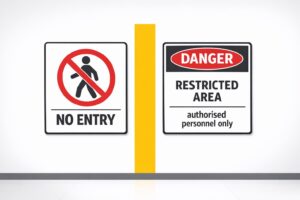
Restricted Area Signs vs. No Entry Signs
Compare No Entry and Restricted Area signs in Australian workplaces — meanings, design differences and AS 1319 compliance.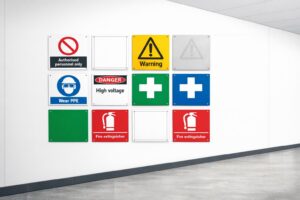
How to Spot Workplace Signage Gaps
Audit your workplace for missing, faded or non‑compliant signs under AS 1319 to reduce incidents and avoid WHS fines.
Symbol Design: Global Standards Explained
Explains ISO 7010 and ISO 3864: standard symbols, colours and sizing for clear, language‑free safety signage and AU compliance.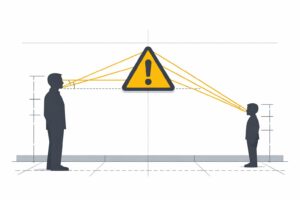
Hazard Sign Visibility Planner
Plan hazard sign placement for max visibility with our free tool. Ensure safety by finding the best spot, height, and angle—try it now!