High Noise Area Signs: Compliance Guide
High noise area signs are essential for protecting workers from noise-induced hearing loss, a preventable workplace injury. In Australia, these signs must comply with AS 1319-1994 standards and are required in areas where noise exceeds safe limits – 85 dB(A) over an eight-hour shift or peaks of 140 dB(C). They ensure workers wear hearing protection and help maintain workplace safety.
Key points:
- Noise limits: 85 dB(A) (8-hour average) and 140 dB(C) (peak).
- Sign types: Mandatory signs (blue disc with white earmuff symbol) and warning signs (yellow background with soundwave pictogram).
- Placement: At entry points, noisy machinery, and pathways, ensuring visibility and compliance with size and lighting standards.
- Materials: Durable options like Aluminium Composite Panels or UV-protected signs for Australian conditions.
- Additional requirements: Audiometric testing and noise assessments are mandatory for workplaces exceeding noise standards since 29 July 2025.
Proper signage, combined with noise assessments and protective measures, ensures compliance and protects workers’ hearing.
Understanding Workplace Noise Control: Protecting Your Hearing
sbb-itb-9950c92
Australian Noise Standards Explained
Noise Exposure Limits and Allowable Time Chart for Australian Workplaces
Noise Exposure Limits
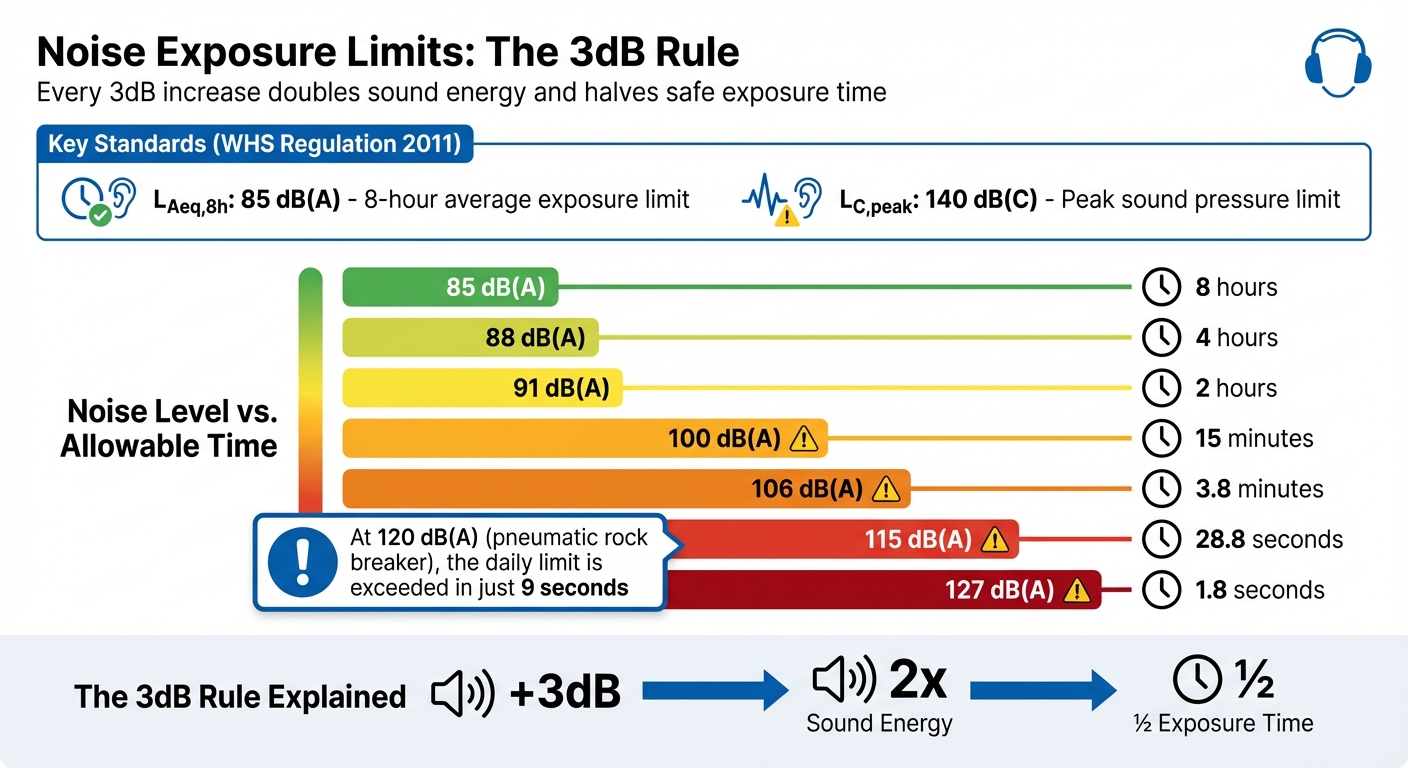
In Australia, noise exposure in workplaces is regulated to ensure worker safety. The standards set by Work Health and Safety Regulation 2011 specify two key limits:
- LAeq,8h of 85 dB(A): This is the average continuous sound pressure level over an eight-hour period, measured at the worker’s ear.
- LC,peak of 140 dB(C): This refers to the peak sound pressure level for short, sharp noises like explosions or hammer strikes [5][7].
"The exposure standard for noise is defined in the Work Health and Safety Regulation 2011 as LAeq,8h of 85 dB(A) or an LC,peak of 140 dB(C)." – WorkSafe Queensland [5]
The 3 dB rule plays a crucial role here: every 3 dB increase doubles the sound energy and halves the time a worker can be safely exposed. For instance:
- At 85 dB(A), an eight-hour exposure is allowed.
- At 88 dB(A), the limit drops to four hours.
- At 91 dB(A), exposure is restricted to just two hours.
To put this into perspective, exposure to 100 dB(A) reaches the daily limit in just 15 minutes, while a 120 dB(A) noise, like a pneumatic rock breaker, exceeds the standard in a mere nine seconds [2][6][8].
| Noise Level dB(A) | Allowable Exposure Time |
|---|---|
| 85 dB(A) | 8 hours |
| 88 dB(A) | 4 hours |
| 91 dB(A) | 2 hours |
| 100 dB(A) | 15 minutes |
| 106 dB(A) | 3.8 minutes |
| 115 dB(A) | 28.8 seconds |
| 127 dB(A) | 1.8 seconds |
These exposure limits guide when protective measures, such as ear protection and warning signs, are required.
When High Noise Signs Are Required
High noise warning signs are mandatory in areas where noise levels exceed the prescribed limits. These signs indicate that workers in the zone must wear personal protective equipment (PPE) to safeguard their hearing [5].
Administrative controls, such as signage, are essential when noise cannot be sufficiently reduced through engineering solutions [5][6].
"As the person conducting a business or undertaking (PCBU), you must reduce your workers’ exposure to noise as much as is possible." – Safe Work Australia [2]
All safety signs must comply with AS 1319: Safety signs for the occupational environment to ensure consistency and clarity [5]. Furthermore, businesses where noise exceeds the exposure standard will need to meet additional requirements from 29 July 2025:
- Audiometric testing: Workers must undergo hearing tests within three months of starting their role and then at least every two years.
- Noise assessments: These should be conducted every five years or whenever significant changes occur, such as new machinery, altered work processes, or structural modifications [5].
These measures are designed to provide long-term protection for workers and ensure compliance with safety regulations.
How to Identify High Noise Areas
Conducting Noise Assessments
Before putting up high noise signage, it’s essential to pinpoint noise hotspots in your workplace. Start with a walkthrough at various times of the day, talking to workers and health and safety representatives. This helps identify noisy equipment, loud processes, and spots where communication is difficult. A simple rule of thumb: if someone has to shout to be heard from one metre away, the noise level likely exceeds 85 dB(A) and needs further assessment [2].
From there, you’ll need precise measurements. Handheld sound level meters (SLMs) can provide spot readings for machinery or specific areas, while personal dosimeters – worn on a worker’s shoulder during their shift – measure actual noise exposure [10].
"The most common instrument to measure decibels is a noise (or sound) level meter." – Safe Work Australia [2]
These assessments should be conducted by a qualified professional, like a certified occupational hygienist or someone with equivalent training [2]. Compare the results to the national exposure standard: noise levels above 85 dB(A) averaged over eight hours, or peaks hitting 140 dB(C), indicate areas needing high noise signage and mandatory hearing protection [2][9]. Keep in mind, measurements should reflect actual noise levels without factoring in earplugs or earmuffs [9]. Proper documentation of these findings is crucial for creating detailed noise zone maps.
Creating Noise Zone Maps
Once you’ve gathered your measurements, translate the data into a clear layout of the workplace. Noise mapping is essential for planning signage placement and staying compliant with Australian standards. Highlight major noise sources, like vibrating machinery, pneumatic tools, compressed air systems, and motors, and mark boundaries where noise levels hit 85 dB(A) [9][11]. Prioritise signage based on noise intensity, exposure length, and worker impact [9].
Your map should clearly indicate areas where hearing protection is mandatory – these are zones exceeding the national standard [11]. If your facility has multiple noise sources, assess each one separately to understand its specific contribution [9].
"Define designated hearing protection areas at work." – OHSA Occupational Health Services Australia [11]
After introducing noise control measures or modifying equipment, update your map to reflect the changes. This ensures your safety program remains effective and compliant. Regular noise assessments – at least every five years or whenever plant layouts, work processes, or building structures change – help maintain accuracy [9][11].
Signage Placement and Design Requirements
Where to Place High Noise Signs
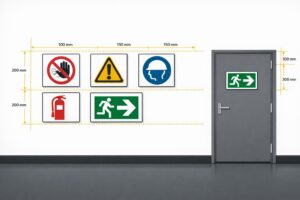
Place high noise signs at eye level at all entry points, such as doorways, access gates, and walkways leading to areas with noise hazards. Attach signs directly to noisy machinery and along pathways frequently used by workers. Ensure the signs are clearly visible, unobstructed, and stand out against their background.
Visibility depends on how far away the signs need to be read. According to AS 1319-1994, symbols should be at least 15 mm tall, and uppercase text should be at least 5 mm tall for every metre of viewing distance [1]. For example, a 300 × 400 mm sign is readable from up to 16.2 metres in good lighting, while a 450 × 600 mm sign works up to 24.33 metres. In dimly lit spaces like warehouses or underground facilities, increase the sign size by at least 50% to maintain readability. For areas requiring 24-hour visibility or low-light conditions, use reflective materials such as Class 400/400T, as specified in AS/NZS 1906.1:2017 [12].
These placement recommendations align with the design standards required for compliance.
Design Standards for Compliance
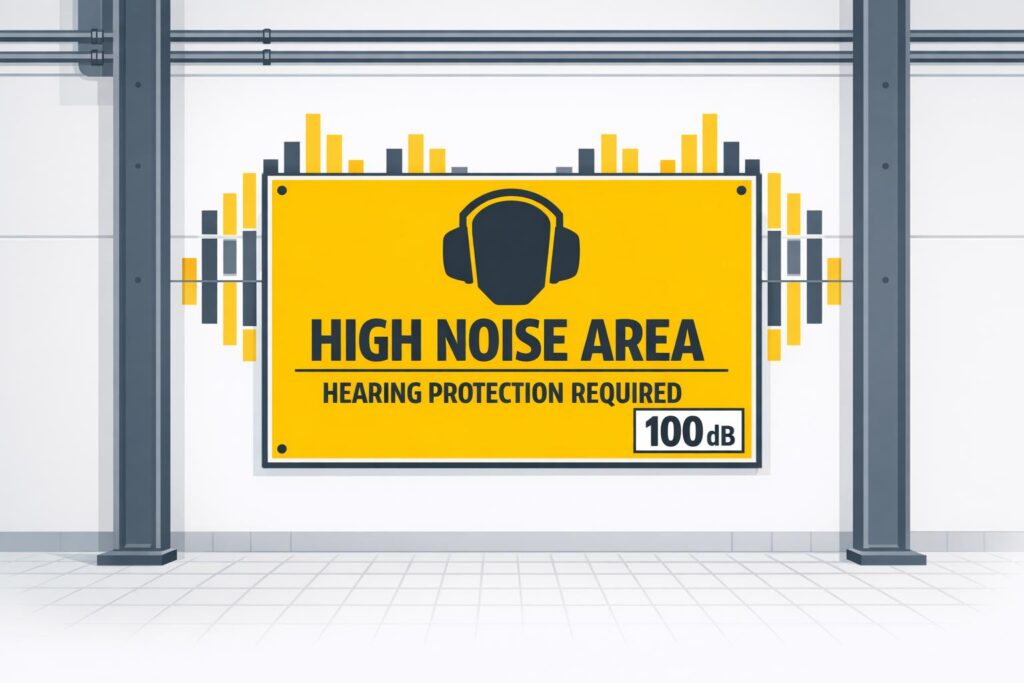
After deciding on sign locations, follow design standards to ensure visibility and adherence to regulations. Australian Standard AS 1319-1994 specifies the design requirements for high noise area signs. Mandatory signs – indicating hearing protection is required – should feature a white earmuff symbol centred within a solid blue disc [1][3]. These signs often use a white background with black text, including clear instructions like "HEARING PROTECTION MUST BE WORN."
In some workplaces, combination signs are used. These include a warning panel (yellow background with a black soundwave pictogram) alongside a mandatory panel (blue disc with white earmuffs) to highlight the hazard and specify the required safety measures [4][13].
To ensure instructions are easily understood, stick to the recommended ratios – 15 mm symbols and 5 mm uppercase text per metre of viewing distance. Avoid cluttering the sign with unnecessary details; focus on delivering the essential message.
Selecting Durable Materials
Durability is crucial for maintaining the effectiveness of signage in Australia’s tough conditions. Exposure to strong UV rays, fluctuating temperatures, and extreme weather demands robust materials. For permanent outdoor signs, Aluminium Composite Panel (ACM) is a reliable choice, offering a balance of durability and light weight [1][12]. Solid aluminium is even more durable but comes with a higher price tag. For indoor use or less demanding outdoor environments, materials like Polypropylene or Foam PVC are good alternatives [12].
Laminated signs are especially useful for outdoor settings, as lamination protects against UV damage, fading, and graffiti, extending the sign’s lifespan [1][13]. PXP Safety signs, for instance, use solvent outdoor printing with a UV protective film, designed specifically for Australian conditions. To keep signage effective and compliant, regular maintenance – such as cleaning and ensuring proper lighting – is essential [1].
Adding High Noise Signs to Your Safety Program
Supporting Noise Control Measures
High noise area signs act as administrative controls within the hierarchy of controls, coming into play after higher-level measures – like elimination, substitution, or engineering controls – have been implemented as far as reasonably practicable [9]. For instance, if it’s not possible to eliminate a loud machine or install acoustic barriers to bring noise levels below the 8-hour average of 85 dB(A) or peak levels of 140 dB(C), signage becomes a necessary tool.
These signs act as visual cues, reminding workers to use personal protective equipment (PPE). When noise assessments reveal exposure above these limits, mandatory signs – often featuring strong wording like "MUST" (e.g. "Hearing Protection Must Be Worn") – clearly communicate the requirement [3]. Before finalising permanent signage, consider trialling temporary noise barriers to evaluate whether they can reduce noise levels enough to make permanent signs unnecessary [9].
Beyond indicating PPE requirements, high noise signs are closely tied to health monitoring programs, often triggering mandatory audiometric testing for workers exposed to high noise levels [2]. This connection reinforces a broader approach to managing risks and prioritising worker safety.
Maintaining Compliance Over Time
Once high noise signs are in place, ensuring their ongoing effectiveness is crucial for maintaining compliance. Regular noise assessments should be conducted whenever new equipment is introduced, work processes are changed, or exposure levels are unclear [9]. These reviews help ensure alignment with Australian safety standards and industry practices. As machinery is moved or processes evolve, reassess the placement and condition of your signs.
To keep signs effective, ensure they are clean, clearly visible, and securely mounted. Use materials like lamination, UV coatings, and pre-drilled holes for durability [4]. In low-light or night-shift environments, upgrading to Class 2 reflective materials can significantly improve visibility [1].
Worker education is equally important. Employees must understand what each sign means and the actions required. Combine this with detailed workplace mapping that highlights noise zones to foster a strong safety culture that complies with Australian standards. Tools like the Safe Work Australia noise ready reckoner can help identify tasks that warrant signposted areas [2].
For durable, compliant signage that meets Australian standards, consider trusted providers like PXP Safety. Regularly reviewing and updating your signage program ensures continuous improvement and a safer workplace for everyone.
Conclusion
Protecting workers from noise-induced hearing loss begins with proper high noise signage. These signs aren’t just a legal obligation under Australian Standard AS 1319-1994 – they’re a critical part of ensuring workplace safety and demonstrating a commitment to worker wellbeing.
"As the person conducting a business or undertaking (PCBU), you must reduce your workers’ exposure to noise as much as is possible." – Safe Work Australia [2]
Effective high noise signage uses a blue disc with a white symbol and includes clear "MUST" instructions. These signs should be placed at eye level, in well-lit, unobstructed areas, ensuring they’re easy to see and follow [1][3]. Keep in mind that any workspace where employees need to raise their voices to communicate with someone just one metre away likely exceeds the 85-decibel exposure limit, requiring appropriate signage and controls [2].
To maintain compliance, it’s important to regularly review noise assessments, check the condition of your signs, and ensure workers understand the safety measures in place. Whether it’s installing durable aluminium composite panels for permanent outdoor use or choosing Class 2 reflective materials for better visibility during night shifts, selecting high-quality, compliant materials from PXP Safety ensures long-lasting effectiveness and adherence to safety standards.
FAQs
How do I know if an area is a “high noise area”?
A high noise area is any location where noise levels go beyond safe exposure limits, making it essential to have mandatory signage and enforce the use of hearing protection. To identify such areas, it’s crucial to carry out workplace noise assessments using appropriate measuring equipment. If noise exceeds the permissible exposure limit, the area must be clearly marked with signage that meets Australian standards, and protective measures should be implemented to safeguard workers.
What size should a high noise sign be for my viewing distance?
A high-noise sign needs a pictogram size of at least 15 mm per metre of viewing distance. This sizing ensures the sign stays clear and easy to read from the required distance, aligning with Australian safety standards.
When do I need audiometric testing and repeat noise assessments?
New workers must undergo audiometric testing within three months of starting their job. For all workers, regular testing is required at least once every two years. Workers who were employed before 2024 need to complete their first test by 1 January 2026. Additionally, workplaces must conduct repeat noise assessments in line with safety regulations to ensure compliance and safeguard workers from harmful noise levels.
Related Blog Posts
You may also be interested in
FAQs About Workplace Safety Signs in Australia
AS 1319 sign types, placement, materials and maintenance for workplace safety and WHS compliance in Australia.
Restricted Area Signs vs. No Entry Signs
Compare No Entry and Restricted Area signs in Australian workplaces — meanings, design differences and AS 1319 compliance.
How to Spot Workplace Signage Gaps
Audit your workplace for missing, faded or non‑compliant signs under AS 1319 to reduce incidents and avoid WHS fines.
Symbol Design: Global Standards Explained
Explains ISO 7010 and ISO 3864: standard symbols, colours and sizing for clear, language‑free safety signage and AU compliance.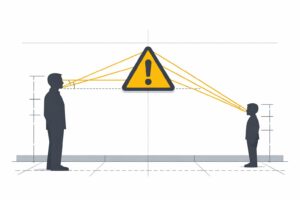
Hazard Sign Visibility Planner
Plan hazard sign placement for max visibility with our free tool. Ensure safety by finding the best spot, height, and angle—try it now!