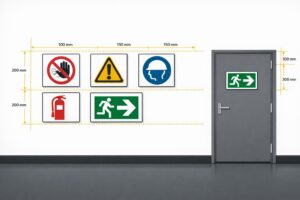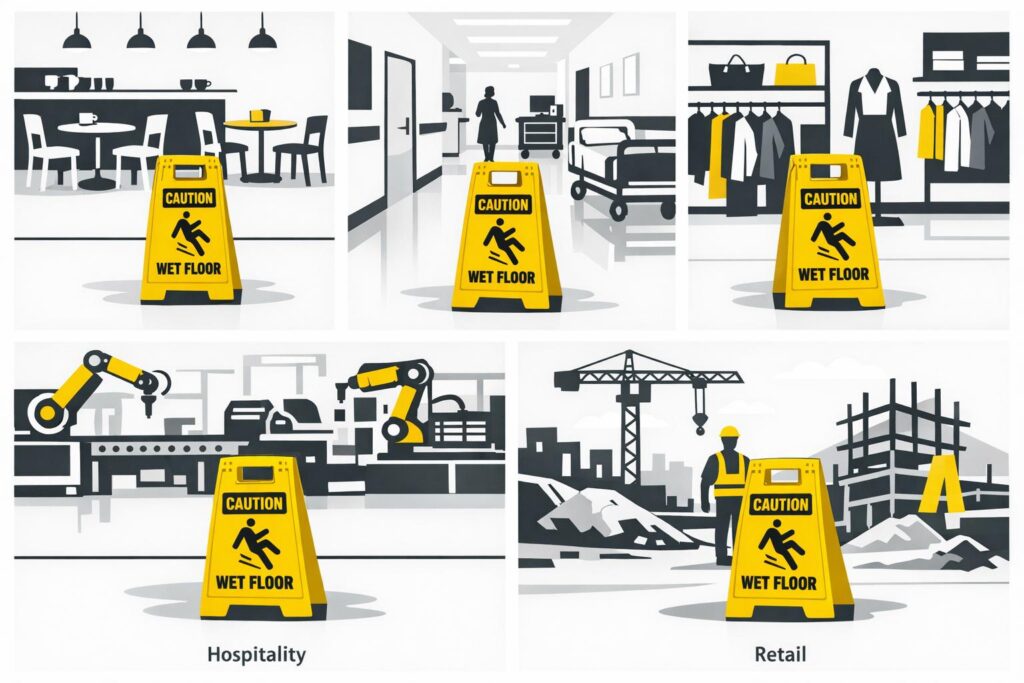
Top 5 Industries Needing Slip Hazard Signs
Every year in Australia, slips, trips, and falls cause thousands of workplace injuries, making up 21.8% of serious workers’ compensation claims. These incidents cost the economy $28.6 billion annually and lead to an average of 8.8 weeks off work. Slip hazards often arise from wet or greasy floors, uneven surfaces, or cluttered spaces, and businesses must comply with WHS laws to minimise these risks. Slip hazard signs, adhering to AS 1319:1994 standards, are a key safety measure to prevent injuries.
Industries most at risk include:
- Hospitality and Food Service: Greasy kitchen floors, spills in dining areas, and wet entries during rain.
- Healthcare and Aged Care: Spills from bodily fluids, wet bathrooms, and cluttered hallways.
- Retail and Commercial Spaces: Spills in food courts, rainwater at entrances, and slippery surfaces.
- Manufacturing, Warehousing, and Logistics: Oil spills, wet loading docks, and uneven floors.
- Construction and Building Maintenance: Muddy or uneven surfaces, trailing cords, and open voids.
Slip hazard signs must be tailored to the environment, using durable materials like aluminium for outdoor areas and portable A-frame signs for temporary hazards. Proper placement, regular inspections, and adherence to WHS standards are essential for workplace safety.
1. Hospitality and Food Service
Common Slip Hazards in the Industry
In Australia’s hospitality and food service sector, slip hazards are a constant concern. Kitchens often face grease and oil buildup, along with liquid spills during food prep, which can make floors dangerously slick. Research shows that contaminated floors can increase the likelihood of slips by almost 14 times [6]. Outside the kitchen, dining areas are prone to spills from customers, and building entrances can become risky when rainwater is tracked indoors. Cold rooms and walk-in freezers add to the problem, with ice and condensation creating slippery surfaces.
High-Risk Areas Requiring Signage
Key areas that demand clear signage include kitchens, dishwashing zones, cold storage rooms, dining spaces, bathrooms, and entrance foyers. These spots are particularly prone to slip hazards, especially during spills or wet weather, and require specific signage solutions to ensure safety.
Types of Slip Hazard Signs Needed
To manage these risks effectively, a mix of signage is essential. Yellow warning signs with black triangles are ideal for wet or greasy floors, while portable A-frame “Wet Floor” signs should be deployed immediately after a spill. In kitchens, mandatory signs with blue backgrounds can enforce the use of non-slip footwear. Additionally, hot surface warnings near ovens, deep fryers, and hot plates are critical to reducing burn risks. All signs must comply with AS 1319-1994 standards, including proper pictogram sizing [7].
For businesses in need of quality safety signage, PXP Safety provides a range of durable, customisable options that align with Australian regulations.
Australian-Specific Considerations for Signage
Under the WHS Regulations 2011, businesses are required to use effective safety signage, with non-compliance penalties reaching over $3 million for corporations and $600,000 for individuals [7]. Given the high turnover in hospitality and the employment of many young workers, some with limited English skills, clear and visual signage is crucial. Signs should be placed at eye level in well-lit areas, and regular checks are necessary to ensure they remain visible and undamaged. Faded or broken signs can be as ineffective as having none at all.
Warehouse Safety: Preventing Slip, Trip, and Fall Accidents
2. Healthcare and Aged Care
Healthcare and aged care settings, like the hospitality industry, face their own set of slip hazards, and addressing these risks requires carefully designed signage solutions.
Common Slip Hazards in the Industry
Facilities in healthcare and aged care are particularly prone to unique slip risks. Spills caused by water, bodily fluids, or incidents related to incontinence are frequent hazards. The Australian Commission on Safety and Quality in Health Care highlights:
"Older people may make extraordinary efforts to avoid an incontinent episode, which may increase their risk of falling" [8].
Additional hazards include freshly mopped floors, water tracked in from rain at entrances, and transitions between different types of flooring, such as carpet to polished timber [1][9]. Cluttered hallways filled with medical equipment and cords further heighten the risks, particularly for residents dealing with conditions like dementia, delirium, or mobility challenges [8]. These issues make the need for specific signage solutions all the more pressing.
High-Risk Areas Requiring Signage
Certain areas within healthcare and aged care facilities are especially prone to slips and falls. For instance, falls often happen around patient beds in hospitals and aged care homes, frequently without witnesses [8]. Bathrooms and shower rooms are another danger zone, with water pooling, soap residue, and the physical effort required to move safely in these spaces. Entranceways and foyers can also become slippery when wet weather leads to rainwater being tracked indoors. Corridors used for cleaning or filled with medical equipment present continuous risks. Additionally, medical imaging rooms and spaces with specialised equipment like X-rays or lasers require clear exclusion zone signage to prevent unauthorised access [10].
Types of Slip Hazard Signs Needed
Signage in healthcare must address both temporary and permanent hazards. Portable "Wet Floor" signs should be used immediately in response to spills or during cleaning, alongside dry mopping to ensure surfaces are safe [1]. Exclusion zone signs, often paired with physical barriers, are critical in areas containing hazardous medical equipment to safeguard both staff and patients [10]. High-visibility markings on steps and ramps, designed to align with AS 1657 and AS 1428 standards, assist individuals with limited mobility [9]. For transitions between floor types, contrasting strips help alert residents to potential level changes – an important feature for older individuals with impaired vision, who are at twice the risk of falling [8]. These measures, combined with adherence to local guidelines, ensure comprehensive safety.
Australian-Specific Considerations for Signage
As of July 2025, updated regulatory guidance will help the healthcare and social assistance sectors manage workplace health and safety risks. The Australian Commission on Safety and Quality in Health Care has also released updated best practice guidelines specifically focused on fall prevention [3][8]. Since falls often lead to long-term injuries affecting ankles, knees, or backs, signage should be part of a broader safety strategy that includes clear walkway protocols and rapid spill response measures [1]. Signs must be both highly visible and thoughtfully placed to ensure they are understood by residents, including those with cognitive impairments.
For Australian healthcare and aged care facilities, providers like PXP Safety offer durable, customisable slip hazard signs that meet local standards and are built to withstand the challenges of these demanding environments.
3. Retail, Shopping Centres and Commercial Buildings
Common Slip Hazards in the Industry
Retail spaces, especially shopping centres and commercial buildings, often face slip hazards due to high foot traffic and diverse operations. Spills – whether liquid or solid – are frequent culprits. Food courts, for instance, can quickly become risky with drinks and food scraps left behind, while leaks from products in retail aisles add to the problem [1][11]. Cleaning routines can also introduce hazards. Wet floors from mopping, if not followed by dry mopping, significantly increase the risk of slips [1][3].
Weather conditions play a big role too. Wind-driven rain entering through doorways, or water and mud tracked in by customers on rainy days, can make foyers and entrances slippery [1][9]. Changes in flooring – like moving from carpet to polished surfaces – reduce traction, as do maintenance issues such as worn floor coverings, broken tiles, or greasy patches [1][3]. These risks highlight the importance of marking high-risk zones clearly to prevent accidents.
High-Risk Areas Requiring Signage
Some areas in retail and commercial spaces need extra attention when it comes to signage. Entrances and foyers, where water often gets tracked in during bad weather, are particularly risky. These areas are further complicated by sudden changes in flooring types [12][1]. Stairs and ramps with uneven steps, slippery edges, or steep inclines also require clear warning signs to alert people to potential dangers [12][4].
Food courts and retail aisles should have immediate signage around spills until they are cleaned up [12][1]. Cold storage areas and commercial kitchens are other high-risk zones, with hazards like ice, condensation, and grease [12]. Loading docks, often exposed to rain and oil leaks, are also problematic due to their smooth concrete surfaces [12]. Given that slips and trips are a leading cause of serious injuries in NSW workplaces, clear and effective signage is absolutely necessary [12].
Types of Slip Hazard Signs Needed
Retailers can use a mix of temporary and permanent signage to manage slip hazards effectively. Temporary yellow A-frame signs are ideal for spills or freshly mopped floors, offering high visibility and easy portability [13][14]. Anti-slip vinyl floor stickers are another option, providing extra grip in high-traffic areas like lobbies, even when wet [13].
For outdoor areas, such as car parks or building exteriors, aluminium composite panels (ACP) are a great choice. These signs are built to withstand Australia’s harsh weather conditions, including strong UV rays and heavy storms [13]. Reflective and glow-in-the-dark signs are particularly useful for areas with low lighting, night-time operations, or emergency exits [13]. Common signs like "Slippery When Wet", "Watch Your Step", and "Cleaning in Progress" are often used together as part of a broader safety plan [13].
Australian-Specific Considerations for Signage
In Australia, slip hazard signage must meet local safety standards. AS/NZS 3661.2:1994 outlines ways to reduce slip risks, while AS 4586-2013 focuses on the slip resistance of pedestrian surfaces [12]. The Work Health and Safety Regulation 2025 requires businesses to manage risks with appropriate controls, including effective signage [12][3].
Given Australia’s tough weather conditions, signage materials need to be durable. Aluminium composite panels, for example, offer excellent UV resistance and longevity compared to temporary options [13]. Scheduling floor cleaning outside peak hours is another practical step to reduce exposure to wet floor hazards [5]. For Australian retail and commercial spaces, robust signage made from weather-resistant materials like aluminium is not just practical – it’s essential for keeping people safe.
sbb-itb-9950c92
4. Manufacturing, Warehousing and Logistics
Common Slip Hazards in the Industry
Manufacturing and warehousing facilities are no strangers to slip and trip risks, with the sector recording a higher-than-average rate of non-fatal injuries per 100,000 workers compared to other industries [5]. The culprits? Floors contaminated with liquids, oils, or residues; dry materials like powders and dust that reduce traction; and packaging waste such as stretch wrap and plastic bags. Add to that polished surfaces, worn floor sections, raised tile edges, and uneven levels, and it’s clear why these environments are hazardous. Environmental factors, like rainwater tracked in through entrances or wet floors after cleaning, only heighten the danger.
High-Risk Areas Requiring Signage
Some areas in manufacturing, warehousing, and logistics facilities pose a greater risk than others. Loading docks and entrances, exposed to the elements and heavy foot traffic, are prime trouble spots. Internal pathways, corridors, and routes used for moving goods are equally prone to hazards, as are staff areas like kitchens, canteens, break rooms, and toilets where spills are common. Steps, stairways, and transitional zones – like ramps or areas where floor levels change – also demand extra vigilance. Importantly, any area undergoing cleaning or where a spill has occurred should be marked with clear warning signs to alert workers immediately.
Types of Slip Hazard Signs Needed
Effective signage is essential for reducing risks in these high-hazard zones. Portable warning signs, like A-frame boards displaying messages such as "Caution. Wet Floor" or "Caution. Spilt Oil", are perfect for temporary hazards caused by spills, cleaning, or rain. Instructional signs placed near spill kits or in high-risk zones can help workers quickly and correctly handle spills. Contrasting floor markings can highlight safe walkways and evacuation routes, while more substantial barriers in bright, high-visibility colours are ideal for areas with serious hazards, such as trenches or zones with heavy machinery. To minimise trip risks, maintain a 600mm clearance along walkways.
Australian-Specific Considerations for Signage
Under Australian Model WHS laws, employers are required to maintain robust safety procedures, regularly inspect workplaces for hazards, and consult with workers to mitigate risks as much as reasonably possible. Fixed platforms, walkways, and stairways must comply with Australian Standard AS 1657 to ensure they meet safety requirements. With tens of thousands of injuries caused by slips, trips, and falls each year [2], durable and clear signage is a critical part of workplace safety. Scheduling cleaning outside of peak work hours can also reduce exposure to temporary hazards. Additionally, Australia’s unpredictable weather makes it essential to use durable materials, such as aluminium signs with UV protection, to ensure long-term visibility and compliance.
For businesses needing reliable, customised slip hazard signs, PXP Safety offers a wide range of solutions designed to endure industrial conditions while adhering to Australian safety standards.
5. Construction and Building Maintenance
Common Slip Hazards in the Industry
Construction sites are among the most accident-prone workplaces in Australia, particularly for slips, trips, and falls [16]. The primary culprits? Building materials, power tools, and equipment left in walkways, creating an obstacle course of trip hazards [4]. Add to that environmental factors like muddy surfaces, wind-driven rain sneaking through doorways, and dusty or sandy patches, and the risks multiply [1]. Uneven surfaces, such as potholes, ditches, cracked floors, and sudden level changes, further increase the danger [3]. Other hazards include spills, wet mopping, trailing electrical cords, and uncovered holes, all of which demand attention to minimise accidents [1].
High-Risk Areas Requiring Signage
Some areas on construction and maintenance sites pose a greater danger than others and need clear, visible signage. Service pits, open hatches, ditches, and voids are particularly hazardous and must be marked immediately to prevent accidents. Alarmingly, 50% of fatal workplace falls in Australia occur from heights of 3 metres or less [16]. Transition zones, where surface types change, also need clear warnings to alert workers [1]. Outdoor spaces like parking areas, muddy yards, and gate entrances often have uneven or slippery ground due to weather conditions and require extra caution [4]. Temporary hazards, such as freshly mopped floors or spills, should be flagged with portable signs, while walkways and corridors must be kept free of clutter [16]. A mix of temporary and permanent signage is essential to address these risks effectively.
Types of Slip Hazard Signs Needed
A multi-layered approach to signage works best for construction sites. Temporary A-frame signs with warnings like "Caution: Wet Floor" or "Caution: Spill" are ideal for short-term hazards [1]. Permanent signs should be installed in high-risk areas, featuring messages like "Danger: Open Void" or "Watch Your Step" [16]. To ensure visibility, place signs at a height of 115–168 cm from the floor [15]. Tony Spearing, Senior Director of Commercial Operations at Thermo Fisher Scientific, emphasises the importance of proper placement:
"The placement of a sign can have a big impact on its effectiveness; it’s the primary factor in a sign’s visibility" [15].
For tasks involving significant fall risks – more than 2 metres – a Safe Work Method Statement is mandatory. This includes outlining control measures, such as the use of appropriate signage, to enhance site safety [4][16].
Australian-Specific Considerations for Signage
Australian Model WHS laws require PCBUs (Persons Conducting a Business or Undertaking) to eliminate or reduce slip and fall risks as much as reasonably possible [3][4]. Signage must comply with specific standards for signal words and colour coding:
- Danger signs (white text on a red background) highlight risks that could lead to death or serious injury.
- Warning signs (black text on an orange background) indicate a lower, but still serious, level of risk.
- Caution signs (black text on a yellow background) address hazards that could cause minor injuries [15].
Given Australia’s tough outdoor conditions, construction sites need signage that can withstand extreme weather. Durable materials like aluminium with UV protection are ideal, as they resist damage from sun, rain, and dust. Companies like PXP Safety offer construction-grade signs that meet these demands while adhering to Australian safety standards.
Industry Comparison Tables
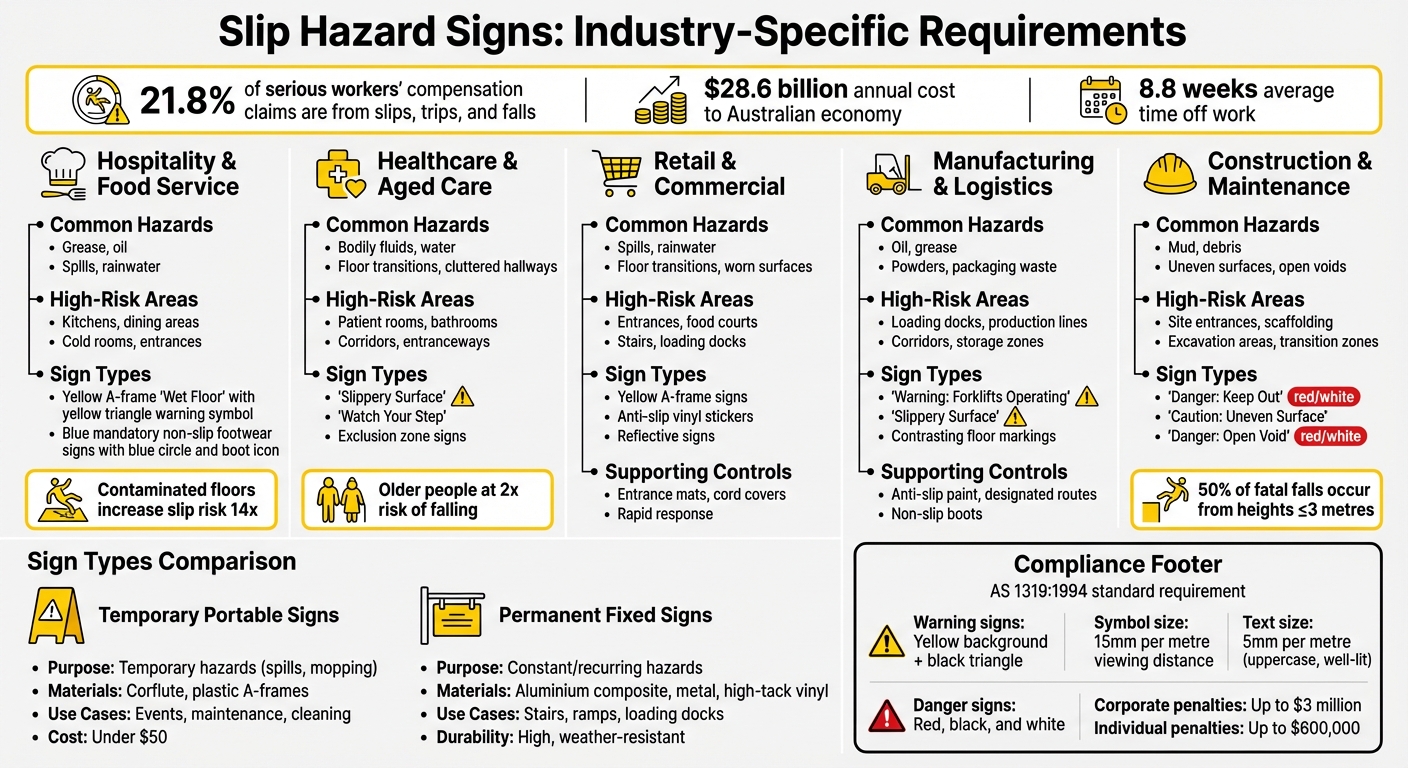
Slip Hazard Signs by Industry: Requirements and High-Risk Areas Comparison
Building on the earlier detailed analysis, the table below compares various industries based on common hazards, high-risk areas, the types of signage required, and the supporting safety measures in place.
| Industry | Common Hazards | High-Risk Areas | Required Signage Types | Supporting Controls |
|---|---|---|---|---|
| Hospitality & Food Service | Spilled liquids, grease, food scraps, cleaning detergents [19][5] | Kitchens, bars, dining areas, restrooms, entryways [19][5] | A-frame "Caution Wet Floor" signs, "Cleaning in Progress" | Non-slip mats, prompt spill cleanup, scheduled cleaning [5] |
| Healthcare & Aged Care | Body fluids, water, floor wax, liquid medications [5] | Patient rooms, corridors, showers, commercial kitchens [19][5] | "Slippery Surface", "Watch Your Step", "Wet Floor" | Non-slip flooring, frequent safety checks, staff training [5] |
| Retail & Commercial | Rainwater at entrances, spilled drinks, trailing cables [19][5] | Entrances, food courts, restrooms, escalators, aisles [19][5] | A-frame "Caution Wet Floor" signs, "Watch Your Step" | Entrance mats, heavy-duty cord covers, rapid response teams [5] |
| Manufacturing & Logistics | Oil, grease, dry powders, stretch wrap, label backing [5] | Loading docks, production lines, aisles, storage zones [5] | "Warning: Forklifts Operating", "Slippery Surface" | Anti-slip paint, designated traffic routes, PPE (non-slip boots) [5] |
| Construction & Maintenance | Mud, wet concrete, debris, uneven surfaces, trailing leads [5] | Site entrances, stairwells, scaffolding, excavation areas [5] | "Danger: Keep Out", "Caution: Uneven Surface" | Site hoarding, proper lighting, stable ladder use [5] |
The table highlights how different industries face unique challenges, requiring tailored signage and controls to address both temporary and ongoing risks effectively. Below, another table outlines the differences between temporary portable signs and permanent fixed signs, demonstrating how each type serves distinct safety needs. Temporary signs are ideal for short-term hazards like spills or maintenance, while permanent signs address risks that are constant or long-term.
| Feature | Temporary Portable Signs | Permanent Fixed Signs |
|---|---|---|
| Purpose | Alerts for temporary hazards (e.g. spills) [19] | Alerts for constant or recurring hazards [18] |
| Use Cases | Mopping, temporary leaks, events, spills [18][19] | Stairs, ramps, outdoor paths, loading docks [18][5] |
| Durability | Lower; designed for mobility and short-term use [18] | High durability [18] |
| Materials | Corflute, plastic A-frames, adhesive labels [18][19] | Aluminium Composite, metal, high-tack vinyl [18] |
Signage design also plays a critical role in ensuring visibility and compliance. For example, warning signs use a yellow background with a black triangle, while danger signs incorporate red, black, and white to highlight life-threatening hazards [17][20]. To ensure proper visibility, symbols must measure at least 15 millimetres per metre of viewing distance, and uppercase text should be a minimum of 5 millimetres per metre in well-lit conditions [18][20]. All signage must adhere to the Australian Standard AS 1319-1994.
These comparisons emphasise the importance of choosing the right signage to manage slip hazards and maintain workplace safety across diverse industries. Tailored solutions are essential for ensuring compliance and protecting workers in Australian workplaces.
Conclusion
Slip hazard signage plays a crucial role in preventing workplace injuries across industries like hospitality, healthcare, retail, manufacturing, and construction. In Australia, slips, trips, and falls result in tens of thousands of injuries each year, many with long-term consequences for workers and businesses alike[1][2]. Clear and effective warning signs help identify potential dangers, reducing the likelihood of incidents before they occur. They are an essential component of workplace hazard communication[21].
The impact of these injuries goes beyond health concerns, exposing businesses to legal and financial risks. Meeting WHS obligations through compliant signage demonstrates a company’s commitment to safety and its duty of care. At under $50, a proper warning sign is a small expense compared to the potential costs of an accident[21].
"The difference between a safe workplace and an accident waiting to happen often comes down to one thing: proper warning signs." – SafetySigns.com.au[21]
Adhering to AS 1319-1994 standards ensures hazards are clearly marked with standardised pictograms and colour coding. In Australia, the yellow triangle with a black border is instantly recognisable and widely understood as a cautionary symbol[21][22][23].
When selecting signage, choose materials suited to the environment. For outdoor areas, Aluminium Composite Panels are durable and weather-resistant, while anti-slip vinyl is ideal for high-traffic indoor spaces[13]. Providers like PXP Safety offer AS 1319-compliant, customisable signs made from robust aluminium with UV protection and high-quality outdoor-grade printing. To maximise effectiveness, place signs strategically, inspect them regularly, and ensure prompt placement around spills or hazards[21].
Incorporating slip hazard signage into workplace safety measures is a practical and cost-effective way to protect employees, visitors, and businesses across Australia.
FAQs
Why are slip hazard signs important for workplace safety in Australia?
Slip hazard signs are essential for ensuring workplace safety in Australia. With slips, trips, and falls being some of the most common causes of workplace injuries, these signs help reduce the risk of serious harm. Injuries such as sprained ankles, knee damage, or back problems can take a long time to recover from, impacting both individuals and businesses. Clear signage acts as a warning system, alerting workers and visitors to dangers like wet floors, uneven ground, or cluttered areas.
Australian workplace health and safety (WHS) laws require businesses to identify and address hazards. By using AS 1319:1994-compliant slip hazard signs, businesses not only meet legal obligations but also ensure their signs are consistent and easy to recognise. PXP Safety offers signs that are built to last, weather-resistant, and can be customised to suit various industries and environments across the country.
What are the best slip hazard signs for different industries in Australia?
Slip hazard signs play a crucial role in ensuring safety across various industries. The design and material of these signs should align with the specific risks and conditions of the environment. Common examples include yellow-and-black warning signs like “Caution – Slippery When Wet” to highlight temporary hazards, and blue-and-white mandatory signs such as “Wear Non-Slip Footwear” to emphasise essential safety measures. For outdoor or high-traffic areas, materials like aluminium or UV-protected polymers are ideal, while lightweight, foldable signs are better suited for temporary indoor spills.
Here’s how different industries can use these signs effectively:
- Construction sites: Heavy-duty aluminium signs with reflective lettering, such as “Slippery When Wet” or “Caution – Wet Concrete,” are ideal for areas like excavation zones and water pits. Additionally, mandatory signs like “Wear Non-Slip Boots” should be placed near tool zones to reinforce safety requirements.
- Hospitality and food service: Portable fold-up signs like “Wet Floor – Caution” are perfect for spills or freshly mopped areas. These signs are easy to set up and remove once the hazard is no longer present.
- Retail and shopping centres: Permanent UV-protected signs, such as “Slippery When Wet,” are well-suited for entrances, escalator landings, and outdoor walkways. In high-traffic areas, larger floor-mounted signs like “Caution – Wet Floor” provide clear visibility to prevent accidents.
PXP Safety offers a range of customisable, durable slip hazard signs tailored to the specific needs of Australian industries. Their high-quality materials ensure compliance, durability, and effectiveness in minimising slip risks.
What are the regulations in Australia for using slip hazard signs?
Australian workplace health and safety laws require businesses to address slip and trip hazards as far as reasonably practicable. When these risks can’t be fully removed, it’s mandatory to use clearly visible slip hazard signs to alert workers and visitors to potential dangers like wet floors or uneven ground. This is a fundamental requirement under national WHS laws.
In Australia, slip hazard signs must adhere to AS 1319:2004, the national standard for safety signage. This means they must feature a yellow background with black symbols or text, meet specific size and font requirements, and be durable enough to withstand Australia’s outdoor conditions. Failing to comply with these standards can lead to legal penalties and increased liability for businesses.
Choosing a trusted supplier, such as PXP Safety, can help businesses stay compliant. PXP Safety offers aluminium-based signage with UV protection that meets AS 1319 standards, ensuring the signs are durable, effective, and suitable for maintaining safety in Australian workplaces.
Related Blog Posts
You may also be interested in
FAQs About Workplace Safety Signs in Australia
AS 1319 sign types, placement, materials and maintenance for workplace safety and WHS compliance in Australia.
Restricted Area Signs vs. No Entry Signs
Compare No Entry and Restricted Area signs in Australian workplaces — meanings, design differences and AS 1319 compliance.
How to Spot Workplace Signage Gaps
Audit your workplace for missing, faded or non‑compliant signs under AS 1319 to reduce incidents and avoid WHS fines.
Symbol Design: Global Standards Explained
Explains ISO 7010 and ISO 3864: standard symbols, colours and sizing for clear, language‑free safety signage and AU compliance.
Hazard Sign Visibility Planner
Plan hazard sign placement for max visibility with our free tool. Ensure safety by finding the best spot, height, and angle—try it now!