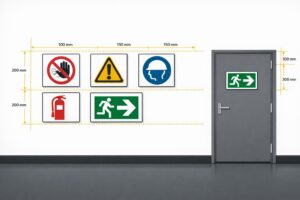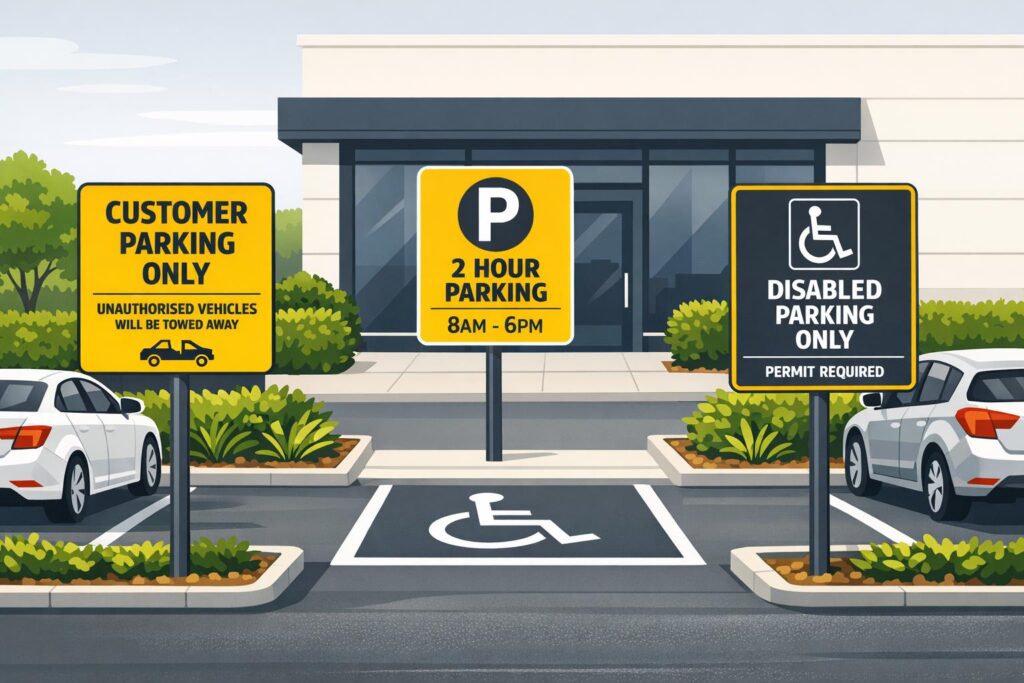
Mandatory Parking Signs for Businesses
Parking signs are not just a formality – they’re a legal requirement for Australian businesses. They help manage traffic, ensure safety, and meet compliance standards. Without proper signage, businesses risk legal issues, disputes, and unauthorised vehicle problems. Here’s what you need to know:
- National Standards: Comply with AS 1742.11 (parking controls), AS 2890 (parking facilities), and AS 1428.1 (disability access).
- State-Specific Rules: Check local council regulations (e.g., Queensland’s MUTCD).
- Private Parking Rules: Clearly outline conditions, avoid government-style designs, and use distinct colours.
- Accessibility: Disabled parking signs must follow strict standards and include the International Symbol of Access.
- Materials: Use durable materials like aluminium with UV and anti-graffiti coatings for longevity.
- Placement: Signs should be visible, placed at entry points, and mounted at 1,200–1,900 mm height.
- Maintenance: Regular inspections are essential to keep signs readable and compliant.
Proper signage ensures smooth parking management, reduces disputes, and keeps your business on the right side of the law.
Regulatory Requirements for Parking Signs
Australian Standards and State Rules
When installing parking signs, it’s essential to adhere to key national standards. AS 1742.11 outlines parking control requirements; AS 2890.1 and AS 2890.5 cover off-street and on-street parking specifics; and AS 1743 provides manufacturing guidelines [2][4][5][6]. For accessible parking, compliance with AS 1428.1 is mandatory [2].
Keep in mind that state-specific rules may apply. For instance, Queensland follows its own Manual of Uniform Traffic Control Devices (MUTCD), which aligns with Australian Standards but includes unique amendments. One example is the requirement to use "motor bikes" instead of "motor cycles" on parking signs [6]. Before installing signage, consult your local council to confirm any state-specific regulations and determine if additional approvals are necessary.
Aside from meeting technical standards, private signage must also comply with legal requirements to ensure enforceability.
Legal Requirements for Private Parking Signs
Private parking signs function as a contract between the property owner and motorists. According to the Queensland Department of Transport and Main Roads:
The conditions on a sign form the basis of the contract between the property owner and occupier and the motorist. The owner and occupier’s right to remove vehicles is generally defined by signs [3].
It’s crucial that your signs do not mislead or confuse motorists about parking conditions or the penalties for breaching those conditions [3]. Private parking signs must not resemble official government designs – steer clear of red and white layouts, government fonts, or regulatory symbols. Instead, use distinct colours like blue, green, or yellow to differentiate private signage [7].
If you intend to tow unauthorised vehicles, your signs must clearly outline the towing process. Include details such as the "Tow Away" symbol, contact information for the towing company, and – in Queensland – the maximum allowable towing and storage fees [3][6]. Using fake "No Stopping" or "No Parking" signs that mimic official government signage can result in hefty fines, removal orders from councils, and potential legal issues [7]. Ignoring these requirements could lead to invalid enforcement and costly retrofitting [7][8].
Checklist: Required Parking Signs for Businesses
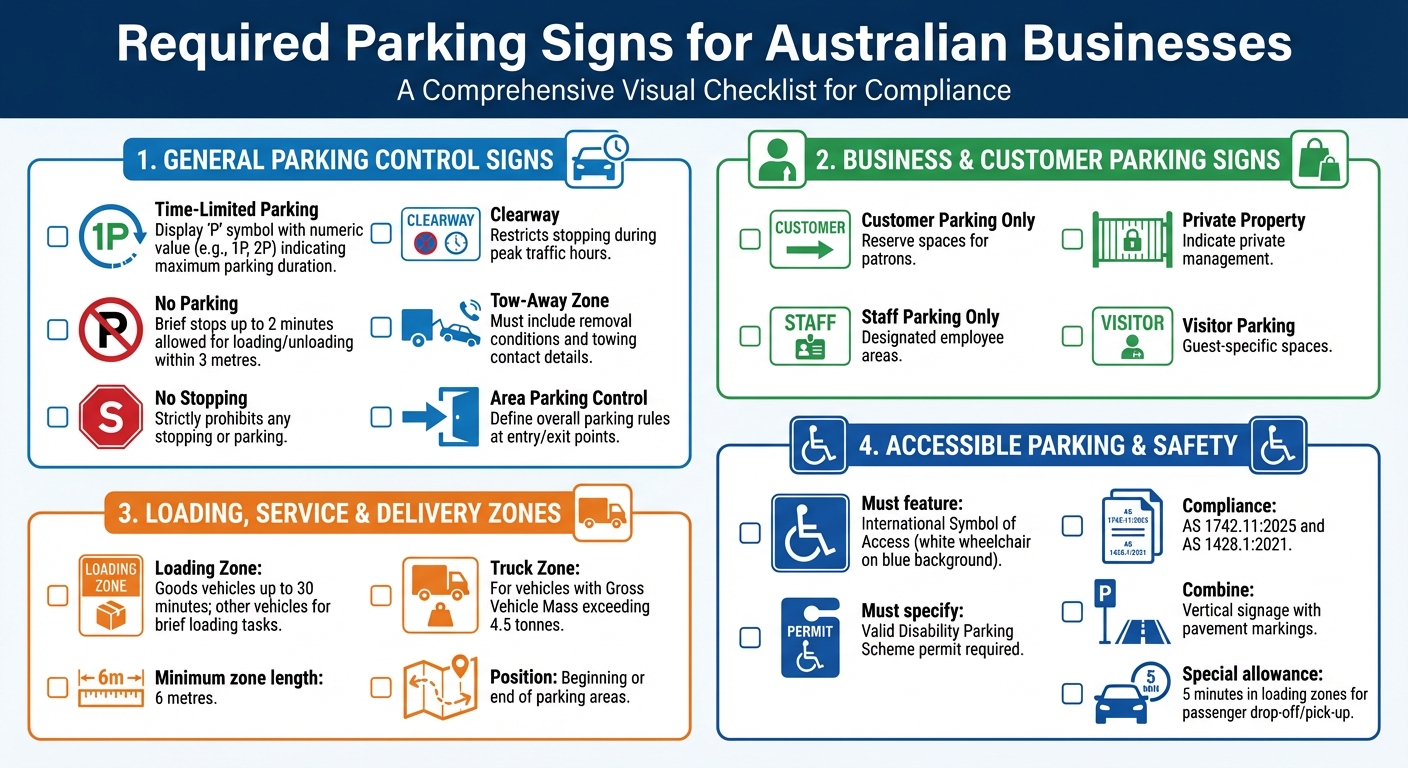
Essential Parking Signs Required for Australian Businesses Compliance Checklist
To meet regulatory and legal standards, businesses must implement appropriate signage to ensure parking compliance and smooth operations.
General Parking Control Signs
Time-limited parking signs are essential for managing turnover. These signs typically feature a numeric value alongside a "P" (e.g., 1P or 2P), indicating the maximum parking duration allowed [1] [10]. No Parking signs permit drivers to stop briefly – up to two minutes – for loading or unloading passengers or goods, as long as they stay within three metres of the vehicle [9] [10]. No Stopping signs, on the other hand, strictly prohibit any stopping or parking to maintain traffic flow and improve safety. Similarly, Clearway signs restrict stopping during peak traffic hours in busy zones [1] [9].
For private parking areas, Tow-Away Zone signs must clearly outline the removal conditions and provide towing contact details [6] [3]. In larger parking facilities or business precincts, Area Parking Control signs at entry and exit points are crucial for defining the overall parking rules [6].
Business and Customer Parking Signs
Privately managed parking areas require clear and straightforward signage, such as "Customer Parking Only" or "Private Property", to reserve spaces for patrons and indicate private management. This clarity is critical, as the Queensland Department of Transport and Main Roads explains:
The conditions on a sign form the basis of the contract between the property owner and occupier and the motorist [3].
These signs play a key role in ensuring effective parking management for both businesses and customers.
Loading, Service, and Delivery Zone Signs
Loading Zone signs designate areas for vehicles involved in loading or unloading goods or passengers. Goods vehicles are generally allowed up to 30 minutes, while other vehicles should only stop briefly to perform their tasks [9]. For heavier vehicles, Truck Zone signs are designed for those with a Gross Vehicle Mass exceeding 4.5 tonnes, ensuring appropriate access and parking [9]. These zones should be positioned at the beginning or end of parking areas and span a minimum of six metres to accommodate larger vehicles [6].
Accessible Parking and Safety Signs
Accessible Parking signs must feature the International Symbol of Access – a white wheelchair on a blue background – and specify that the spaces are reserved for vehicles displaying a valid Disability Parking Scheme permit [11] [10]. These spaces must comply with Australian Standards AS 1742.11:2025 and AS 1428.1:2021 [2]. To enhance visibility, it is advisable to combine vertical signage with pavement markings that clearly outline the parking bay boundaries [6] [10]. Additionally, vehicles with disability permits are permitted to stop in designated loading zones for up to five minutes to drop off or pick up passengers [11].
These signage requirements form the foundation for ensuring compliance, accessibility, and safety in parking areas.
sbb-itb-9950c92
Sign Design, Placement, and Maintenance Guidelines
Design and Material Standards
Parking signs in Australia must adhere to the AS 1742 series, particularly Part 11, which addresses parking controls, and AS 1743, which outlines road sign specifications [4][5]. According to the Queensland Department of Transport and Main Roads, only manufactured signs meet the necessary authority and legibility standards, while hand-written signs fall short [3].
The choice of materials plays a key role in ensuring signs can endure harsh conditions. Durable materials are essential to withstand strong winds and prolonged UV exposure [3]. For restrictions applicable at night, signs should either be illuminated or made with reflective materials that comply with AS/NZS 1906.1 standards [4]. High-contrast colour combinations, such as black text on a white background or vice versa, are critical for visibility [3]. Mixed-case fonts are easier to read than all-capital letters, and the inclusion of clear symbols – like a tow truck icon – can help convey messages quickly, even for those with language or literacy challenges [3]. Once a well-thought-out design is in place, proper placement ensures these signs achieve their intended purpose.
For businesses, PXP Safety offers parking signs crafted from robust aluminium with UV-protective film and outdoor solvent printing. These signs are built to endure Australian weather conditions, meet compliance standards, and can be customised to suit specific requirements.
Placement and Visibility
Even the best-designed sign is ineffective if it isn’t positioned correctly. Parking signs should be prominently displayed at every vehicle entry point, facing oncoming traffic [3]. In car parks, repeating signs at intervals ensures drivers are consistently reminded of parking restrictions for individual spaces [3]. Positioning signs at a height of 1,200 mm to 1,900 mm allows for optimal viewing [3], and they should be legible from at least 20 metres away [3].
For on-street parking, placing signs on the "far side" (after an intersection) is preferred, especially near pedestrian crossings, to avoid being obscured by stationary vehicles [6]. In areas marked as "No Stopping" – such as near school crossings where violations are common – vertical signs can be reinforced with diagonal pavement markings to enhance visibility [6].
Maintenance Best Practices
Regular maintenance is critical to keeping signs compliant and readable. Inspections should be conducted frequently to check for damage, fading, or obstructions [1][12]. Any issues should be addressed within seven days to maintain legal enforceability and reduce potential disputes [3].
Anti-graffiti coatings can help signs maintain a professional appearance, even in areas prone to vandalism [1]. Additionally, it’s essential to periodically cross-reference signage with the latest Australian Standards – AS 1742.11:2025 for parking controls and AS 1743:2023 for road sign specifications – to ensure ongoing compliance [4][5].
Conclusion
This checklist has covered the key requirements for ensuring parking signage compliance for Australian businesses. Ignoring these standards can lead to legal troubles and operational headaches. On the other hand, following the guidelines set out in Australian Standards – like AS 1742.11 (updated in 2025)[4] – helps ensure your signs are enforceable, strategically designed for effective parking management, and remain functional with proper upkeep.
For businesses looking to meet these compliance standards, expert solutions are available. PXP Safety offers durable parking signs made from sturdy aluminium, featuring UV-protective film and outdoor solvent printing. They also provide customisation options to suit specific needs, such as "Staff Parking Only", "Visitor Parking", or "Electric Vehicle Charging."
FAQs
What happens if my business doesn’t have the required parking signs?
Not having the correct mandatory parking signs in place can lead to serious issues for your business. It might violate the Road Safety Act and Australian Standard AS 1742.11, leaving you open to fines, legal complications, and heightened safety risks in your car park.
Without these signs, managing traffic flow becomes harder, pedestrian safety can be compromised, and unauthorised parking may become a persistent problem. Meeting these standards not only helps you stay compliant but also ensures a safer and more organised space for your business, employees, and customers.
What do I need to do to ensure my private parking signs comply with Australian regulations?
To ensure your private parking signs meet Australian regulations, they need to align with AS 1742 (Manual of Uniform Traffic Control Devices). This standard covers critical aspects like sign size, colours, reflective finishes, and wording. Additionally, if the parking area is accessible to the public, AS 2890.5:2020 applies, detailing requirements for dimensions, clearances, and visibility.
Here’s how to stay compliant:
- Check local regulations: Local councils and states may have additional rules, so it’s essential to confirm these before proceeding.
- Design with clarity: Use a white background with a red border, clear symbols, and simple wording. For example, “PRIVATE PARKING – NO UNAUTHORISED VEHICLES” is both direct and compliant.
- Select durable materials: UV-protected aluminium with a reflective coating ensures your signs remain visible and withstand harsh weather conditions.
- Install properly: Mount signs at the correct height and inspect them regularly to keep them legible and in line with standards.
For a smooth process, consider working with a professional like PXP Safety, which specialises in creating signs that adhere to Australian Standards and local guidelines. This ensures your signage is not only compliant but also built to last.
What materials are best for parking signs to withstand Australian weather?
For parking signs to withstand Australia’s unpredictable climate, aluminium is often the go-to choice. Its resilience against rust and ability to endure extreme weather make it ideal for outdoor use. When paired with UV protection and outdoor-grade printing, aluminium signs maintain their clarity and durability even under intense sunlight and fluctuating temperatures.
Although Australian standards like AS 1742 and AS 2890.5 outline requirements for aspects such as design, size, and reflectivity, they don’t specify the materials to be used. Opting for top-quality, weather-resistant materials not only helps meet these standards but also ensures your signs remain functional and dependable for years, offering excellent value for your business.
Related Blog Posts
You may also be interested in
FAQs About Workplace Safety Signs in Australia
AS 1319 sign types, placement, materials and maintenance for workplace safety and WHS compliance in Australia.
Restricted Area Signs vs. No Entry Signs
Compare No Entry and Restricted Area signs in Australian workplaces — meanings, design differences and AS 1319 compliance.
How to Spot Workplace Signage Gaps
Audit your workplace for missing, faded or non‑compliant signs under AS 1319 to reduce incidents and avoid WHS fines.
Symbol Design: Global Standards Explained
Explains ISO 7010 and ISO 3864: standard symbols, colours and sizing for clear, language‑free safety signage and AU compliance.
Hazard Sign Visibility Planner
Plan hazard sign placement for max visibility with our free tool. Ensure safety by finding the best spot, height, and angle—try it now!