Australian Standards for Warehouse Exit Signs
In Australia, exit signs in warehouses aren’t just a safety measure – they’re a legal requirement. These signs ensure safe evacuation during emergencies like power outages or fires. Compliance with the AS/NZS 2293 series is mandatory, as referenced in the National Construction Code (NCC). Key points include:
- Standards Overview:
- AS/NZS 2293.1: System design, installation, and operation.
- AS/NZS 2293.2: Maintenance and routine servicing.
- AS/NZS 2293.3: Construction and performance of signs.
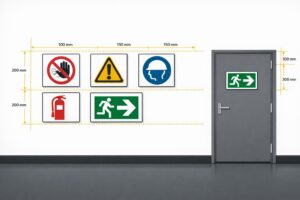
- Placement Rules: Signs must be mounted 2–2.7m above the floor or above doorways over 2.7m high. They must be visible along evacuation routes.
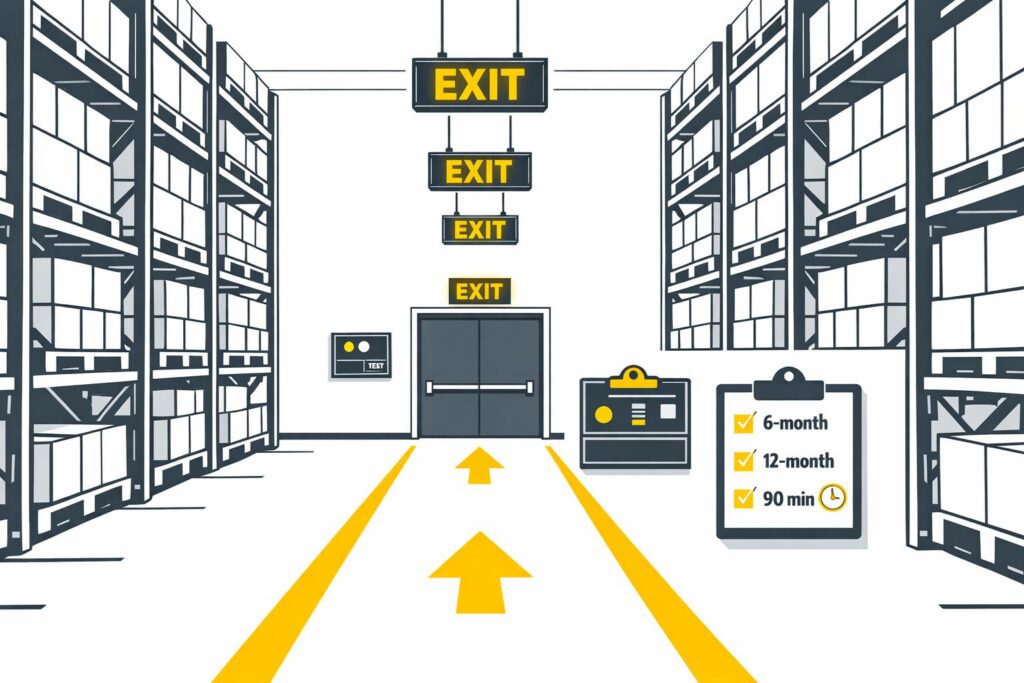
- Maintenance: Inspections every 6 and 12 months are required, including a 90-minute battery test. Records must be kept for 7 years.
- Non-Compliance Penalties: Breaches can result in fines reaching millions of dollars, legal liability, and reputational harm.
For warehouses with complex layouts, tailored signage solutions may be necessary to meet these requirements. Providers like PXP Safety offer compliant, durable options designed for industrial environments.
Exit Signs and Emergency Egress Lighting
sbb-itb-9950c92
AS/NZS 2293: Emergency Lighting and Exit Sign Systems
The AS/NZS 2293.1:2018 standard is a critical component of the AS/NZS 2293 series, specifically addressing the installation of emergency lighting and exit signs in warehouses. These are among the essential safety signs required for regulatory compliance. This standard applies to central battery systems, single-point systems, and self-contained systems that activate automatically during power outages. These specifications align with the safety objectives of the broader AS/NZS 2293 series. A single-user licence for AS/NZS 2293.1:2018 is priced at $242.18 AUD [2].
Design and Installation Requirements
Exit signs must be strategically placed to remain visible along evacuation routes. According to Section 5.8.1 of the standard, these signs must be installed at a height between 2m and 2.7m above the floor. If a doorway exceeds 2.7m in height, the sign should be mounted directly above it. The regulation states:
"Exit signs shall be mounted not less than 2m and not more than 2.7m above floor level, or immediately above the doorway if the doorway is higher than 2.7m, unless variations to these heights are specifically permitted by the relevant regulatory authority." [3]
In cases where the layout makes visibility challenging, larger signs may be required, with any deviations in height needing approval from local authorities [3]. The primary goal is to ensure clear visibility along evacuation routes.
Once installed, these systems must undergo regular maintenance to ensure functionality during emergencies.
Illumination and Maintenance Requirements
System reliability is essential, particularly during power failures when exit signs are meant to activate automatically [6]. While AS/NZS 2293.1:2018 focuses on design and installation, the AS/NZS 2293.2:2019 standard (available for $149.01 AUD [5]) outlines maintenance requirements. This includes mandatory inspections every 6 and 12 months, which involve a 90-minute battery test to verify emergency capacity, as well as cleaning to remove dust, dirt, and insects. Maintenance records must be retained for seven years [4].
To streamline maintenance, warehouse operators should document baseline information for each exit sign, such as a unique identifier (e.g., EX1), installation date, and location details [4]. Additionally, since smoke can hinder the effectiveness of emergency lighting, proper ventilation or construction methods should be employed to keep escape routes clear [3].
Placement and Visibility Guidelines
Expanding on the earlier discussion about installation and maintenance, this section dives into practical steps for sign placement and maintaining visibility in warehouse settings. While the technical standards were covered before, here we’ll address the specific challenges warehouses face when ensuring signs remain visible.
Mounting Height and Placement Rules
According to AS/NZS 2293.1, exit signs should be mounted between 2 metres and 2.7 metres above the floor, or directly above doorways that exceed 2.7 metres in height. These signs must be positioned at all designated exits, staircases, and critical locations to guarantee they’re easily seen. If visibility is blocked by racking systems, machinery, or stored goods, facility managers need to reassess the placement. This might involve opting for larger signs or consulting with regulatory authorities to approve alternative mounting heights [3].
These rules are designed to complement the sign’s features, ensuring they remain functional and visible in emergencies.
Design Specifications for Visibility
Exit signs must feature a green background, a white running-man pictogram, and directional arrows for clear guidance [3]. Paired with illumination systems that activate during power outages, these design elements ensure visibility in a variety of lighting conditions. Regular physical inspections are critical to confirm that dust, dirt, or insects haven’t obscured the signs. Additionally, new shelving, stock, or other potential obstructions should be checked to ensure they don’t block visibility. Keeping a detailed register of each sign’s unique identifier and location simplifies visibility audits and ensures compliance [4].
National Construction Code (NCC) Requirements
The National Construction Code (NCC) Volume One Part E4 sets the standards for exit signs in Australian warehouses, outlining performance requirements, while AS/NZS 2293.1 provides the technical guidelines for their design and installation. Together, these ensure that exit signs are effective during emergencies and meet legal compliance.
Under the NCC’s performance requirement EP4.2, exits must be identified "to the degree necessary to facilitate safe evacuation" [7]. For warehouses – classified as Class 7b or 8 buildings – this requirement depends on factors like floor area, fire load, and the distance occupants need to travel to reach an exit [7]. Importantly, the NCC acknowledges that different buildings have varying needs when it comes to emergency visibility. As the Code explains:
"The BCA recognises that not all buildings need the same level of visibility in an emergency… Any decision made in this context can extend to not requiring an item to be installed… if that is the appropriate action to be taken" [7].
This approach ensures that warehouse exit signage is not only compliant but also tailored to support safe evacuations effectively.
Mandatory Exit Signs and Exemptions
The NCC outlines specific requirements for the placement and operation of exit signs in warehouses. These include:
- Installing exit signs above every door leading to a required exit, at fire-isolated stairway doors, and at points where exits discharge to roads or open spaces [9][10].
- Ensuring the system operates automatically for at least 90 minutes during a power failure, reaching 10% of required light output within 1 second and 80% within 15 seconds [7][9].
Certain exemptions are also provided under the NCC. For example, internal areas of sole-occupancy units in Class 2, 3, or 9c buildings, or Class 4 parts of a building, may not require exit signage [7]. Additionally, low-occupancy warehouses with ample natural light, short travel distances, and workers who are familiar with the layout may qualify for reduced signage, though this usually requires professional certification [7]. Directional exit signs with arrows are mandatory in cases where the path to an exit isn’t immediately clear or visible [7][10].
For photoluminescent exit signs, specific requirements include:
- Maintaining a continuous charge using a 100 lux light source directed at the sign face.
- Ensuring the light source has a colour temperature of at least 4000 K.
- Limiting the maximum viewing distance to 24 metres.
- Using pictograms that are 1.3 times larger than those on standard electric signs [8][10].
These guidelines ensure that exit signage in warehouses is both practical and effective in guiding occupants to safety during emergencies.
Compliance Requirements for Warehouses
Legal Obligations and Penalties
Warehouse operators in Australia must adhere to strict regulations outlined in the Work Health and Safety (WHS) legislation and the National Construction Code. A key requirement is the installation of emergency escape lighting and exit signs that automatically activate in the event of a lighting failure. These systems are governed by specific standards: system design and installation (AS/NZS 2293.1), routine servicing and maintenance (AS/NZS 2293.2), and the physical construction of the signs (AS/NZS 2293.3) [1][5][11]. Compliance with these standards is non-negotiable.
Failing to meet these obligations can lead to severe repercussions. In states like Victoria and Western Australia, breaches of Occupational Health and Safety (OH&S) laws concerning emergency lighting are treated as indictable offences [3]. As highlighted by Elumen [3]:
"Breaches of Occupational Health and Safety (OH&S) laws are treated as indictable offenses. Non-compliance can result in hefty penalties and fines, which can vary depending on the number of affected lights and the severity of the breach." – Elumen [3]
Penalties can include fines running into millions of dollars and legal accountability for injuries or delays in evacuation caused by non-compliance [3].
To ensure compliance, warehouses must establish a documented schedule for regular testing and cleaning of emergency lighting systems as mandated by AS/NZS 2293.2:2019. Records of these tests must be kept for at least seven years [4]. Additionally, when procuring exit signs, ensure they align with the design and performance standards in AS/NZS 2293.3:2018. For LED signs, compliance with measurement standards such as IES LM-79 and IES LM-80 is essential [1].
Given the complexity of these requirements, warehouses often need tailored approaches to meet their specific operational needs.
Custom Solutions for Warehouse Safety
Warehouses frequently face unique challenges in meeting compliance standards, particularly due to factors like high shelving, intricate layouts, or harsh industrial conditions. For example, standard mounting heights for exit signs (2 m to 2.7 m) may not be practical in spaces with tall racking or other obstacles. In such cases, larger signs can be used to ensure visibility remains within the occupants’ line of sight [3]. For outdoor areas or loading docks, weather-resistant materials are crucial.
Companies like PXP Safety specialise in creating customised signage solutions for warehouses. Their signs, crafted from durable aluminium with UV protection and outdoor-grade printing, are designed to endure tough environments. Whether it’s directional signs for long corridors, oversized signs for high ceilings, or bespoke designs to align with a facility’s safety protocols, tailored solutions help warehouses comply with AS/NZS standards while addressing their unique challenges.
Exit Sign Types for Warehouses
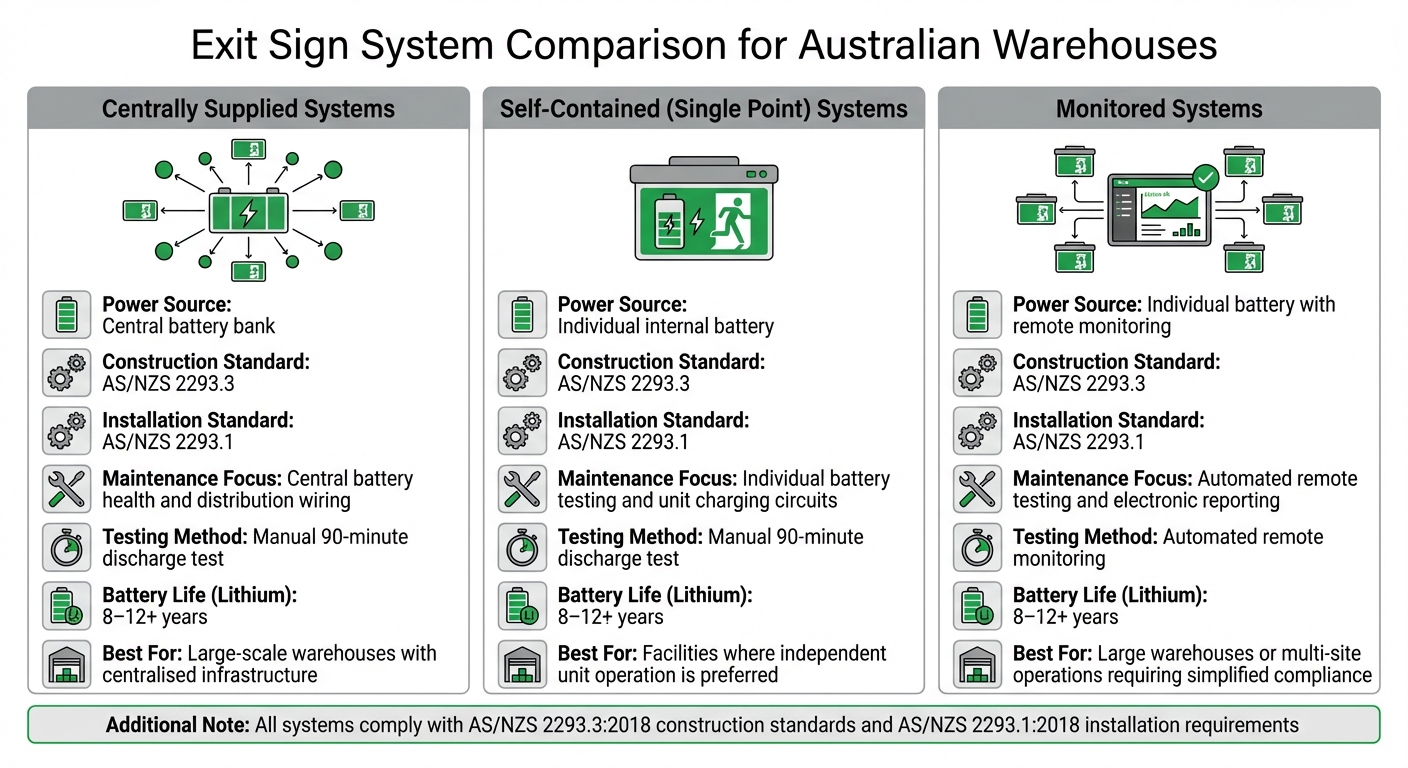
Australian Warehouse Exit Sign Systems Comparison: Centrally Supplied vs Self-Contained vs Monitored
Warehouses in Australia primarily rely on two types of exit sign systems: centrally supplied systems and self-contained (single point) systems. Centrally supplied systems are powered by a central battery bank, making them a good fit for large-scale warehouses with an established electrical setup. On the other hand, self-contained systems operate independently with an internal battery and charging unit, ensuring functionality during power outages [1][2].
Both options adhere to the standards outlined in AS/NZS 2293.3:2018 and are installed following AS/NZS 2293.1:2018 [1][2]. Modern LED exit signs also comply with IES LM-79 and LM-80 standards, ensuring long-term visibility – a crucial aspect for emergencies.
For environments requiring added flexibility, monitored systems provide automated testing and electronic reporting, simplifying compliance with the maintenance requirements of AS/NZS 2293.2:2019. These systems often utilise lithium batteries, which last 8 to 12+ years and can cut maintenance costs by 50% to 80% compared to older NiCD batteries [4]. However, compatibility is key – replacing a monitored fitting with a standard one can lead to errors and potential compliance issues [4]. The table below highlights the key differences among these systems.
Exit Sign Comparison Table
| Feature | Centrally Supplied Systems | Self-Contained (Single Point) Systems | Monitored Systems |
|---|---|---|---|
| Power Source | Central battery bank | Individual internal battery | Individual battery with remote monitoring |
| Standard (Construction) | AS/NZS 2293.3 | AS/NZS 2293.3 | AS/NZS 2293.3 |
| Standard (Installation) | AS/NZS 2293.1 | AS/NZS 2293.1 | AS/NZS 2293.1 |
| Maintenance Focus | Central battery health and distribution wiring | Individual battery testing and unit charging circuits | Automated remote testing and electronic reporting |
| Testing Method | Manual 90-minute discharge test | Manual 90-minute discharge test | Automated remote monitoring |
| Battery Life (Lithium) | 8–12+ years | 8–12+ years | 8–12+ years |
| Suitability | Large-scale warehouses with centralised infrastructure | Facilities where independent unit operation is preferred | Large warehouses or multi-site operations requiring simplified compliance |
The choice of system depends on warehouse size, layout, and operational needs. For example, centrally supplied systems suit facilities with centralised infrastructure, while self-contained systems are ideal for locations prioritising independent operation. Monitored systems are particularly useful for large or multi-site operations, streamlining compliance and reducing maintenance demands.
Practical considerations also play a role. PXP Safety offers tailored signage solutions made from durable aluminium with UV protection and outdoor-grade printing, designed to withstand harsh industrial conditions. Whether it’s oversized signs for high ceilings, weather-resistant options for loading docks, or directional signs for complex layouts, custom solutions ensure compliance with AS/NZS 2293.3:2018 while adapting to the unique challenges of warehouse environments [1].
Conclusion
Meeting Australian Standards for warehouse exit signs isn’t just a recommendation – it’s a strict legal obligation enforced by the National Construction Code (NCC) and Work Health and Safety (WHS) laws. Compliance with AS/NZS 2293 covers everything from system design and installation to regular maintenance and specific construction standards for luminaires. Businesses must ensure exit signs are installed at the correct heights, undergo routine testing, and maintain accurate records. These measures are crucial, given the serious consequences of failing to comply.
Non-compliance carries hefty penalties. In states like Victoria and Western Australia, breaches are classified as indictable offences, with fines potentially reaching millions of dollars for multiple violations[3]. Beyond the financial impact, non-compliance can increase liability risks and compromise safety during emergencies, making it essential for organisations to implement thorough internal audits and dynamic safety protocols.
To stay compliant, businesses need to take a proactive approach. This includes regular safety checks, maintaining comprehensive records for each fitting, and ensuring that exit paths remain clearly marked, even after changes to the warehouse layout[4]. For warehouses with complex layouts – like those with high ceilings, loading docks, or multi-level storage – customised safety solutions may be necessary to address unique challenges.
PXP Safety offers exit signs designed to meet the demands of industrial environments while adhering to AS/NZS 2293.3:2018 standards. Their signs, crafted from durable aluminium with UV protection and outdoor-grade printing, are built to endure harsh conditions. Whether your facility requires oversized signs for better visibility, weather-resistant options for outdoor areas, or custom designs to fit your warehouse layout, PXP Safety provides tailored solutions to help you stay compliant and maintain a safe environment.
FAQs
Do my warehouse areas qualify for any NCC exit sign exemptions?
Warehouse spaces might not need to install exit signs if they meet certain criteria set out in standards like AS/NZS 2293.1 and AS/NZS 2293.3. Eligibility largely depends on factors such as the size of the building, its layout, and the type of occupancy. To determine if these exemptions apply, it’s crucial to thoroughly review these standards alongside local regulations.
How do I know if I need larger or additional exit signs for visibility?
To figure out if you need larger or extra exit signs, refer to Australian Standard AS2293.1. According to this standard, exit signs should be installed between 2 m and 2.7 m above the floor level. For doorways higher than 2.7 m, the signs should be placed above the doorway.
When assessing your building, take into account factors like the layout, ceiling height, and any obstructions that might block visibility. If the signs can’t be easily seen from all angles or distances, you may need to install bigger signs or add extra ones to ensure both safety and compliance with the standards.
What records do I need to keep to prove AS/NZS 2293 compliance?
To meet the requirements of AS/NZS 2293, it’s crucial to keep detailed records of all routine service and maintenance tasks. These records should include information such as inspection dates, test outcomes, any repairs or replacements carried out, and reports on the overall system condition. This aligns with the guidelines set out in AS/NZS 2293.2:2019 and AS/NZS 2293.1:2018.
Related Blog Posts
You may also be interested in
FAQs About Workplace Safety Signs in Australia
AS 1319 sign types, placement, materials and maintenance for workplace safety and WHS compliance in Australia.
Restricted Area Signs vs. No Entry Signs
Compare No Entry and Restricted Area signs in Australian workplaces — meanings, design differences and AS 1319 compliance.
How to Spot Workplace Signage Gaps
Audit your workplace for missing, faded or non‑compliant signs under AS 1319 to reduce incidents and avoid WHS fines.
Symbol Design: Global Standards Explained
Explains ISO 7010 and ISO 3864: standard symbols, colours and sizing for clear, language‑free safety signage and AU compliance.
Hazard Sign Visibility Planner
Plan hazard sign placement for max visibility with our free tool. Ensure safety by finding the best spot, height, and angle—try it now!