How to Choose Speed Limit Signs for Car Parks
Speed limit signs in car parks are critical for safety, helping to reduce accidents between vehicles and pedestrians. In Australia, these signs must meet specific standards, including AS 1742.4 and AS 2890.1, which regulate their design, placement, and visibility. Here’s a quick guide to selecting the right signs:
- Regulatory vs Advisory Signs: Regulatory signs (white circle, red border) are enforceable on public roads, while advisory signs (black and white) are suitable for private car parks.
- Speed Limits: Shared zones typically use 10 km/h, while private car parks range from 5–20 km/h based on layout and risks.
- Material: Aluminium with reflective sheeting ensures durability and visibility in all lighting and weather conditions.
- Placement: Signs should be visible, unobstructed, and positioned at key areas like entrances, intersections, and near hazards.
Follow these steps to improve safety and compliance in your car park. Let’s explore the standards, materials, and placement strategies in more detail.
Australian Standards and Regulations for Speed Limit Signs
AS 1742 Standards for Speed Limit Signs
In Australia, AS 1742.4:2020 is the key standard governing traffic control devices used to regulate vehicle speeds. It outlines the design and functionality of speed limit signs [4]. This is further supported by AS 1742.1:2021, which provides the general framework for essential safety signs, covering aspects like colour coding, shapes, and numbering systems [5].
For off-street parking facilities, AS 2890.1 complements AS 1742, ensuring consistent signage in car parks [1]. Additionally, AS 1743:2023 addresses the construction of signs, including materials, dimensions, and retroreflectivity. Retroreflective sheeting, as specified in AS/NZS 1906.1:2007, ensures visibility in low-light conditions, particularly important in covered or underground car parks [4][5].
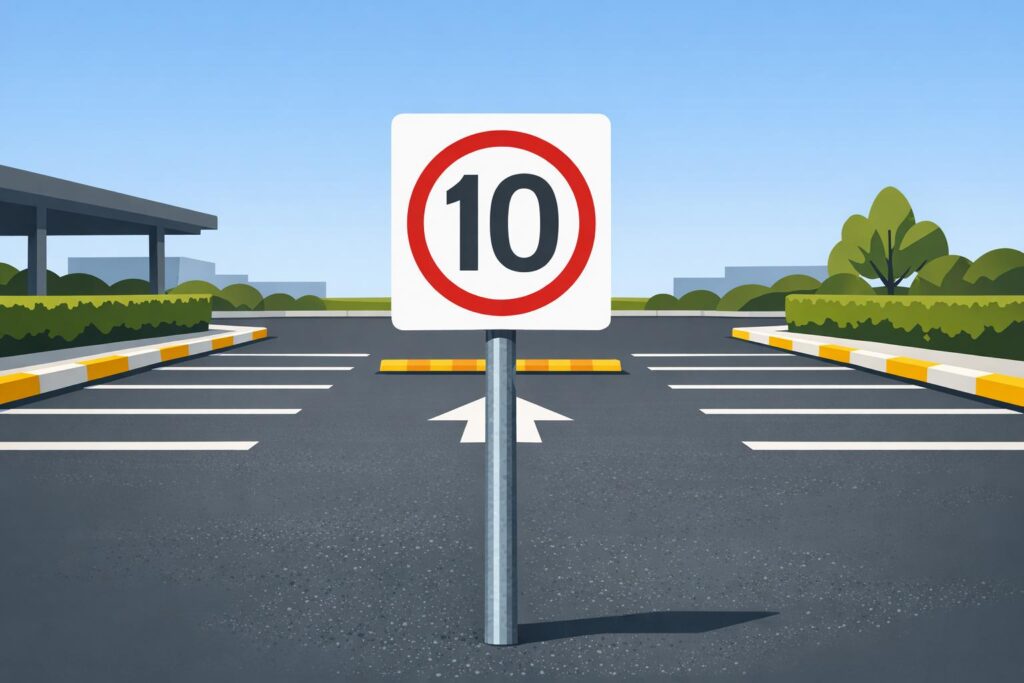
Regulatory speed limit signs feature a bold black numeral on a white circle with a thick red border [1]. Speed limits are generally set in increments of 10 km/h (e.g., 10, 20, 30, 40), though South Australia occasionally uses 25 km/h zones [1][6]. In private car parks, black and white signs are typically advisory rather than enforceable but adhere to standard design principles [1].
Local Council Requirements for Private Car Parks
Local councils play a significant role in setting speed limits for private car parks. While AS 1742 provides the design framework, councils determine specific limits, often 10 km/h or 20 km/h, depending on pedestrian activity and the layout of the car park [1]. In shared zones – spaces where pedestrians and vehicles share the area – the speed limit is set at 10 km/h, requiring specific rectangular black and white "Shared Zone" signs [1][6][7].
To make a speed limit legally enforceable, the signage must be approved by the relevant state or territory transport department. Signs installed on private property without such authorisation are considered advisory, promoting safe driving but not carrying legal penalties [1]. For compliance, consult state-specific guidelines, such as NSW’s Traffic Control at Worksites or Queensland’s Speed Management Framework, to align with local requirements.
sbb-itb-9950c92
What to Consider When Choosing Speed Limit Signs
When selecting speed limit signs, it’s essential to go beyond regulations and local requirements, considering practical factors like car park conditions, visibility, and durability.
Setting Speed Limits Based on Car Park Conditions
The layout of a car park and the number of pedestrians greatly influence speed limits. For example, areas with high foot traffic, such as shopping centres and hospitals, often require a 10 km/h speed limit to ensure safety[8].
Aisle width is another critical factor. Aisles should be at least 6,000 mm wide, with 6,500 mm preferred in busy areas. A Frankston shopping centre faced significant costs – losing 40 bays and spending approximately $12,000 – due to an aisle width of 5,500 mm instead of the recommended 6,000 mm[8].
Sight lines also affect safe driving speeds. Drivers need a clear view of at least 15–20 metres at intersections in low-speed areas[8]. If obstacles like columns or vegetation block visibility, solutions include installing convex mirrors or lowering speed limits. Multi-level car parks with steep ramps (maximum gradient of 1:6 for straight ramps) also require lower speed limits, especially in wet conditions, to maintain vehicle stability[8].
Once speed limits are set, ensuring clear and visible signage becomes the next priority.
Visibility: Sign Placement and Design
For drivers to easily read speed limit signs, the design must prioritise clarity. High-contrast visuals with a luminance ratio of 12:1 between text and background are ideal[9]. In urban car parks, where glare and visual distractions are common, sign luminance may need to range from 700 to 1,700 cd/m², compared to just 35 cd/m² in rural settings[9].
Placement is equally important. Signs should be positioned to avoid obstructions, such as parked vehicles, and placed at least 9 metres (30 feet) away from intersections or parking spots for optimal visibility[10]. Drivers also process only short messages, so signs should be limited to 3–4 concise words[9].
Retroreflective sheeting is a must in dark or multi-level car parks lacking external lighting[9]. In high-risk areas like pedestrian crossings, additional measures – like painting large numerals directly on the pavement – can further enhance visibility and safety[1].
After addressing visibility, the final consideration is the durability and quality of the materials used for the signage.
Durability and Material Selection
Material selection plays a key role in ensuring signs withstand Australia’s harsh weather. Outdoor signs should be made from weather-resistant metals, such as aluminium with UV protection, to prevent fading and damage from intense sunlight.
Speed limit signs must also comply with Australian standards AS 1742.4 and AS 2890.1. Regulatory signs feature a bold black numeral inside a white circle with a thick red border[1]. For private car parks where enforcement isn’t required, black and white advisory signs offer a more affordable option while still promoting safe driving behaviour[1]. However, any signage intended for legal enforcement must be authorised by the relevant state or territory transport department, as unauthorised signs cannot be enforced by law[1].
Standard vs Custom Speed Limit Signs
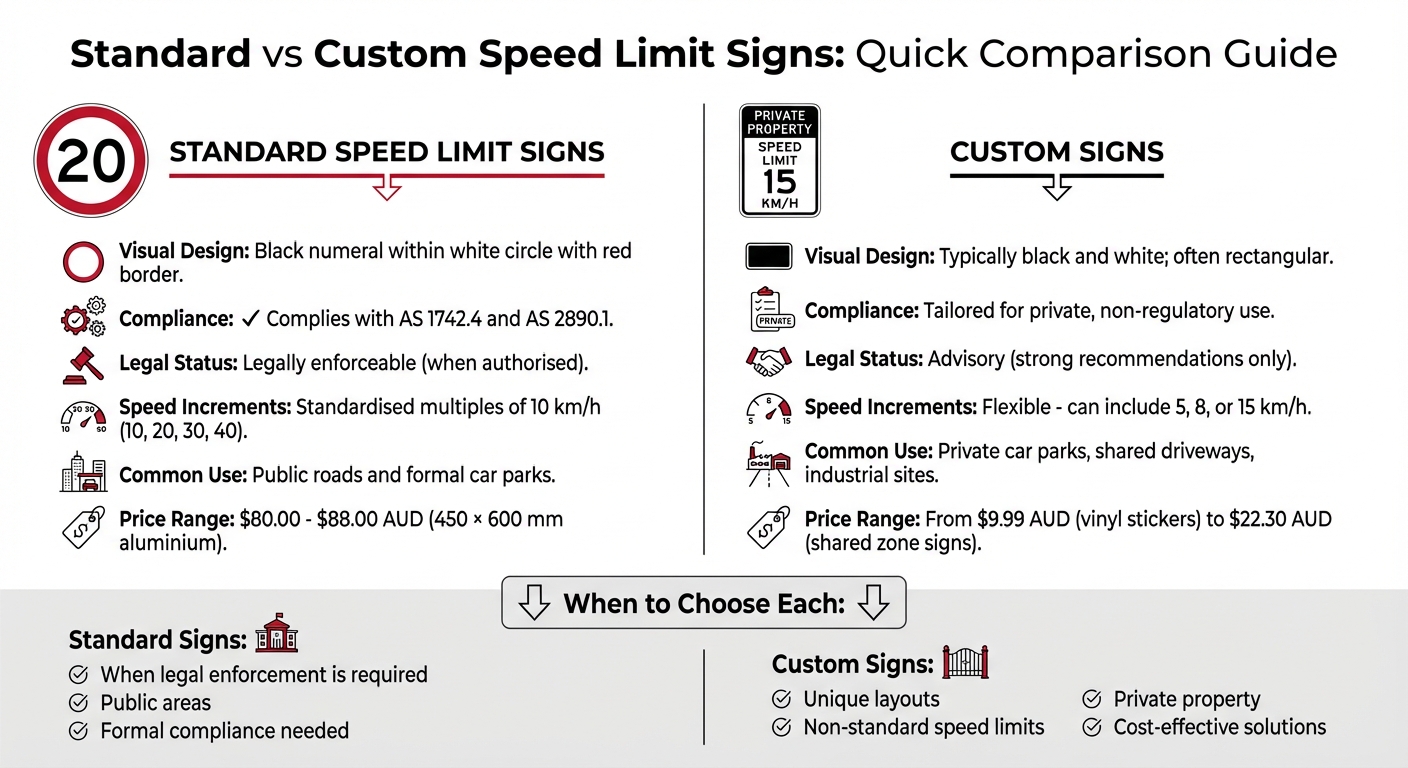
Standard vs Custom Speed Limit Signs for Car Parks Comparison
When it comes to improving safety in your car park, choosing between standard and custom speed limit signs can make all the difference. These options cater to different needs and environments, ensuring your space is both functional and secure.
Comparison of Standard and Custom Signs
Standard speed limit signs adhere to strict guidelines, specifically AS 1742.4 and AS 2890.1, making them legally enforceable when authorised. On the other hand, custom signs are advisory and designed for private areas where legal enforcement isn’t required. These are commonly used in shared driveways, residential complexes, and private car parks.
| Feature | Standard Speed Limit Signs | Custom Signs |
|---|---|---|
| Visual Design | Black numeral within a white circle with a red border | Typically black and white; often rectangular |
| Compliance | Complies with AS 1742.4 and AS 2890.1 | Tailored for private, non-regulatory use |
| Legal Status | Legally enforceable | Advisory, offering strong recommendations |
| Speed Increments | Standardised multiples of 10 km/h | Can include non-standard limits like 5, 8, or 15 km/h |
| Common Use | Public roads and formal car parks | Private car parks, shared driveways, industrial sites |
Standard aluminium signs (450 × 600 mm) range from $80.00 to $88.00 AUD, while custom vinyl stickers start as low as $9.99 AUD. Shared zone or driveway signs are available from $22.30 AUD, providing cost-effective solutions for various needs [2][3][11][12].
When to Choose Custom Signs
Custom signs are the go-to option when your car park has unique requirements or an unconventional layout. For example, in apartment blocks or townhouse complexes, non-standard speed limits like 5 km/h or 15 km/h are often necessary. These signs can also include tailored safety messages, such as "Children at Play" or "Shared Driveway", to encourage cautious driving without requiring formal authorisation [1].
Industries such as farms, caravan parks, and construction sites often rely on custom signs to reflect specific operational conditions. To enhance visibility, custom designs can also incorporate road stencils – large numerals painted directly onto the pavement – to reinforce speed limits in critical areas [1].
How to Position Speed Limit Signs for Maximum Effectiveness
Best Locations for Sign Placement
The first speed limit sign should be placed at the entrance of the car park. This ensures drivers are immediately informed of the speed limit as they enter the area where it officially applies [13]. To reinforce this, additional signs should be installed after major intersections within the car park. These serve as reminders for drivers as they transition onto new lanes or aisles [13].
In pedestrian or shared zones, signs should be positioned at the start of the area, typically indicating a 10 km/h limit [1]. In higher-risk zones, it’s helpful to add a second sign on the left side of the road and use road stencils to reinforce the message [1][13].
For car parks with sharp turns or ramps, especially in multi-level facilities, signs should be installed before the curve. This gives drivers enough time to adjust their speed [13]. Signs should be mounted at least 1.5 metres above the pavement edge and, ideally, 3.6 metres laterally from the travel lane [13]. To address visibility issues caused by glare from sunlight or headlights, angle the signs at approximately 93° to the roadway [14].
Once the primary placement is addressed, the focus shifts to maintaining consistent speed awareness throughout larger or multi-level parking facilities.
Spacing Signs in Large or Multi-Level Car Parks
In expansive car parks, regular speed limit reminders are essential. Without consistent signage, drivers may forget the limit over longer distances [15].
For multi-level facilities, treat each level as a distinct zone. Signage should be installed at the entrances of each level, particularly at the top and bottom of ramps where gradient changes demand extra attention. When placing signs near perpendicular parking stalls, ensure they are parallel to the roadway and face the stalls for optimal visibility to drivers entering the area. If using signs with directional arrows to mark restricted zones, position them at a 30 to 45-degree angle relative to traffic flow. This ensures approaching vehicles can clearly see the signs [15].
Combining Speed Limit Signs with Other Traffic Controls
Adding Speed Bumps and Give Way Signs
Pairing speed limit signs with other traffic control measures can significantly improve safety in car parks. For example, placing speed limit signs right before speed bumps alerts drivers and reinforces the need to slow down [16]. In areas with speed bumps, low-speed limits – like 5 km/h or 10 km/h – are typically used to match the intended effect of these physical measures [17]. Make sure these signs are either retroreflective or illuminated for better visibility. However, STOP signs should not be the primary method for controlling speed; instead, they should be paired with physical measures for a more effective system [16].
To avoid confusion, mount Give Way signs separately from STOP signs and ensure they clearly indicate right-of-way [16]. After a Give Way intersection, it’s helpful to repeat the speed limit to remind drivers of the required pace [19,20]. Additionally, pavement markings can be used alongside pole-mounted signs in high-risk spots, offering drivers immediate visual cues [1].
By combining these elements, you can create a more cohesive and effective safety system for your car park.
Using PXP Safety‘s Parking Sign Range
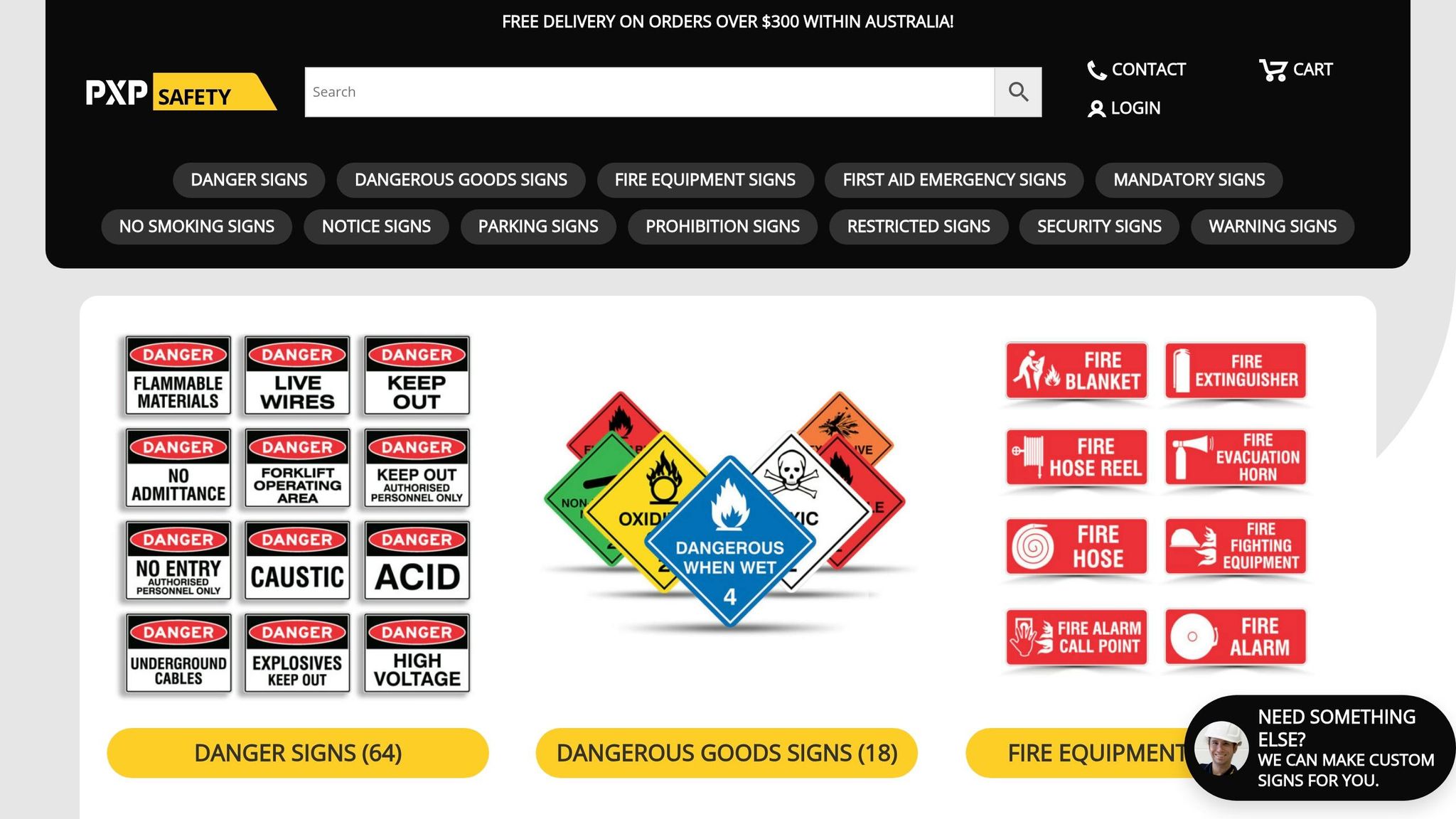
PXP Safety offers a range of parking signs that complement speed limit signs by adding extra layers of traffic control. A well-designed car park safety system needs more than just speed limit signs. PXP Safety’s collection includes Give Way signs, directional signs, and pedestrian warnings, all working together to establish clear traffic rules. These signs are made from durable aluminium with UV protection, ensuring they remain visible and reliable in Australian conditions.
For private car parks, combining mandatory speed limit signs with advisory signs – like "Children at Play" or pedestrian crossing warnings – can encourage drivers to be extra cautious in specific areas [1]. This layered approach blends enforceable limits with additional warnings, addressing various driver behaviours and improving safety across all areas of the car park.
Conclusion
Selecting the right speed limit signs involves ensuring compliance, durability, and thoughtful placement. Begin by identifying whether your car park requires regulatory signs – which must comply with AS 1742.4 and AS 2890.1 standards – or advisory signs for private property. Keep in mind that regulatory signs require state authorisation to be enforceable, while advisory signs provide strong safety guidance without legal enforcement [1].
Material quality is another crucial factor. Using premium aluminium composites with UV-resistant coatings is essential to withstand Australia’s tough weather conditions [18]. As New Signs highlights:
Faded or damaged private parking signs undermine enforcement efforts, violators can claim they couldn’t read the sign or didn’t notice it [18].
To maintain effectiveness, schedule regular maintenance and inspect signs quarterly, especially in high-traffic areas, to ensure they remain visible and functional [18].
Strategic placement is equally important. Install signs at car park entrances and in positions with clear sightlines, avoiding obstructions from vehicles. Drivers should be able to read and understand signs within three seconds [18].
For shared zones, a 10 km/h speed limit is common [1]. Combining speed limit signs with other safety measures like speed bumps and Give Way signs helps establish a well-rounded safety system.
FAQs
Do speed limit signs in private car parks need council approval?
Speed limit signs in private car parks usually don’t need council approval, but they must align with relevant standards and regulations. In Australia, it’s important to ensure these signs meet local safety requirements, are clearly visible, and properly installed. While signs on public roads often require council approval, those in private car parks mainly need to comply with safety and design standards. If you’re uncertain, it’s a good idea to check local regulations or consult the appropriate authorities.
What speed limit should I set for my car park?
The typical speed limit for off-street car parks in Australia usually falls between 10–20 km/h. This range depends on factors like the car park’s layout, the level of pedestrian activity, and local regulations. It’s important to set a speed that ensures the safety of both pedestrians and vehicles while avoiding an unnecessarily low limit that might hinder traffic flow.
For compliance, refer to the Australian/New Zealand Standard AS/NZS 2890.1:2004, which provides guidelines on aspects like signage visibility and dimensions. Always check the relevant standards and local regulations to maintain both safety and compliance.
How many speed limit signs do I need, and where should they go?
The number and positioning of speed limit signs in a car park should align with its layout and potential hazards. At the very least, you should have a sign at the entrance. Beyond that, place additional signs in critical spots such as pedestrian crossings, sharp corners, or areas with heavy foot traffic.
Visibility is key – make sure signs can be seen clearly from all directions. In larger car parks, multiple signs may be necessary to cover all angles. Regularly check the signs to ensure they remain visible and meet compliance standards.
Related Blog Posts
You may also be interested in
FAQs About Workplace Safety Signs in Australia
AS 1319 sign types, placement, materials and maintenance for workplace safety and WHS compliance in Australia.
Restricted Area Signs vs. No Entry Signs
Compare No Entry and Restricted Area signs in Australian workplaces — meanings, design differences and AS 1319 compliance.
How to Spot Workplace Signage Gaps
Audit your workplace for missing, faded or non‑compliant signs under AS 1319 to reduce incidents and avoid WHS fines.
Symbol Design: Global Standards Explained
Explains ISO 7010 and ISO 3864: standard symbols, colours and sizing for clear, language‑free safety signage and AU compliance.
Hazard Sign Visibility Planner
Plan hazard sign placement for max visibility with our free tool. Ensure safety by finding the best spot, height, and angle—try it now!