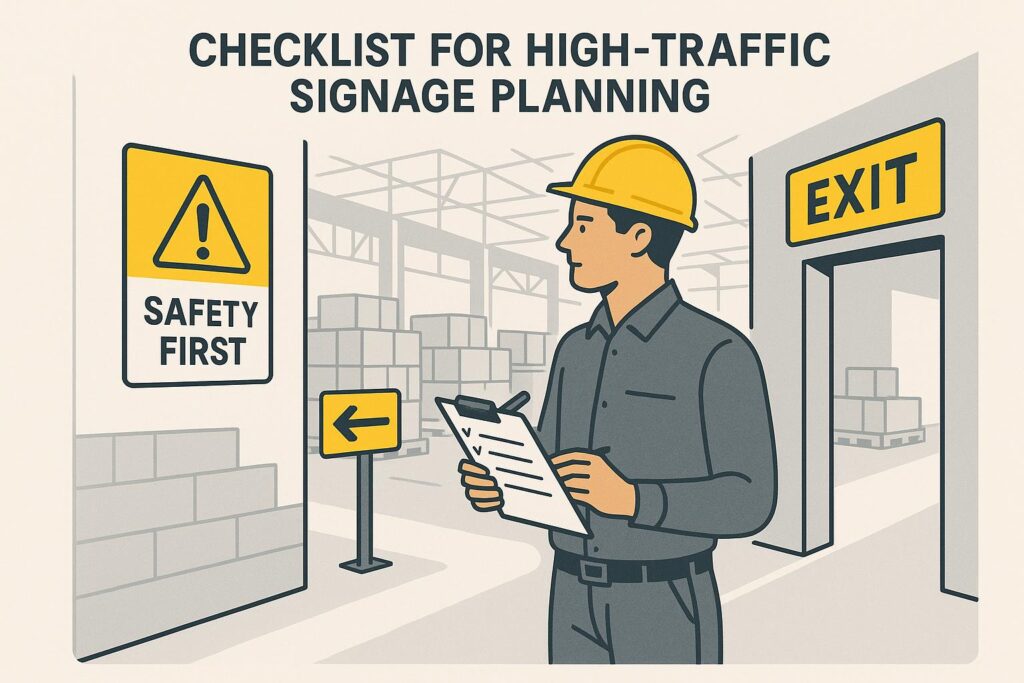
Checklist for High-Traffic Signage Planning
Effective signage is crucial for managing traffic, preventing accidents, and ensuring safety in busy Australian workplaces like construction sites and warehouses. Proper planning ensures compliance with Australian Standards (AS 1742, AS 1319) and avoids risks like congestion, blocked emergency access, and hazards. Here’s a quick breakdown:
- Site Assessment: Map traffic patterns, identify hazards (e.g., power lines, pedestrian zones), and review existing signage with your team.
- Signage Selection: Choose durable materials (e.g., aluminium with UV protection) and design for clarity with appropriate text size, strong contrasts, and simple messaging.
- Installation: Position signs for visibility (at eye level for pedestrians, adjusted for drivers), and follow logical placement to guide traffic effectively.
- Maintenance: Regularly inspect and replace damaged or non-compliant signs. Ensure adherence to standards like AS 1742 and AS 1906 for retroreflective materials.
A well-executed signage plan reduces risks, supports smooth operations, and aligns with legal obligations. Partnering with experts ensures durable, compliant solutions tailored to your site.

4-Step High-Traffic Signage Planning Checklist for Australian Workplaces
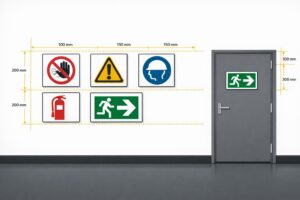
OSHA Safety Signs: Where Should Safety Signs Be Placed
Site Assessment Before Planning
Before putting up any signage, it’s crucial to evaluate the site thoroughly. This helps uncover potential hazards, understand traffic flow, and assess the effectiveness of existing signs. A well-executed assessment ensures your signage plan addresses real risks rather than relying on assumptions. Below are key steps to guide your evaluation.
Map Traffic Patterns and Risk Zones
Start by mapping out the flow of traffic and identifying high-risk areas. Track peak and off-peak traffic volumes and observe how different groups – pedestrians, forklifts, trucks, and other vehicles – move through the site. Pinpoint areas where congestion or conflicts are likely, such as intersections, junctions, and roundabouts, as these significantly impact traffic flow.
Look for hazards like overhead power lines, railway crossings, and pedestrian zones that might need specific warning signs. Ensure there’s enough space for loading ramps or bays, and check that entry and exit points for heavy machinery like trucks and excavators are safely designed. Don’t forget to factor in environmental conditions, such as seasonal weather changes, which could affect the visibility and durability of signs.
Additionally, map out routes used by vulnerable road users and confirm that emergency vehicles can access the site quickly. Consider the needs of local residents, businesses, and public transport systems, including buses and trams, to ensure your signage plan integrates seamlessly with the broader community.[1]
Review Current Signage with Your Team
Once risks have been mapped, involve your team in reviewing the findings. Conduct a site walk with on-site personnel to gather their insights – those who work in the area daily often spot hazards or signage gaps that might be missed otherwise. Use this opportunity to check whether current signs are visible, easy to read, and compliant with AS1319-1994 standards. This collaborative approach ensures your signage plan is grounded in actual workplace conditions, not just theoretical models.
Record Compliance Gaps
Compare your existing signage against the requirements of Australian Standard AS1319-1994 and the Building Code of Australia. Take note of any missing, faded, or damaged signs, as well as those that fail to meet standardised guidelines for colours, symbols, or text. Don’t overlook the need for mandatory Braille and tactile signage in areas where visually impaired workers or visitors may be present. Non-compliance not only poses safety risks but could also lead to penalties.[7]
Documenting these gaps serves two purposes: it highlights areas needing immediate attention and forms the basis for creating a tailored signage solution. By recording these issues, you also demonstrate a commitment to due diligence and workplace safety.
Selecting and Designing Your Signage
After evaluating potential risks, it’s time to choose signage that can handle Australia’s challenging climate while meeting all regulatory requirements. The materials and designs you select should ensure durability, clarity, and long-term performance, tailored to the specific risks of your site.
Choose Materials That Last and Comply
Aluminium signage is a go-to option for high-traffic areas, especially on major road and rail projects. It stands up well to Australia’s intense UV exposure, fluctuating temperatures, and harsh weather conditions. Signs should include UV protective film and outdoor-grade printing to maintain visibility and readability year-round, even in direct sunlight.
For temporary signage, options like hoarding, fence wrap, or banner mesh work well. For permanent installations, ensure the materials meet durability standards and comply with clearance timelines[2][3].
Prioritise Clarity and Visibility
Once you’ve chosen durable materials, the next step is to focus on clear and effective design. Good signage needs to be legible from a distance and stand out from its surroundings[11]. This involves selecting the right letter size and type, using strong colour contrasts, and creating a logical information hierarchy[8][9]. In busy areas, both drivers and pedestrians must be able to quickly absorb the message – there’s no room for cluttered designs or tiny text.
Directional signage should be simple, with minimal wording[10]. Use white space strategically to avoid visual overload, and vary font sizes and weights to establish a clear hierarchy[9]. For signs aimed at motorists, avoid overly animated or rapidly changing elements, as these can distract from the road environment[4].
Custom Signs for Unique Hazards
For hazards that standard signage cannot address, custom signs are indispensable. These are particularly useful for site-specific issues such as koala crossings, unique access points for heavy machinery, or complex traffic patterns that generic signs cannot adequately cover[1].
PXP Safety provides custom signage solutions designed to meet your exact needs while adhering to Australian safety standards. When planning custom signs, consider approval timelines – government logo usage, for example, typically requires a four-week approval process[3]. Ensure the materials are appropriate for your site’s specific environmental conditions. Place custom signs at key entry points where they are clearly visible, adjusting size and wording based on whether the audience will be motorists or pedestrians[3].
sbb-itb-9950c92
Installing and Positioning Signs
Once you’ve chosen and designed your signs, proper installation is key to ensuring they are visible, readable, and effective.
Position Signs at the Right Height and Distance
For pedestrians, signs should be mounted at eye level to maximise readability[12][13]. For drivers, the height and angle must suit the road’s speed and conditions, making them easy to spot. A general guideline is that one inch of text height is legible from about 10 feet away[13].
On expressways with at-grade intersections, advance direction signs typically require 320 mm lettering, while intersection direction signs use 200 mm[8]. For minor roads with speeds under 60 km/h, letters between 160 mm and 200 mm are common[8]. Overhead signs demand larger lettering – 320 mm for non-freeway intersections and 400 mm for freeway exits – to account for their elevated position[8].
Visibility is crucial, so remove any obstructions like trees, buildings, or parked vehicles. Adjust for glare and shadows as needed[12][13][14]. In areas with heavy visual distractions, increasing the letter size can help maintain readability[8][12].
Once visibility is optimised, arrange signs in a sequence that makes sense to viewers.
Install Signs in Logical Order
Signs should be installed in a logical progression, starting with advance warnings and ending with markers at the specific work area. Properly placed road safety signage helps to avoid confusion and risky driving behaviours[15][17]. As 3M Australia highlights:
Confused drivers can lose focus on the driving task and may make erratic manoeuvres, such as slowing or stopping in the roadway, backing down ramps, or making abrupt turns[17].
Before installation, assess the road layout, including curves, gradients, intersections, and sightlines, to ensure drivers have enough time to see and respond to the signs[15]. All installations must comply with the Western Australia Traffic Management Code of Practice and the Australian Manual of Uniform Traffic Control Devices (MUTCD), which outline standards for size, shape, colour, and positioning[15]. Regional requirements may vary, so check with your local road authority, like NSW RMS, VicRoads, or QLD TMR, for specific guidelines[15][16].
While permanent signs require careful planning, temporary signage comes with its own set of rules.
Plan for Temporary Signs
Temporary signs are a legal requirement on all civil sites in Australia[5]. These signs must adhere to Australian Standard AS 1742, which governs traffic control devices[5]. Ideally, temporary signage should be installed before construction begins[2][3].
Most civil projects require a Traffic Management Plan (TMP), which must be approved by local authorities before work starts[5]. This plan details how traffic and pedestrian flow will be managed during the project. Place temporary warning and directional signs where they are most visible, such as at key entry points. Ensure they are not blocked by roadside objects[1][3]. For roadworks, position signs at both ends of the site so they are visible to traffic in both directions[3].
Mesh banner signs on boundary fences can be effective during construction[3]. If your signs include government logos or acknowledgements, plan ahead for approvals. For Australian Government projects, approvals usually take five working days[2], while NSW Government projects may take up to four weeks[3]. Once installed, submit photographs of the signs to funding managers promptly[3].
Maintaining Compliance and Signage Condition
Putting up signs is just step one – keeping them in good shape and compliant is where the real work begins. Regular maintenance is key to ensuring that safety measures remain effective, protecting both workers and the public over time.
Meeting Australian Standards
While following Australian Standards is generally voluntary, it becomes critical when these standards are cited in State or Commonwealth legislation. Courts often consider adherence to these standards when determining if duty holders have met their obligations under the Work Health and Safety Act [18]. Each type of sign must comply with the design and retroreflectivity requirements outlined in standards such as AS 1319, AS 1742, and others [18][6][19].
For traffic control signage, AS 1742 (Manual of Uniform Traffic Control Devices) sets the rules for managing vehicle and pedestrian traffic [19]. AS 1742.1, for example, details essential design elements like colours, sizes, and shapes [19]. Other relevant standards include AS 1743 for road sign specifications, AS 1744 for standard alphabets, and AS 1906.1 for retroreflective materials [19]. Signs that need to be visible at night must use retroreflective materials, with Class 400–1100 being acceptable and Class 1100 mandatory for overhead signage [19].
Scheduling Regular Inspections
Maintaining both temporary and permanent signs is essential and often tied to funding requirements [3]. Set up regular inspections to check for damage, fading, or obstructions. Replace any signs that are compromised immediately. Signs should be made from durable, weather-resistant materials designed for long-term use, similar to those used for road signs [3]. It’s also important to ensure that signs remain visible and unobstructed at all times [3]. For project-specific signage, you’ll typically need to keep signs in place for one to three years after project completion, depending on funding guidelines [3].
Incorporating Signage into Traffic Management Plans
After conducting inspections, include your findings in the Traffic Management Plan. This plan should detail who is responsible for inspections and outline clear procedures for replacing signs, in line with funding requirements [3]. The NSW Government specifies that funding recipients are responsible for "the production, printing, placement, and ongoing maintenance" of both temporary and permanent signs, as well as obtaining necessary approvals [3]. A structured approach like this ensures that signage complies with all relevant regulations and by-laws throughout the project’s duration [3]. Keeping signage in good condition is a critical part of risk management in busy areas.
Partnering with a provider like PXP Safety, which focuses on compliance, durability, and tailored solutions, can further enhance the long-term safety and effectiveness of signage in high-traffic environments.
Conclusion
Planning high-traffic signage effectively requires a structured and thorough approach. A well-prepared checklist helps cover all essential steps – from mapping traffic flow and spotting potential hazards to choosing compliant materials and scheduling regular maintenance. This not only reduces risks for drivers, pedestrians, cyclists, and workers but also ensures emergency vehicles can navigate safely and the public is shielded from active work zones [5]. This careful planning enhances safety while keeping site operations running smoothly.
By studying traffic patterns during both peak and off-peak times and providing clear directional signage, you can ease congestion and avoid unnecessary delays [1][5]. The result? Better traffic flow, improved scheduling, and less disruption to the local area [1][4].
Compliance plays a key role in this process. Following Australian Standards (AS 1742), WHS regulations, and local council rules not only keeps your project within legal bounds but also ensures it meets safety expectations [5]. As highlighted by Civil Products WA:
Most civil projects in Australia require a Traffic Management Plan (TMP) to be approved by local authorities before breaking ground. It outlines how traffic and pedestrian flow will be managed to reduce risks during construction [5].
Signage management should be an ongoing effort. Regular inspections, timely replacements, and alignment with your Traffic Management Plan maintain safety and compliance throughout the project. Each step in the checklist contributes to a well-rounded strategy for managing high-traffic risks. By working with specialists like PXP Safety – who provide durable, regulation-compliant signage – you’re making a long-term investment in the safety and efficiency of your site.
FAQs
What Australian Standards should be followed for high-traffic signage compliance?
High-traffic signage in Australia needs to meet the requirements of AS 1742.3 (Traffic control devices for general use) and AS 1319 (Safety signs for the occupational environment). These standards provide clear rules for the design, placement, and visibility of signs to ensure they communicate safety information effectively while meeting legal obligations.
By adhering to these standards, signage becomes more durable, easier to interpret, and well-suited for busy areas, improving safety and usability in both workplaces and public environments.
What steps can I take to keep my signage visible and effective over time?
To ensure your signage remains clear and effective, it’s essential to use strong, weatherproof materials that can handle Australia’s tough climate. Regular maintenance, like inspecting and cleaning, helps remove dirt, debris, or anything else that might block visibility.
Place signs at eye level in noticeable, well-lit spots, particularly in areas with heavy foot or vehicle traffic. If lighting is insufficient, adding illumination can make a big difference, especially at night or in dim conditions. Also, don’t forget to update or replace signs that start to look worn out to keep them sharp and easy to read.
What should I look for when choosing materials for long-lasting signage in high-traffic areas?
When choosing materials for long-lasting signage, focus on durability, weather resilience, and clarity. Materials such as aluminium or premium-grade plastics are excellent options, as they can endure Australia’s tough outdoor conditions, including intense UV rays and extreme weather changes.
It’s also crucial to ensure your signage meets local safety regulations and is designed for optimal visibility. Using durable finishes like UV-resistant coatings can preserve the sign’s readability over time, even in busy or exposed areas. Selecting the right materials ensures your signs stay functional and dependable for the long haul.
Related Blog Posts
You may also be interested in
FAQs About Workplace Safety Signs in Australia
AS 1319 sign types, placement, materials and maintenance for workplace safety and WHS compliance in Australia.
Restricted Area Signs vs. No Entry Signs
Compare No Entry and Restricted Area signs in Australian workplaces — meanings, design differences and AS 1319 compliance.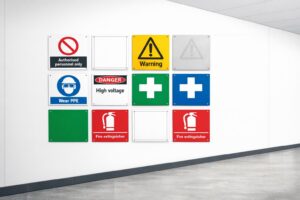
How to Spot Workplace Signage Gaps
Audit your workplace for missing, faded or non‑compliant signs under AS 1319 to reduce incidents and avoid WHS fines.
Symbol Design: Global Standards Explained
Explains ISO 7010 and ISO 3864: standard symbols, colours and sizing for clear, language‑free safety signage and AU compliance.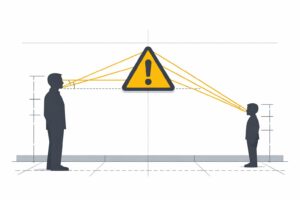
Hazard Sign Visibility Planner
Plan hazard sign placement for max visibility with our free tool. Ensure safety by finding the best spot, height, and angle—try it now!