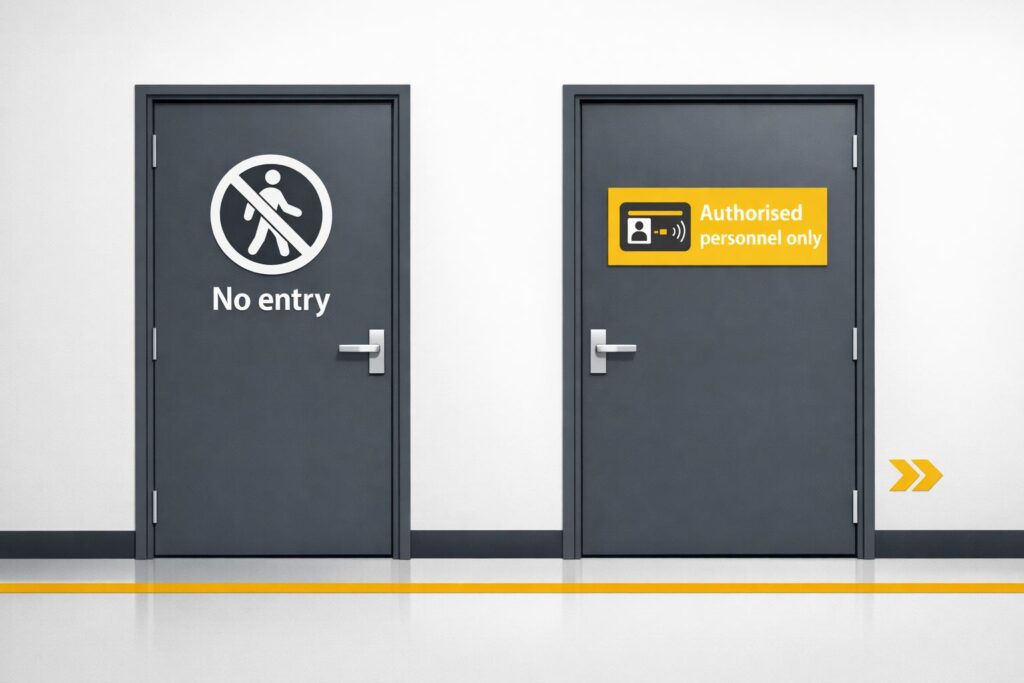
No Entry vs Authorised Personnel Signs
Safety signs like No Entry and Authorised Personnel Only are critical for maintaining workplace safety in Australia. They help control access, reduce risks, and comply with AS 1319-1994 standards. Here’s the key difference:
- No Entry signs: These prohibit access entirely, applying to everyone without exception. They’re ideal for high-risk zones like hazardous areas, construction sites, or restricted traffic zones.
- Authorised Personnel Only signs: These restrict access to individuals with specific training or clearance, such as maintenance staff or security-cleared personnel. Common in IT rooms, laboratories, and machinery areas.
Both signs must meet visibility and design standards, including symbol and text size requirements, ensuring clarity in various environments. Using the right sign avoids confusion, enhances safety, and ensures compliance. Combined signs like "No Entry – Authorised Personnel Only" are also common for stricter access control. Proper placement and durable materials ensure long-term effectiveness, especially in outdoor or high-risk settings.
Safety Signage
sbb-itb-9950c92
No Entry Signs
‘No Entry’ signs play a crucial role in ensuring safety and maintaining order across various environments. Here’s a closer look at their purpose, design, and where they’re commonly used.
What No Entry Signs Mean
In Australia, ‘No Entry’ signs are strict prohibition signs that clearly convey that access to a specific area is forbidden for everyone, without exception [5][1]. Unlike restricted access signs aimed at specific groups, these apply universally.
These signs are essential safety signs every Australian workplace needs, as they prevent unauthorised access to high-risk zones like laboratories, construction sites, areas with heavy machinery, or places storing hazardous chemicals [8]. Beyond safety, they also protect security and privacy in settings such as staff-only areas, IT server rooms, and loading docks in commercial buildings [9].
Their purpose is straightforward, which allows for a clear and standardised design.
Design and Standards Compliance
‘No Entry’ signs must comply with AS 1319-1994, which outlines specific design requirements. The design features a black pictogram placed behind a red diagonal slash, with any text written in black.
To ensure visibility, the standards specify minimum sizes: symbols must be at least 15mm per metre of viewing distance, and uppercase text must be at least 5mm per metre [7][2]. For instance, if a sign is intended to be read from 10 metres away, the text should be at least 50mm tall. In dimly lit areas, these dimensions should increase by at least 50% to maintain readability [2].
These guidelines ensure that the signs remain clear and effective in a variety of environments.
Where No Entry Signs Are Used
‘No Entry’ signs are used extensively across Australian workplaces and public areas. For traffic management, the familiar red circle with a white horizontal bar is used to prevent vehicles from entering one-way streets, car park exits, or highway off-ramps, helping to avoid head-on collisions [9].
In industrial contexts, these signs protect workers from dangers like excavations or active heavy machinery [9]. They are also crucial in specialised settings, such as sterile areas in healthcare facilities, biosecurity checkpoints in agriculture, and restricted zones in airports. To maximise their effectiveness, signs should be mounted at eye level and placed in clear view [9].
Authorised Personnel Only Signs
"Authorised Personnel Only" signs are used to restrict entry to individuals who are trained, cleared, or specifically permitted to access certain areas [4][10]. Unlike general prohibitions, these signs ensure operations run smoothly and safely by limiting access to those with the necessary qualifications or authorisation. Depending on the level of risk, these signs may be classified as "Danger" signs – indicating life-threatening hazards – or as "Prohibition" signs, which denote restricted behaviours [10][11].
What Authorised Personnel Only Signs Mean
In workplaces, "Authorised" refers to people who have undergone appropriate training, hold security clearance, or have received explicit permission to enter a particular area [4][10]. This creates a conditional restriction rather than a blanket ban. For instance, a plant room might be off-limits to regular staff but accessible to trained maintenance professionals who are familiar with the risks and safety measures involved. It’s essential to educate employees about what "Authorised" means in the context of your workplace [4].
Design and Standards Compliance
These signs must meet the requirements of AS 1319-1994, with their design tailored to the risk level of the area. High-risk zones often feature a "Danger" header, which includes a white word inside a red oval set against a black background. The text is displayed in black on a white background [4][10]. Lower-risk areas may use a prohibition-style design, characterised by a red circle with a slash over a black symbol [11].
To ensure visibility, the symbols on these signs should measure at least 15 mm per metre of viewing distance, and the text should be 5 mm per metre. In dimly lit areas, these sizes should increase by 50% [3]. Placement is equally important – signs should be mounted at eye level, against contrasting backgrounds, and kept free from obstructions to maximise visibility [3][4].
Where Authorised Personnel Only Signs Are Used
These signs are commonly found in Australian workplaces where controlled access is crucial for safety or security. Typical locations include server rooms, plant rooms, machinery areas, and storage facilities for chemicals or hazardous materials. They’re also used in high-security zones, such as those housing sensitive information, as well as in specialised environments like research centres, secured hospital rooms, and areas with specific risks, such as fragile roofs [3][10].
For outdoor use, durable materials like 0.6-mm Colorbond steel or aluminium composite panels are recommended. These materials can last five to eight years in outdoor conditions and endure temperatures ranging from -40°C to 80°C [6]. Such materials are ideal for permanent signage exposed to harsh weather, ensuring longevity and reliability [3][6].
Comparing No Entry and Authorised Personnel Only Signs
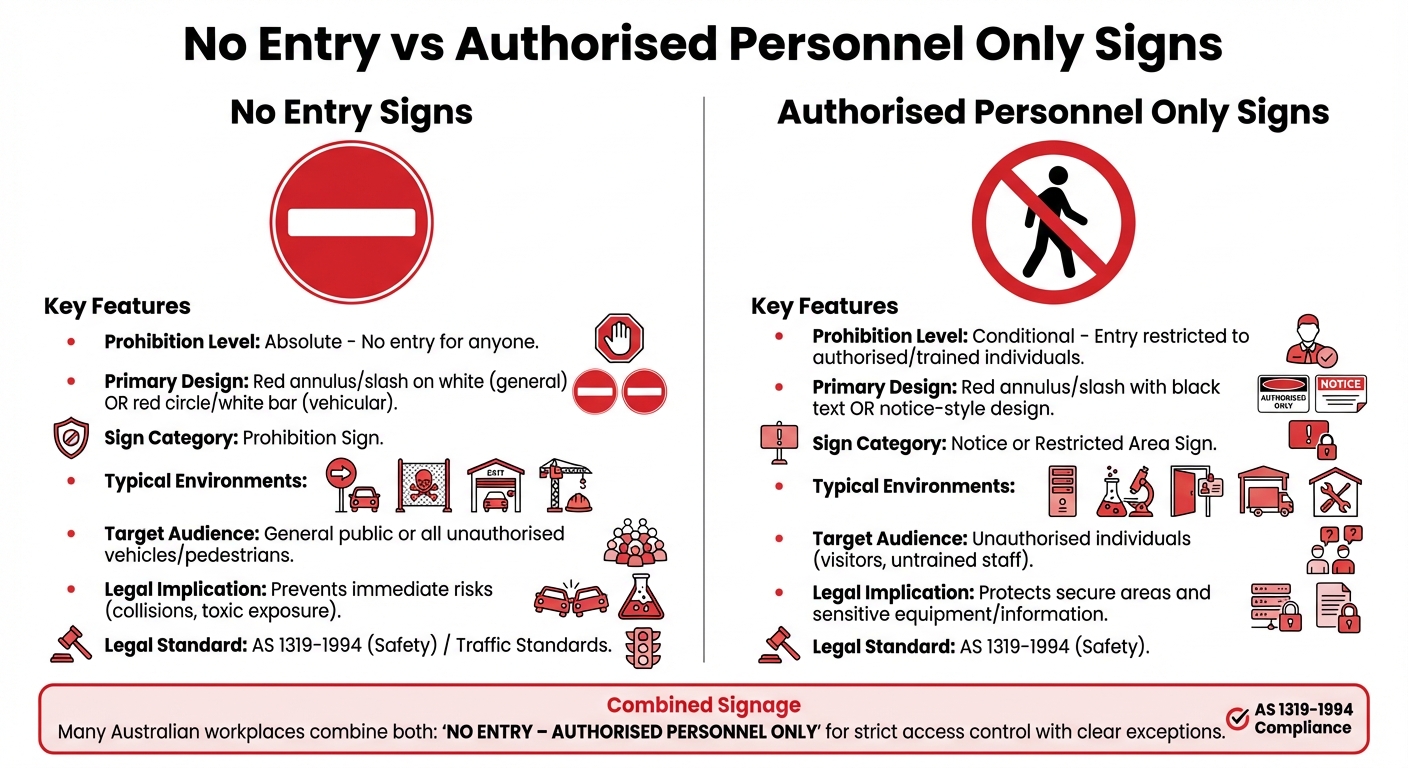
No Entry vs Authorised Personnel Only Signs: Key Differences Comparison
This section looks at how No Entry and Authorised Personnel Only signs differ in their purpose, design, and usage within Australian workplaces.
Both signs restrict access, but they serve different functions. No Entry signs impose an outright prohibition, while Authorised Personnel Only signs limit access to individuals with specific clearance or training.
Design Differences
The designs of these signs reflect their purposes. No Entry signs typically feature a red circular band (known as an annulus) with a diagonal slash over a contrasting symbol on a white background. For vehicular settings – like one-way street exits or car park exits – they appear as a solid red circle with a horizontal white bar. Meanwhile, Authorised Personnel Only signs may use a similar red annulus and slash but are often displayed in a notice-style format, featuring bold black text on a white background, depending on their classification.
Legal and Functional Purposes
The legal and functional implications also vary. No Entry signs are designed to prevent immediate dangers, such as avoiding head-on collisions or exposure to hazardous materials. On the other hand, Authorised Personnel Only signs focus on regulating access to secure or sensitive areas, ensuring only trained or approved personnel can enter.
Comparison Table
| Feature | No Entry Signs | Authorised Personnel Only Signs |
|---|---|---|
| Prohibition Level | Absolute: No entry allowed for anyone (or any vehicle) [9][17] | Conditional: Entry restricted to authorised or trained individuals [15][9] |
| Primary Design | Red annulus/slash on white (general) or red circle/white bar (vehicular) [9][16] | Red annulus/slash with black text, or notice-style design with clear messaging [12][17] |
| Sign Category | Prohibition Sign [5] | Notice or Restricted Area Sign [13] |
| Typical Environments | One-way roads, hazardous zones (e.g., asbestos, blasting), car park exits, construction perimeters [14][9] | Server rooms, laboratories, staff-only areas, loading docks, maintenance rooms [9][12] |
| Target Audience | General public or all unauthorised vehicles/pedestrians [9] | Unauthorised individuals, such as visitors or untrained staff [9] |
| Legal Implication | Prevents immediate risks (e.g., collisions, toxic exposure) [9] | Protects secure areas and sensitive equipment or information [9] |
| Legal Standard | AS 1319-1994 (Safety) / Traffic Standards [6][9] | AS 1319-1994 (Safety) [6][5] |
Combined Signage
Many workplaces in Australia combine these messages into one sign, such as "NO ENTRY – AUTHORISED PERSONNEL ONLY", to enforce strict access rules while clearly stating exceptions for authorised individuals [14][15].
Understanding these distinctions ensures the correct signs are used for safety, security, and compliance in various environments.
When to Use Each Sign Type
Choosing the right sign depends on the level of risk, the intended audience, and whether you’re addressing safety hazards or controlling access to restricted areas. While both No Entry and Authorised Personnel Only signs limit access, their purposes differ. Here’s a closer look at when to use each.
When to Use No Entry Signs
No Entry signs are essential when access must be completely prohibited to avoid immediate physical danger. These signs are commonly used in high-risk areas like construction zones or near hazardous machinery, where unauthorised entry could lead to severe injuries or even fatalities. They’re also critical for one-way streets or car park exits, where entering the wrong way could result in accidents [9]. Other examples include areas storing dangerous chemicals or unstable structures [9].
These signs are absolute – no one is permitted entry. To ensure they serve their purpose, they must be positioned for optimal visibility and clarity.
"The ‘Danger: No Entry Authorised Personnel Only’ sign is a vital directive to restrict access to specific areas for safety and security reasons. It clearly designates zones solely for those who are authorised, minimising risks and maintaining operational integrity." – SafetySignage.au [4]
When to Use Authorised Personnel Only Signs
On the other hand, Authorised Personnel Only signs are used when access restrictions depend on an individual’s role, training, or clearance. These signs are ideal for areas like IT server rooms, laboratories, maintenance closets, and loading docks, where the focus is on protecting sensitive equipment, information, or operations [9][12].
They are also necessary in zones requiring specific training or personal protective equipment (PPE) [8][9]. These signs allow conditional access, meaning only individuals with the proper credentials or training can enter, while unauthorised individuals are restricted. This makes them effective for securing commercial spaces or operational areas where specific expertise is essential.
Getting Compliant Signage from PXP Safety
PXP Safety offers signage solutions that prioritise workplace safety while adhering to Australia’s strict compliance standards. Following AS 1319-1994 is not just a legal requirement but a crucial step in ensuring a safer work environment. PXP Safety’s Australian-made signs are built to meet these standards and withstand the tough conditions unique to Australia. Here’s a closer look at their offerings and what makes them stand out.
Standard and Custom Sign Options
PXP Safety caters to diverse needs with both ready-made and custom signage options tailored for No Entry and Authorised Personnel Only zones. Their standard signs come in a variety of sizes, from small 200 x 150mm signs (readable up to 3.7 metres in well-lit settings) to larger 600 x 450mm options (visible up to 11 metres). Prices range from $15.00 to $92.00, depending on the size and material used [4].
Custom signage is also available for addressing specific hazards. These signs maintain compliance with AS 1319-1994 and AS 2700 standards, ensuring appropriate colours and layouts [4]. The Danger signs follow the mandated design, featuring the word ‘Danger’ in white text within a red oval, framed by a black rectangle [4].
PXP Safety sweetens the deal with free delivery on orders over $100 and bulk discounts for larger purchases [4]. Whether you choose standard or custom options, all signs are designed to remain compliant and visible, even in Australia’s challenging outdoor conditions.
Material Quality and Standards Compliance
The durability of PXP Safety signs is a key feature. Made from aluminium composite panels, they are ideal for permanent outdoor use, withstanding temperatures ranging from -40°C to 80°C [4][6]. Each sign is laminated to provide UV protection, extend its lifespan, and offer anti-graffiti properties [8]. Metal signs typically last five to eight years outdoors [6].
"Our Australian-made Danger Signs are designed to fully meet the Australian Standard AS 1319-1994, ensuring they adhere to the highest standards of quality and safety." – Safety Signage AU [4]
Every sign is crafted to meet the exact dimensional requirements outlined in AS 1319-1994, ensuring compliance and reliability in any workplace setting. Whether you’re looking for durability, visibility, or adherence to standards, PXP Safety delivers on all fronts.
Conclusion
Knowing the difference between No Entry and Authorised Personnel Only signs is crucial for workplace safety and meeting legal obligations in Australian workplaces. No Entry signs are absolute – they bar all access to areas that pose significant risks or are strictly off-limits. On the other hand, Authorised Personnel Only signs restrict access to specific individuals, such as trained staff, who are equipped to handle the tasks or risks within these areas[4][8][12][15]. Many workplaces in Australia use combined signs like "Danger: No Entry Authorised Personnel Only" to clearly mark high-risk zones where unauthorised entry could have severe consequences[4].
No Entry signs work best for areas requiring total exclusion, such as emergency exits or zones with general hazards. Meanwhile, Authorised Personnel Only signs are suited for areas like laboratories, machinery rooms, or hazardous material storage, where only trained individuals should enter[8][15]. Under Australian safety laws, having durable and compliant signage is mandatory[9]. Regular inspections and replacing faded or damaged signs are vital to avoid legal risks and ensure safety[9].
"The ‘Danger: No Entry Authorised Personnel Only’ sign is a vital directive to restrict access to specific areas for safety and security reasons… minimising risks and maintaining operational integrity." – Safety Signage AU[4]
Choosing high-quality, compliant signage is not just about meeting legal requirements – it’s about protecting lives and ensuring operational safety. Australian-made options, like those from PXP Safety, are designed to provide the durability and visibility needed for long-term compliance and effectiveness in Australian workplaces. These signs help maintain a safe and secure environment, ensuring your workplace remains protected.
FAQs
Can I use both signs on one door?
Yes, it’s perfectly fine to display both ‘No Entry’ and ‘Authorised Personnel Only’ signs on the same door, as long as each serves a specific purpose and is easy to understand. The ‘No Entry’ sign completely restricts access for unauthorised individuals, while the ‘Authorised Personnel Only’ sign indicates that only approved individuals are allowed through.
To avoid confusion or visual clutter, make sure the signs are placed thoughtfully. They should remain clear, easy to spot, and comply with Australian safety standards to ensure proper communication.
How do I decide the right sign size for my viewing distance?
To determine the right sign size for your viewing distance, follow Australian safety standards. Symbols should measure at least 15mm in height for every metre of viewing distance, while uppercase text should be 5mm per metre. In areas with low lighting, it’s recommended to increase these sizes by 50% to improve visibility. Place signs at eye level, use contrasting backgrounds, and make sure they remain unobstructed to ensure they are as effective as possible.
What does “authorised” mean in my workplace?
In your workplace, “authorised” means individuals who have been given explicit permission to access certain spaces or carry out specific duties. Authorised personnel are those who have been officially approved – whether through training, proper identification, or assigned roles – to enter restricted areas. This approach helps maintain safety, security, and compliance by ensuring only those with the right authority can access these zones.
Related Blog Posts
You may also be interested in
FAQs About Workplace Safety Signs in Australia
AS 1319 sign types, placement, materials and maintenance for workplace safety and WHS compliance in Australia.
Restricted Area Signs vs. No Entry Signs
Compare No Entry and Restricted Area signs in Australian workplaces — meanings, design differences and AS 1319 compliance.
How to Spot Workplace Signage Gaps
Audit your workplace for missing, faded or non‑compliant signs under AS 1319 to reduce incidents and avoid WHS fines.
Symbol Design: Global Standards Explained
Explains ISO 7010 and ISO 3864: standard symbols, colours and sizing for clear, language‑free safety signage and AU compliance.
Hazard Sign Visibility Planner
Plan hazard sign placement for max visibility with our free tool. Ensure safety by finding the best spot, height, and angle—try it now!