How Safety Signs Improve Visual Learning
Essential safety signs help Australian workplaces communicate safety information quickly and effectively. They use visuals, which the brain processes 60,000 times faster than text, making them vital for hazard awareness and training. Legally required under the Work Health and Safety Act 2011 and AS 1319-1994, these signs break down language barriers, improve hazard recognition, and support a culture of safety.
Key Points:
- Visual Advantage: 90% of information absorbed by the brain is visual, making signs faster and easier to understand than text.
- Legal Standards: Signs must meet AS 1319-1994 guidelines, including specific colours and shapes for danger, prohibition, warning, mandatory, and emergency signs.
- Retention Boost: Pairing visuals with text increases information retention by up to 65%.
- Design Tips: Use simple, high-contrast designs and limit signs per area to six or fewer to avoid cognitive overload.
- Durability: Materials like UV-protected aluminium ensure signs withstand Australia’s harsh conditions.
Safety signs also enhance training by reinforcing learned behaviours and overcoming language barriers with universal symbols. Regular audits and employee feedback ensure they remain effective and compliant.
How Safety Signs Improve Workplace Learning and Retention Statistics
How Safety Signs Improve Information Retention
How the Brain Processes Visual Information
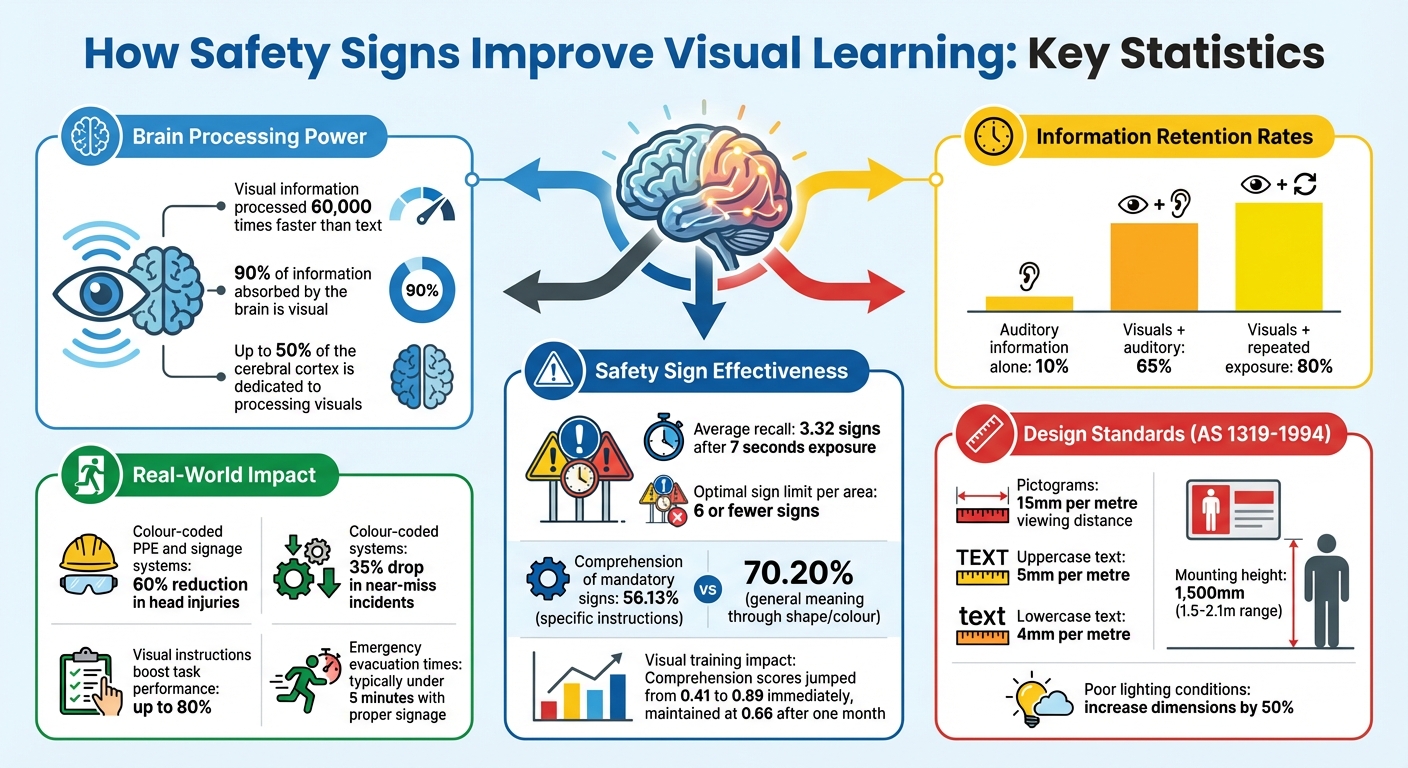
Did you know that up to 50% of the cerebral cortex is dedicated to processing visuals? This makes safety signs an incredibly effective tool, as they tap into one of the brain’s most powerful processing systems [9].
Unlike text-based warnings, safety signs convey messages instantly. For instance, a pictogram of a person slipping communicates "danger" far quicker than reading "Caution: Slippery Surface" [3][6]. This rapid recognition can be critical during emergencies, where every second counts.
Research also shows that combining visuals with other forms of engagement significantly boosts retention. While auditory information alone leads to about 10% retention, adding visuals increases this to 65%. Pairing visuals with repeated exposure – like walking past a sign daily – can push retention rates up to 80% [9].
Real Applications in Workplace Safety
In August 2024, a study by Seoul National University of Science and Technology tested 513 construction workers in Pyeongtaek, South Korea. Led by Jong Yil Park, the research assessed how many safety signs workers could recall after seeing them for just seven seconds. The results were telling: on average, participants remembered only 3.32 signs. When more than nine pictogram-based signs were displayed at once, recall rates plummeted due to cognitive overload [7].
This highlights an important principle: simplicity works best. To avoid overwhelming workers, limit the number of safety signs in one area to six or fewer. Position the most critical warnings in the top-left corner, where people naturally focus their attention first [7].
Adding text to images can further enhance understanding without slowing reaction times [4][6]. Even a brief explanation of a symbol’s meaning can significantly improve long-term memory for more complex signs [8]. Additionally, high-contrast designs are essential in challenging conditions. Signs with strong contrasts between symbols and backgrounds remain visible in low-light or harsh environments, ensuring workers can rely on them when it matters most [3].
sbb-itb-9950c92
Designing Safety Signs That Support Learning
Colour Coding and Symbol Clarity
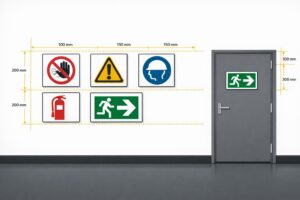
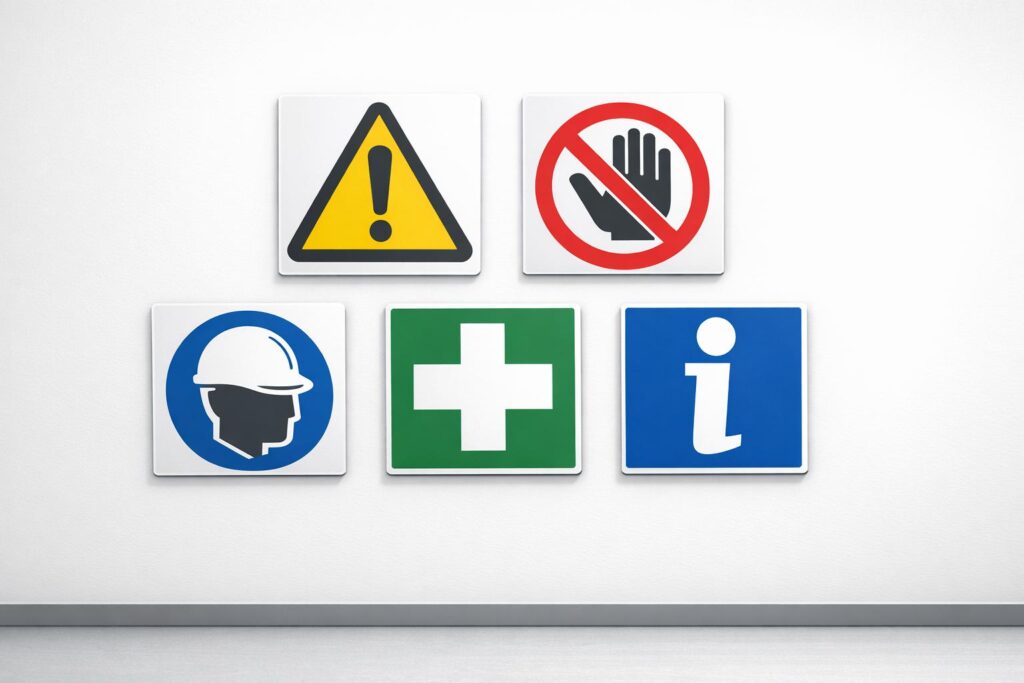
Australia’s AS 1319-1994 standard sets clear guidelines for the colours and shapes used on safety signs to ensure immediate hazard recognition. For example:
- Danger signs: A red oval within a black rectangle.
- Prohibition signs: A red circle with a diagonal slash.
- Warning signs: A yellow triangle with a black border.
- Mandatory signs: Blue circles with white symbols.
- Emergency signs: Green rectangles or squares [10].
These colour schemes are designed to trigger quick recognition. Studies have shown that using colour-coded personal protective equipment (PPE) and signage systems can lead to a 60% reduction in head injuries and a 35% drop in near-miss incidents [10].
The success of safety symbols depends on five cognitive factors: familiarity, concreteness, simplicity, meaningfulness, and semantic closeness [4]. Symbols that resemble real-world objects tend to be easier to recognise and remember compared to abstract designs. For instance, comprehension tests revealed that while only 56.13% of individuals fully understood specific mandatory sign instructions, 70.20% could interpret the general meaning through shape and colour coding alone [10].
By adhering to these principles, safety signage can communicate effectively and support safer workplaces.
Text Hierarchy and Visibility
Legibility is key, and this depends on strict adherence to sizing rules. According to AS 1319, the following minimum dimensions apply:
- Pictograms: 15 mm per metre of viewing distance.
- Uppercase text: 5 mm per metre.
- Lowercase text: 4 mm per metre [11].
In poor lighting or difficult viewing conditions, these dimensions should be increased by at least 50%.
To maximise visibility, signs should be mounted at 1,500 mm on walls or fences, positioned against contrasting backgrounds, and adequately lit. These measures not only improve clarity but also help reduce emergency evacuation times, typically keeping them under five minutes [10].
Durability and Compliance
A sign’s durability is just as important as its design. In Australian workplaces, where conditions often include harsh UV exposure, temperature fluctuations, and severe weather, safety signs must be made from materials that can withstand these elements. Common choices include metal or UV-protected aluminium, which ensure long-lasting visibility and performance, even in low-light environments [13].
Regular maintenance is crucial to maintaining the effectiveness of safety signs. Inspections every few months help keep signs clean, bright, and legible [10]. Damaged or faded signs should be replaced immediately. Providers such as PXP Safety offer a range of customisable safety signs that meet these standards, ensuring reliability in demanding Australian conditions.
Using Safety Signs in Workplace Training
Using Safety Signs as Training Tools
Safety signs aren’t just static reminders; they can be dynamic tools in workplace training. Instead of relying solely on formal instruction, incorporate these signs into active learning sessions. For example, during safety briefings, guide employees to the actual locations where signs are posted. This hands-on method links the training material directly to the workspace, making it easier for employees to understand when and where to apply what they’ve learned [14]. This practical approach mirrors the way well-designed signs function in daily tasks.
Visual cues are particularly effective in enhancing memory and task performance. Research shows that visual instructions can boost task performance by up to 80%. This makes them invaluable for teaching complex procedures like Lockout/Tagout (LOTO) operations. Step-by-step infographics included in training materials can break down intricate tasks into manageable steps [14].
"Signs are also an effective way to overcome language or literacy barriers. It’s like that old adage, a picture tells a thousand words."
– Michael Selinger, Editor-in-Chief, Health & Safety Handbook [5]
A study focusing on traffic sign training found that comprehension scores nearly doubled immediately after training and remained significantly higher even a month later [4].
For critical actions, such as wearing protective clothing, embedding warnings directly into task instructions – rather than just posting them on nearby walls – leads to much higher compliance rates [15]. Incorporating safety signs into procedural manuals and standard operating procedures during training helps workers develop the habit of checking visual cues before starting tasks. These signs don’t just assist in training; they also prepare employees to carry out safe practices consistently.
Reinforcing Knowledge with Visual Cues
Once formal training is complete, safety signs continue to serve as constant reminders of safe practices. The brain processes visual information quickly, making daily exposure to these signs an effective way to reinforce knowledge over time.
"Posters and signages reinforce what’s learned in training, making knowledge stick."
– VisualMitra [14]
In fast-paced or high-pressure environments, workers may not have the time – or the mental bandwidth – to recall detailed training manuals. Safety signs simplify this by presenting key protocols in a clear, concise format. This benefits both new hires and seasoned employees, ensuring that safety remains a priority.
Companies like PXP Safety offer customisable signs designed for durability, featuring UV-protective film and outdoor-grade printing. These features ensure that signs remain bright and legible, preserving their effectiveness as reinforcement tools. After all, a faded or damaged sign loses its ability to support ongoing learning and compliance, making durability a crucial factor in maintaining workplace safety.
Reducing Learning Barriers Through Visual Communication
Supporting Multilingual Workforces
Australia’s workplaces are incredibly diverse, with employees often speaking a variety of languages. Safety signs play a crucial role in bridging these language gaps by using universal symbols that communicate safety messages without relying on words. Considering there are nearly 7,000 languages spoken globally, these symbols act as a common visual language that everyone can understand [16].
"Visual communication is a universal language. Regardless of a person’s native language or literacy level, images and symbols can convey meaning almost instantly."
– REGALTAG [3]
The International Organization for Standardization (ISO) has developed globally recognised graphical symbols, such as those in ISO 7010, to ensure safety messages are understood worldwide [16]. These symbols often depict real-world objects or actions – like a flame to indicate fire or a falling figure to warn of slip hazards. This semantic closeness makes it easier for workers from different cultural and linguistic backgrounds to quickly interpret the message [4].
Visual communication also ensures swift decision-making in emergencies. Research supports this: a 2012 study in the International Journal of Industrial Ergonomics tested Vietnamese workers’ understanding of Taiwanese traffic signs. Initially, their comprehension score was 0.41. After targeted visual training, it jumped to 0.89 immediately, and even after a month, their score remained significantly higher at 0.66 [4]. This study highlights how semantic closeness – the direct connection between an image and its meaning – helps maintain understanding over time, regardless of cultural differences.
For the best results, combining symbols with simple text enhances comprehension and increases compliance (p < .001) [17]. These strategies help break down language barriers while simplifying training processes.
Reducing Training Time
In addition to improving clarity, safety signs also cut down on the time needed for formal training. Pictograms simplify complex protocols, making them instantly understandable [3][7]. This reduces the mental effort required for workers to process safety instructions, allowing them to absorb and act on information faster.
Text-heavy instructions require employees to read, interpret, and mentally convert words into actions. Visual signs, on the other hand, eliminate much of this process. A well-designed hazard symbol communicates the risk and the required action almost instantly. This "at a glance" understanding is particularly valuable in high-pressure environments where quick decisions are critical [3][7].
That said, overcrowding an area with too many signs can overwhelm workers and reduce their effectiveness. A study involving 513 construction workers found that the average recall rate for multiple safety signs was just 3.32 items, with over 95% of participants remembering six or fewer signs at a time [7]. To maintain effectiveness, it’s essential to manage sign placement and limit information density.
PXP Safety offers durable, customisable aluminium signs with UV protection, ensuring long-lasting clarity. By addressing language barriers and shortening training times, safety signs contribute to a stronger safety culture in Australian workplaces. Regular evaluation of these tools ensures they remain effective and aligned with workplace needs.
Measuring the Effectiveness of Safety Signs
Observation and Incident Tracking
Monitoring workplace behaviour and tracking incidents can highlight how well safety signs are working. Conduct structured audits twice a year or after major changes to workplace layouts, equipment, or processes [18]. These inspections ensure signs are still relevant, visible, and effective in their current placement.
During these audits, use a site map to mark every location where safety or instructional signs should be placed [18]. This method ensures no areas are overlooked and helps uncover gaps in coverage. Pay close attention to whether workers are following the instructions on the signs, such as wearing the proper PPE in required areas or avoiding restricted zones. Document any incidents tied to non-compliance and keep detailed audit records to guide future improvements [18][4].
These observations lay the groundwork for gathering valuable feedback directly from employees about the effectiveness of the signs.
Gathering Employee Feedback
Employees interact with safety signs daily, making their insights essential for identifying weaknesses. One way to evaluate signs is through comprehension testing, which measures how easily workers understand the signs at first glance (‘guessability’) [4]. According to standards, comprehension levels must meet at least 67% accuracy under ISO 3864-3 guidelines, while ANSI Z535.3 sets the bar higher at 85% [4].
"The industrial designer should make a sign as clear and unequivocal as possible so that the target group understand the message."
– Mono, 1997 [4]
Visual recall tests provide another way to assess effectiveness. Show safety signs briefly (about seven seconds), then ask workers to recall or describe them within 20 seconds [7]. Research shows that workers remember an average of only 3.32 items [7], so these tests can reveal whether too many signs in one spot are overwhelming.
Additionally, ask employees to evaluate signs based on five cognitive features: familiarity, concreteness, simplicity, meaningfulness, and semantic closeness (how well the image communicates the intended concept) [4]. Self-reporting questionnaires can also be used to gauge how hazardous or readable workers perceive specific signs, factoring in their backgrounds and experience levels.
These feedback tools work hand-in-hand with formal audits, offering a direct line to workers’ experiences and ensuring compliance with safety standards.
Ensuring Compliance with Standards
Regular audits are vital for confirming that workplace safety signs meet Australian Standard AS 1319-1994, which governs their design and use [1][19]. Ensure signs follow the correct colour-coding and shapes: for instance, danger signs should feature white text on a red oval within a black rectangle, warning signs should use yellow triangles with black borders, and mandatory signs should appear as blue circles with white symbols [12][1].
Check that signs are installed at a height of 1.5 to 2.1 metres for optimal visibility [18][2]. Evaluate their readability under both daylight and low-light conditions, and confirm the use of photoluminescent materials in dark areas [18]. Signs should also stand out against contrasting backgrounds and remain free from obstructions like stacked items [1].
| Audit Category | Inspection Checklist [18] |
|---|---|
| Warning Signs | Are hazard areas marked with yellow/black triangles? |
| Mandatory Signs | Are PPE instructions (e.g., helmets, eye protection) visible? |
| Prohibition Signs | Are "No Smoking" and restricted-area signs installed? |
| Fire & Emergency | Are fire exits and extinguishers clearly marked? |
| Maintenance | Are signs clean, undamaged, and reflective where necessary? |
Outdated signs should be removed to avoid visual clutter and maintain clarity [18]. Replace any signs that are faded, damaged, or feature outdated symbols to ensure ongoing compliance [18][1]. Assign a WHS officer to maintain a digital logbook of inspections for easy tracking of compliance records [18].
When combined with other approaches, these checks support a strong visual safety strategy that helps maintain a secure workplace.
Safety Signs in the Workplace | signs & symbols | #WorkplaceSafety #SafetySigns
Conclusion
Safety signs play a crucial role in helping workers quickly understand and act on safety information. The human brain processes images much faster than text [3], making clear colours and symbols essential in reducing cognitive strain and overcoming language barriers.
Studies from Rice University highlight that a single verbal explanation can greatly improve understanding and memory retention [8]. When visual cues are paired with concise instructions, they reinforce safety protocols effectively. This combination of visuals and brief messaging forms a powerful approach to workplace safety.
That said, signs alone cannot eliminate hazards. As Michael Selinger, Editor-in-Chief of the Health & Safety Handbook, explains:
"A sign on its own cannot be the single safety solution for controlling any particular hazard or risk – it must be used in conjunction with other controls"
– Michael Selinger [5]
For safety programmes to succeed, compliant signage must work hand-in-hand with training and other protective measures.
In Australia’s diverse workplaces, investing in durable, standards-compliant safety signs enhances both training outcomes and overall safety. Providers like PXP Safety offer signage solutions designed to improve visual communication while meeting Australian safety regulations. When paired with thorough training and additional safety controls, high-quality signage helps foster a safer work environment.
FAQs
How many safety signs should be in one area?
Safety signs in any workplace should strike the right balance: enough to clearly highlight hazards, but not so many that they overwhelm employees. Placement is just as crucial – signs should be positioned close to the hazards they address and spaced thoughtfully to remain effective and easy to spot.
Do safety signs need both symbols and text?
Safety signs often combine symbols and text to ensure they are easily understood by a diverse audience. Symbols offer quick, universal recognition, while text provides additional detail and clarity – especially in more complex situations or for individuals who may not immediately recognise the symbols. This combination helps convey critical safety information effectively.
How often should safety signs be checked or replaced?
Safety signs need regular inspections to ensure they remain clear, readable, and effective. If signs become damaged, faded, or difficult to interpret, they should be promptly replaced. A good rule of thumb is to inspect them annually or whenever there are major changes in the workplace. These routine checks are essential for maintaining safety standards and meeting compliance requirements.
Related Blog Posts
You may also be interested in
FAQs About Workplace Safety Signs in Australia
AS 1319 sign types, placement, materials and maintenance for workplace safety and WHS compliance in Australia.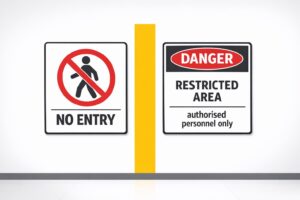
Restricted Area Signs vs. No Entry Signs
Compare No Entry and Restricted Area signs in Australian workplaces — meanings, design differences and AS 1319 compliance.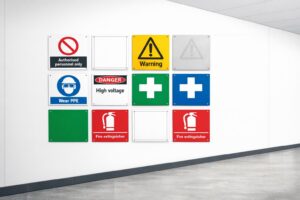
How to Spot Workplace Signage Gaps
Audit your workplace for missing, faded or non‑compliant signs under AS 1319 to reduce incidents and avoid WHS fines.
Symbol Design: Global Standards Explained
Explains ISO 7010 and ISO 3864: standard symbols, colours and sizing for clear, language‑free safety signage and AU compliance.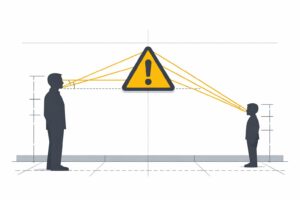
Hazard Sign Visibility Planner
Plan hazard sign placement for max visibility with our free tool. Ensure safety by finding the best spot, height, and angle—try it now!