Temporary Fire Signs: Compliance Tips
Temporary fire signs are a legal requirement on construction sites in Australia. They provide critical safety information, guide workers during emergencies, and ensure compliance with Australian Standards like AS 1319:2010 and AS 2419.1:2021. Failure to comply can lead to fines of up to $220,000 for corporations and $110,000 for individuals, alongside potential shutdowns or insurance issues.
Key Points:
- AS 1319:2010: Specifies design (red background, white text/symbols), placement (eye level, unobstructed), and durability standards for signs.
- AS 2419.1:2021: Introduced updates such as hydrant ID plates, block plans, and visibility measures like red strobe lights for hydrants.
- Penalties: Non-compliance risks include hefty fines, stop-work orders, and invalidated insurance claims.
- Common Sign Types: Fire equipment signs (extinguishers, hydrants), emergency exit signs, and mandatory PPE signs.
- Sign Placement: Fire extinguisher signs must be at least 2,000 mm above floor level, with clear visibility even in smoke or low light.
Regular inspections and updates are essential as construction progresses. Signs must remain visible, durable, and compliant with regulations to ensure safety and avoid penalties.
Australian Standards for Temporary Fire Signs
Australian Fire Sign Standards: AS 1319:2010 vs AS 2419.1:2021 Requirements
Two key Australian Standards regulate temporary fire signage on construction sites: AS 1319:2010 (Safety Signs for the Occupational Environment) and AS 2419.1:2021 (Fire Hydrant Installations). Below, we break down the design and placement rules under AS 1319:2010 and the updates introduced in AS 2419.1:2021, which impact temporary signage.
AS 1319:2010 Requirements
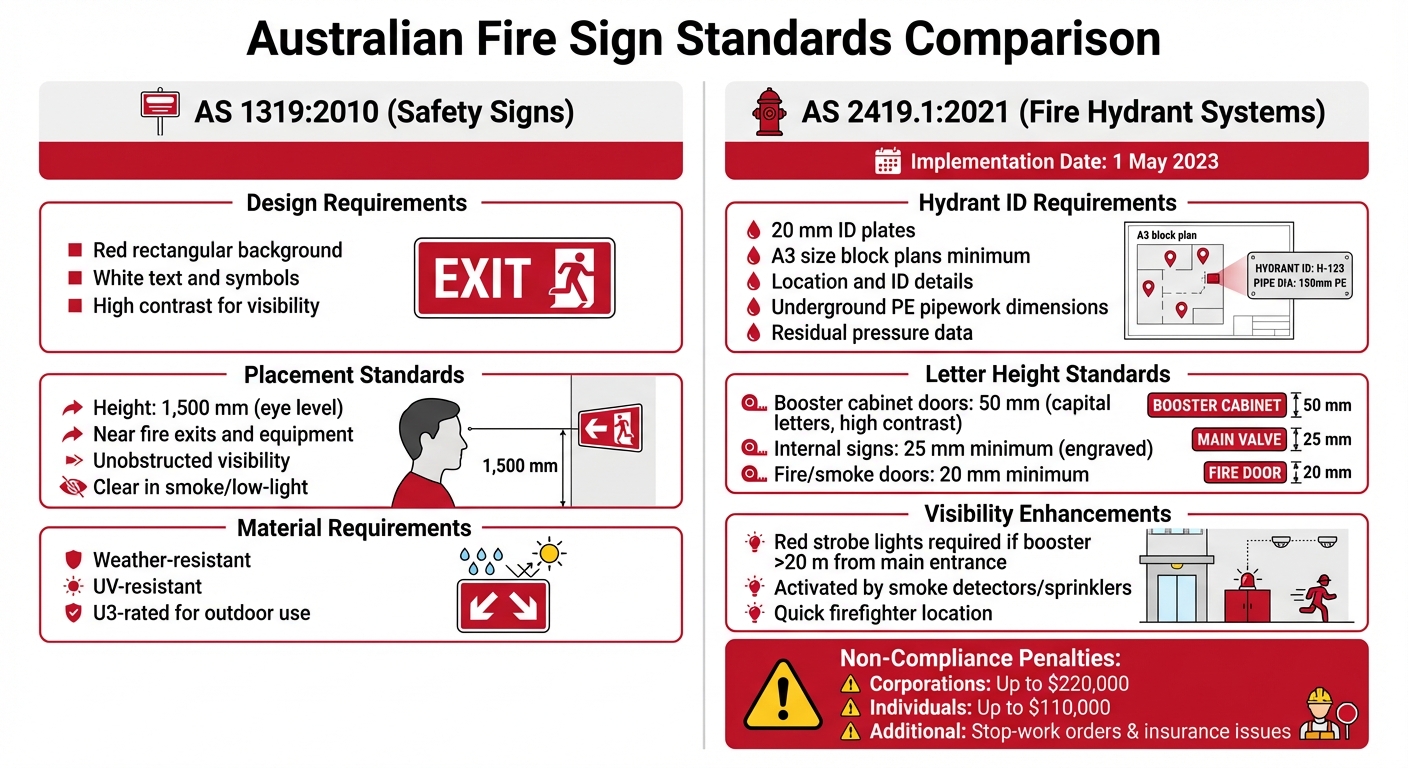
AS 1319:2010 provides specific guidelines for the design and placement of temporary fire signs. These signs must have a red rectangular background with white text, symbols, or a combination of both. This colour scheme ensures they remain noticeable, even in smoke-filled or chaotic environments.
To meet visibility standards, signs must be legible from a reasonable distance and positioned to remain visible under low-light or smoky conditions. Placement is critical – fire signs should be located near fire exits and directly above or next to firefighting equipment, such as extinguishers and hose reels. The recommended height for mounting is approximately 1,500 mm, ensuring signs are at eye level while avoiding any potential hazards.
Construction sites demand durable signs. Materials must be weather-resistant, withstanding UV exposure and harsh conditions. For outdoor areas, using U3-rated materials is recommended to ensure long-term legibility and reliability.
AS 2419.1:2021 Changes
The 2021 update to AS 2419.1, implemented from 1 May 2023, introduced refined standards for fire hydrant system signage. According to HTC Group, "The 2021 version of AS2419.1 introduces significant improvements in designing, installing, and commissioning fire hydrant systems that was introduced on the 1st of May 2023" [2].
One major update involves hydrant identification. Each hydrant must now include a 20 mm ID plate linking it to the site’s block plan. These block plans, which must be at least A3 in size, are required to detail the location and ID number of every hydrant, the dimensions of underground PE pipework, and the water supply’s residual pressure. Booster cabinet doors must display capital letters at least 50 mm high in a high-contrast colour, while internal signs for booster and test pressure must feature engraved letters no smaller than 25 mm high.
Additional visibility measures have also been introduced. For instance, if a booster is installed on a building façade but positioned more than 20 m from the main pedestrian entrance, it must now include a red strobe light. This light is activated by smoke detectors or sprinkler systems, helping firefighters locate it quickly. As Complete Fire and Pumps explains, "New standards call for hydrants to have clear, easily recognisable signs that guide firefighters directly to them, ensuring quick access in critical situations" [3].
sbb-itb-9950c92
Required Temporary Fire Signage on Construction Sites
Common Temporary Sign Types
Construction sites need to display essential safety signs to ensure worker safety and assist emergency services. Fire equipment signs are essential for marking the location of extinguishers, hydrants, and hose reels. These signs must follow the standard red rectangular background with white text or symbols, as outlined in AS 1319:2010 [1]. Their purpose is to help emergency responders quickly locate fire suppression tools during a crisis.
Emergency information signs, featuring a green background with white symbols, are used to point out exits, first aid stations, and assembly points [4]. Mandatory signs, which display blue circles with white pictograms, indicate the required use of personal protective equipment, while danger signs, with a red oval on a black background, highlight life-threatening risks such as high-voltage areas [4].
The absence or inadequacy of proper signage can have serious repercussions. For instance, in 2025, a builder in Sydney faced a $470,000 fine for multiple safety violations, including insufficient signage [4]. Under Australia’s Work Health and Safety laws, businesses can be fined up to $23,100 for non-compliant signage, with state-specific penalties in Western Australia ranging from $5,000 to $25,000 [4]. As construction progresses, updating signage is critical to maintaining safety and compliance.
Updating Signs as Construction Progresses
Temporary signage must adapt to the evolving nature of construction sites. Signs should be installed before any work begins and remain in place until the project is finished, with regular updates to reflect changes on-site [4]. For example, as new floors are built or fire protection systems are extended, signs indicating the highest active fire hydrant must be repositioned accordingly [4].
Site managers are responsible for conducting regular inspections to identify new hazards and ensure that signage matches the current layout. When new entry points are created, additional signs must be placed at these locations [4]. Any signs that become faded, damaged, or blocked by scaffolding, materials, or tarpaulins need immediate replacement to stay compliant [1].
"Regular risk assessments become necessary whenever workplace layouts, processes, or hazards change" [6].
Keeping a stock of spare signs on-site allows for quick replacements when needed. Including signage checks in routine safety audits ensures that fire equipment locations and other vital information remain clearly marked even as the site evolves [4].
Design and Material Requirements
This section highlights the specific design and material standards required for temporary fire signs, ensuring they remain visible and durable under tough site conditions.
Colour and Text Requirements
According to AS 1319, fire signs must adhere to strict colour guidelines for quick recognition during emergencies. Signs should feature a red rectangular background with white text and symbols [1][8]. The red safety colour must meet a luminance factor of at least ≥ 0.07, with chromaticity coordinates ranging approximately between 0.524 and 0.690 (x) and 0.310 and 0.351 (y) [7].
Text on these signs must be clear and legible from the intended viewing distance. The standard specifies uppercase letters with a minimum height of 5 mm per metre of viewing distance [9]. For example, a sign viewed from 10 metres must have text at least 50 mm tall. Similarly, pictograms should be no smaller than 15 mm per metre of viewing distance [9]. High contrast is essential – placing a white sign on a white wall, for instance, can render it ineffective [8].
Weather-Resistant Materials
Temporary fire signs on construction sites face Australia’s challenging weather conditions, making durable materials crucial. For short-term use, 5 mm corrugated plastic (Corflute) is a popular choice due to its lightweight design and ability to last up to 3 years outdoors [9][10].
In areas with intense sun exposure, polypropylene signs (1.4 mm thick) are a better option. These signs offer excellent UV stability, withstand temperatures between –40°C and 150°C, resist fading and cracking for 3 to 5 years, and are fully recyclable [9][10]. For longer-term installations, Colorbond metal signs provide durability for 5 to 8 years outdoors [10]. Importantly, all materials must maintain the required red and white colours throughout their lifespan to comply with AS 1319.
Size and Placement Standards
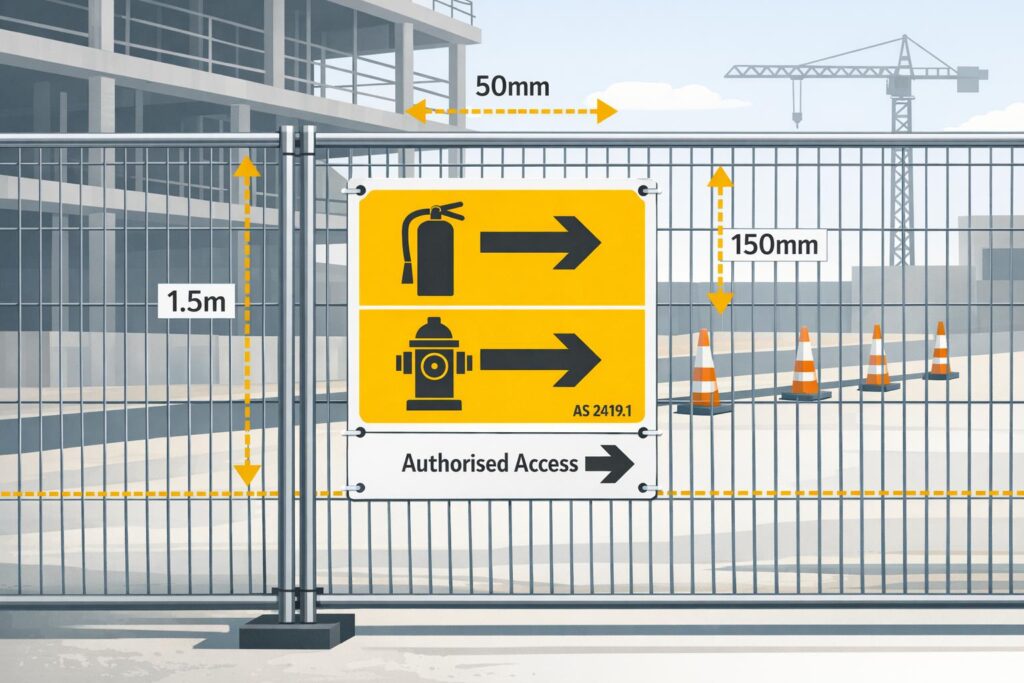
Sign dimensions should correspond to the viewing distance and environmental conditions. Standard-sized signs (300 mm x 225 mm) are suitable for distances up to 12 metres, while larger signs (450 mm x 300 mm) are recommended for 18-metre viewing distances [12]. In poorly lit or dusty environments, sizes should increase by at least 50% to ensure visibility. Fire equipment location signs should be mounted at a minimum height of 2,000 mm above the floor, enabling visibility from up to 20 metres away [11][14].
In areas with vehicular traffic, such as forklift zones, larger signs are essential since operators in motion may struggle to read smaller text or pictograms [12]. Signs should always be placed against contrasting backgrounds and kept unobstructed by items like scaffolding, stacked materials, or structural elements [13][14]. These measures are vital for maintaining compliance and ensuring the safety of workers during construction activities.
For organisations needing compliant, durable temporary fire signs, PXP Safety offers a range of solutions tailored to meet these stringent standards.
Sign Placement and Visibility Rules
Placement Best Practices
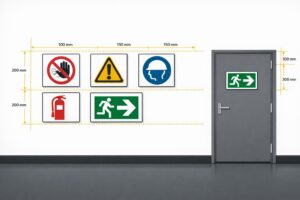
Strategic sign placement plays a key role in ensuring visibility and compliance on busy construction sites. Temporary fire signs, in particular, must be positioned to remain visible during emergencies. All fire safety signs should be installed at eye level or higher in areas free of obstructions [1]. If visibility is compromised by scaffolding, stacked materials, or temporary walls, additional directional signs are necessary to guide workers effectively to equipment or exits [1].
Fire extinguisher location signs must be mounted at least 2,000 mm above the finished floor, with equipment signs for extinguishers and hose reels placed directly above or beside the equipment [5][1]. Fire exit signs should be installed either above or adjacent to every designated exit and must remain illuminated – using built-in or emergency lighting – to ensure they are visible during power outages or when smoke reduces visibility [1].
On sites with limited natural light or during night shifts, critical safety signage should be placed in areas illuminated by emergency lighting [1]. Routine maintenance and cleaning are essential to prevent dust accumulation, which can make signs harder to read [4]. In New South Wales, fire doors leading to exits or fire stairs must display signage on both sides of the door, ensuring clarity for both occupants and emergency responders [1]. Additionally, state-specific rules may impose further placement requirements.
State-Specific Requirements
While national standards set the groundwork, individual states add their own layers of compliance. Authorities such as Fire and Rescue NSW (FRNSW), Queensland Fire and Emergency Services (QFES), and ACT Fire & Rescue (ACTF&R) have specific guidelines for construction sites [1]. For example, in Queensland, fire door tags must be issued by a QBCC-licensed fire door contractor and include the Fire Resistance Level (FRL) achieved [5].
| Signage Type | Minimum Letter Height | Mandatory Placement Standards |
|---|---|---|
| Fire/Smoke Doors | 20 mm | High contrast; NSW requires signs on both sides [5][1] |
| Fire Hydrant Booster (External) | 50 mm | Capital letters; must include A3 size block plan [5] |
| Fire Hydrant Booster (Internal) | 25 mm | Engraved sign indicating booster and test pressure [5] |
| Fire Extinguisher (Location) | Per AS 2444 | Minimum 2,000 mm above finished floor level [5] |
| Fire Extinguisher (Cupboard) | 32 mm | On external door of enclosure [5] |
| Fire Indicator Panel | 50 mm | High contrast lettering "FIRE PANEL" [5] |
Failing to comply with signage regulations can result in steep penalties. Under national WHS laws, businesses may face fines up to $23,100 for missing or incorrect signage [4]. In 2025, a Sydney construction company was fined $470,000 for multiple safety violations, including inadequate site signage [4]. In Western Australia, penalties for signage breaches range from $5,000 to $25,000, with CASM Construction fined $750,000 after an incident where hazards were not clearly marked [4].
Compliance Updates and Audit Procedures
Meeting AS 2419.1:2021 Standards
The AS 2419.1:2021 standard brought crucial updates to temporary fire signage for construction sites. Released on 3 September 2021, this nearly 300-page document is now the go-to guide for fire hydrant installations under the National Construction Code (NCC) 2022 [15][17]. A standout change focuses on improved visibility and guidance, ensuring signage directs firefighters straight to hydrants without unnecessary delays during emergencies [16].
The updated standard also emphasises durability. Signs must be made from materials that can withstand Australia’s tough outdoor conditions, including corrosion and extreme weather. This is especially critical for bushfire-prone areas, where signage and equipment must endure high temperatures and ember attacks [16]. To maintain compliance, regular inspections are essential, as the standard requires hydrants and their signage to remain unobstructed at all times – free from vehicles, construction debris, fences, or vegetation [16].
With these new requirements in place, regular audits are a must to ensure ongoing compliance and functionality.
Regular Signage Audits
Systematic audits are key to maintaining adherence to the updated standards. These should be conducted twice a year or whenever significant changes occur in the site’s structure or operations [18]. Begin by creating a current site map that pinpoints all required fire safety sign locations based on the site’s construction phase [18]. Then, inspect each sign for issues like fading, peeling, cracking, or obstructions caused by construction activity [18][19].
"Safety signage should be checked regularly – ideally as part of your monthly/quarterly workplace inspections." – Phoenix Graphics [19]
Most safety signs are effective for 3–7 years, but Australia’s harsh weather can shorten their lifespan, making earlier replacement necessary [19]. During audits, ensure signs meet AS 1319 standards for symbols, colours, and readability, even in low-light conditions [18][19]. Keep detailed records of all findings to demonstrate compliance during WHS inspections. Also, remove outdated or conflicting signs to reduce visual clutter [18][19].
These regular checks not only help with compliance but also boost site safety by addressing hazards as they arise.
Conclusion
Temporary fire signage plays a critical role in ensuring safety on construction sites and is a legal obligation under the National Construction Code and state regulations. Ignoring these requirements can lead to hefty fines, increased liability, and, most importantly, put lives at risk.
To comply, signage must meet the standards outlined in AS 1319:2010, including specifications like minimum text heights – 10 mm for lift warnings and 50 mm for fire hydrants – and proper positioning at eye level or higher. Additionally, AS 2419.1:2021 highlights the need for durability, ensuring signs remain effective in challenging site conditions.
Given the ever-changing nature of construction sites, regular audits are essential to confirm that signage remains visible and up to code. Effective maintenance not only satisfies legal requirements but also provides critical guidance during emergencies, potentially saving lives.
Take the time to review your temporary fire signage to ensure it aligns with these standards. Keeping your signage compliant and up-to-date is key to maintaining a safe and legally sound construction environment.
FAQs
Which fire signs are mandatory on my construction site?
Construction sites must have mandatory fire signs, including fire equipment signs and fire safety signs. These signs play a crucial role in helping workers and visitors quickly locate fire-fighting equipment and understand emergency procedures. To stay compliant with Australian standards, it’s essential to regularly check that your signage aligns with the most up-to-date regulations, ensuring a safer environment for everyone on site.
How do I apply AS 2419.1:2021 updates to temporary hydrant signage?
To comply with the updates outlined in AS 2419.1:2021, it’s essential to focus on several key areas, including hydrant location, classification, and signage requirements.
For external hydrants located within 100 metres of a hardstand, these must now be classified as attack hydrants. Additionally, signage should be positioned so it is clearly visible from the hardstand, ensuring easy identification during emergencies.
Beyond placement, ensure all hydrants meet the updated standards for pressure testing and operational specifications. This includes verifying the reticulation system’s pressure levels and ensuring booster systems are in place where required.
Finally, signage must align with the revised standards and local regulations, ensuring it is clear, accurate, and easy to interpret. This attention to detail will help maintain compliance and improve safety outcomes.
How often should I audit and replace temporary fire signs on site?
Temporary fire signs need regular audits to ensure they remain visible and meet compliance standards. These signs generally require replacement every 6 to 12 months. However, if they become damaged, obscured, or fail to align with current site conditions and regulations, earlier replacement may be necessary. Frequent inspections are key to maintaining safety and adhering to Australian guidelines.
Related Blog Posts
You may also be interested in
FAQs About Workplace Safety Signs in Australia
AS 1319 sign types, placement, materials and maintenance for workplace safety and WHS compliance in Australia.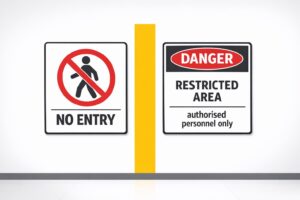
Restricted Area Signs vs. No Entry Signs
Compare No Entry and Restricted Area signs in Australian workplaces — meanings, design differences and AS 1319 compliance.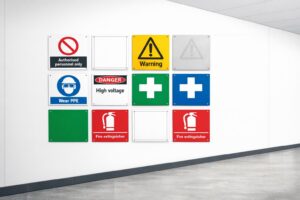
How to Spot Workplace Signage Gaps
Audit your workplace for missing, faded or non‑compliant signs under AS 1319 to reduce incidents and avoid WHS fines.
Symbol Design: Global Standards Explained
Explains ISO 7010 and ISO 3864: standard symbols, colours and sizing for clear, language‑free safety signage and AU compliance.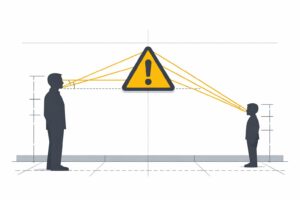
Hazard Sign Visibility Planner
Plan hazard sign placement for max visibility with our free tool. Ensure safety by finding the best spot, height, and angle—try it now!