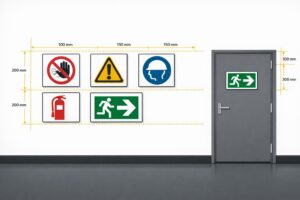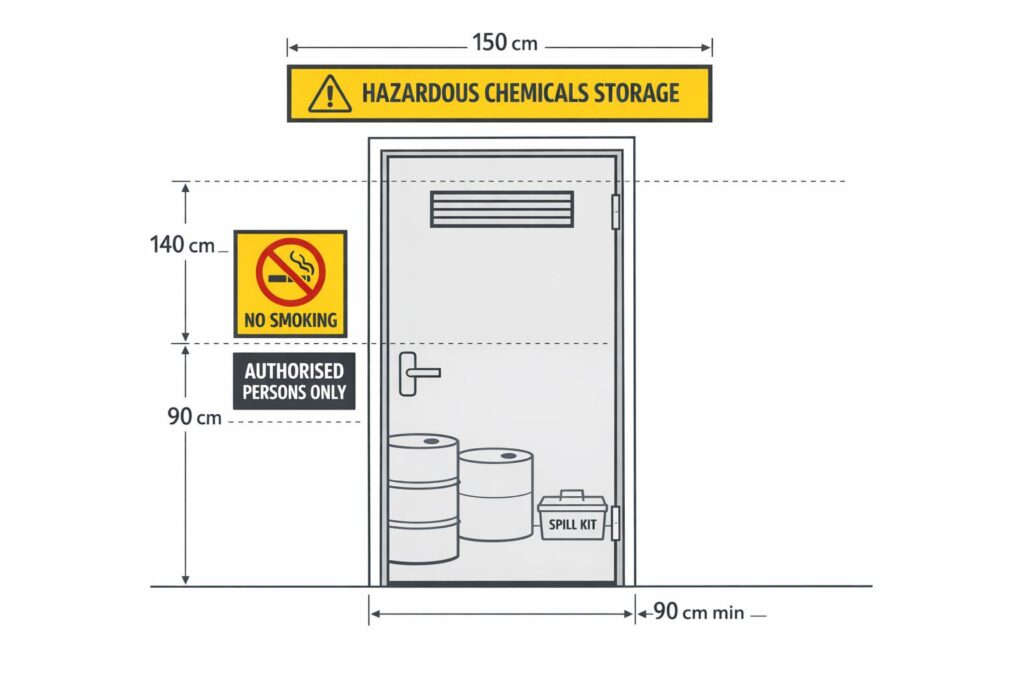
How to Choose Hazardous Material Storage Signs
Hazardous material storage signs are essential for workplace safety and compliance with Australian regulations. They help identify chemical hazards, prevent accidents, and guide emergency responders during incidents. Here’s what you need to know:
- Regulations: Signs must comply with Australia’s WHS Regulation 2025, the ADG Code, and the GHS system for chemical classification.
- Types of Signs:
- Outer Warning Placards (e.g., "HAZCHEM") are mandatory at facility entrances.
- Bulk Storage Placards are required for containers over 500 litres or kilograms, displaying UN Numbers, HAZCHEM Codes, and ADG Class labels.
- Packaged Goods Placards apply to smaller storage areas exceeding Schedule 11 thresholds.
- Materials: Use durable, weather-resistant materials like reflective aluminium or polypropylene to ensure legibility and compliance.
- Placement: Signs must be visible from 10 metres away, free from obstructions, and separate from other notices.
- Thresholds: Specific storage quantities trigger signage requirements, such as 200 litres for flammable gases or 50 litres for highly toxic chemicals.
Proper signage ensures safety, compliance, and efficient emergency response. Keep signs in good condition and update them if storage conditions change.
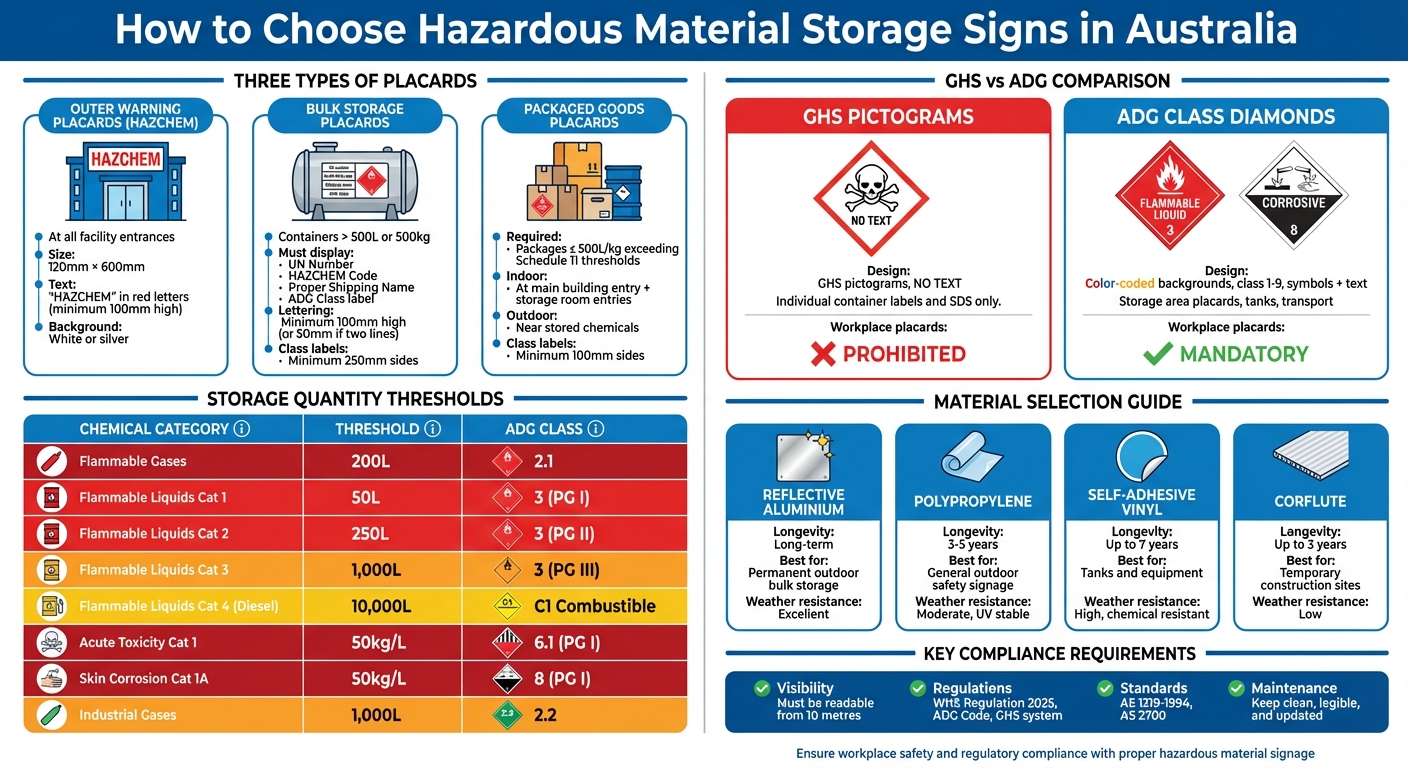
Australian Hazardous Material Storage Sign Requirements and Thresholds Guide
Australian Compliance Requirements
Key Regulations for Hazardous Material Signage
Understanding the essential safety signs and legal framework is an essential first step. The WHS Regulations (Part 7.1, Schedule 11, and Schedule 13) form the backbone of compliance requirements. These regulations are complemented by the Australian Dangerous Goods (ADG) Code, which outlines specifications like dimensions, colours, and class labels for placards [1].
For workplaces storing flammable and combustible liquids, AS 1940-2017 provides additional guidelines that align with WHS placard rules. These are particularly relevant for industries like petrol stations, fuel depots, and facilities handling large quantities of liquid fuels [1].
Placards become mandatory when the quantity of hazardous materials exceeds the thresholds in Schedule 11. For highly hazardous substances – such as Category 1 Flammable Liquids or Category 1 Acute Toxicity chemicals – the threshold is as low as 50 litres or kilograms. In comparison, less hazardous substances like Category 4 Flammable Liquids (e.g., diesel) require placards only when storage reaches 10,000 litres [1].
To meet compliance, placards must be made from durable, weather-resistant materials. They should always remain clean and clearly legible. Additionally, they must be placed separately from other signage to avoid confusion. Importantly, workplace placards must use ADG Code class diamonds rather than GHS pictograms [1].
The next step is to understand the specific types of placards required for different storage scenarios.
Types of Placards and When to Use Them
Australian regulations specify three main types of placards:
- Outer Warning Placards: Commonly referred to as HAZCHEM signs, these are required at all workplace entrances where emergency services may need access. The sign must feature the word "HAZCHEM" in red letters (at least 100 mm high) on a white or silver background, with typical dimensions of 120 mm by 600 mm. These are mandatory whenever any Schedule 11 threshold is exceeded.
- Bulk Storage Placards: These apply to containers with a capacity greater than 500 litres or a net mass exceeding 500 kilograms. The placard should be positioned on the container’s external surface or nearby. It must display the Proper Shipping Name, UN Number, HAZCHEM Code, and the appropriate ADG Class label. Lettering should be at least 100 mm high (or 50 mm if split into two lines), and class labels must have a minimum side length of 250 mm.
- Packaged Goods Placards: These are necessary for storage areas containing packages of 500 litres/kilograms or less if the total quantity exceeds Schedule 11 thresholds. For indoor storage, placards should be placed at the main building entry and at every entry to the specific storage room. For outdoor storage, they should be located near the stored chemicals. When assessing thresholds, assume all containers are full, and for gas cylinders, use the water capacity (WC) indicated on the neck [1].
| Chemical Category | Required Quantity | ADG Class |
|---|---|---|
| Flammable Gases (e.g., LP gas) | 200 L | 2.1 |
| Flammable Liquids Category 1 | 50 L | 3 (PG I) |
| Flammable Liquids Category 2 | 250 L | 3 (PG II) |
| Flammable Liquids Category 3 | 1,000 L | 3 (PG III) |
| Flammable Liquids Category 4 (diesel) | 10,000 L | C1 Combustible |
| Industrial Gases (nitrogen, oxygen) | 1,000 L | 2.2 |
| Acute Toxicity Category 1 | 50 kg or L | 6.1 (PG I) |
| Skin Corrosion Category 1A | 50 kg or L | 8 (PG I) |
An important exemption exists for fuel retailers: service stations are generally not required to display outer warning placards or information placards for underground tanks used for vehicle refuelling. However, this exemption does not apply to above-ground LPG tanks or other hazardous chemicals stored above the specified thresholds [1].
sbb-itb-9950c92
Choosing the Right Sign Types
Common Hazardous Material Sign Types
Once compliance is sorted, the next step is choosing signs that effectively communicate hazards. In Australian workplaces, specific sign types are used to address different hazard communication needs.
Danger signs are designed to warn about serious hazards. On the other hand, GHS pictograms are used for labelling individual containers, featuring graphic symbols, signal words, and crucial hazard details [7][8]. The size of GHS pictograms depends on the container size – ranging from 15×15 mm for smaller volumes to 100×100 mm for containers holding 25 litres [7].
ADG Code class diamonds are essential for placarding storage areas. These diamonds are colour-coded, displaying class numbers (1–9), symbols, and descriptive text. For example, Class 3 flammable liquids are marked with a red background and a flame symbol, while Class 8 corrosives feature black and white sections with a corrosion symbol [5][6]. Bulk and packaged applications must follow the specified dimensions for these signs.
If a chemical has multiple significant hazards, subsidiary risk signs are also required. Secondary hazards, as outlined in Section 2 of the Safety Data Sheet, must be displayed alongside the primary class label on bulk tank placards [1][8].
Understanding these sign types highlights why only ADG Code class diamonds are suitable for placarding purposes.
GHS Pictograms vs Dangerous Goods Class Diamonds
Clear hazard communication relies on differentiating between GHS pictograms and ADG Code class diamonds. While both systems address chemical hazards, they serve distinct purposes and are not interchangeable for workplace placarding [1][2].
GHS pictograms consist of a black symbol on a white background with a red diamond-shaped border but do not include text [5][8]. They are mandatory for labelling individual chemical containers and are featured in Section 2 of Safety Data Sheets to inform workers about specific health, physical, and environmental risks [7]. However, in Australia, GHS pictograms cannot be used for placarding storage areas, tanks, or facility entrances [1][2]. This is where the role of ADG Code class diamonds becomes essential.
Dangerous Goods class diamonds, regulated by the ADG Code, use defined colours, include class numbers, and often feature descriptive text [5][6]. These diamonds are the only approved format for information placards and outer warning placards in Australian workplaces [1]. The visual differences are clear: for instance, a Class 3 flammable liquid diamond is red, while a Class 8 corrosive diamond has black and white contrasting sections [5][6].
| Feature | GHS Pictograms | Dangerous Goods Class Diamonds |
|---|---|---|
| Primary Use | Labelling individual containers and SDS [5][2] | Placarding storage areas, tanks, and transport [5][1] |
| Visual Design | Red border, white background, black symbol, no text [5][8] | Colour-coded backgrounds, class numbers (1–9), symbols, and text [5][6] |
| Mandatory for Placards? | No (prohibited for placarding in Australia) [1][2] | Yes [1][2] |
For environments storing a mix of chemicals, the information placard must include all relevant ADG class diamonds, displayed side by side on a white or silver background [1][2]. These diamonds can be arranged horizontally, vertically, or diagonally, provided they are clearly visible from at least 10 metres away [9][10]. If you’re managing a transit storage area where chemical types frequently change, consider using slip-in/slip-out frames for quick updates to the displayed class labels [1].
Assessing Your Site’s Storage Needs
Factors to Consider for Sign Placement
To ensure emergency responders can quickly identify hazards, display outer warning placards (HAZCHEM signs) at every facility entrance. Indoors, place information placards at the main entry and on every door leading to chemical storage areas [1][10].
Think about how your facility’s layout might affect the visibility of signs. Avoid placing signs above doors or in spots where doors, gates, or other objects could block them. Signs should remain legible from at least 10 metres away, regardless of the conditions [9][10]. For bulk tanks, attach placards directly to the tank’s surface or position them immediately next to it [1][9].
Keep placards separate from other notices to avoid confusion, and avoid placing them too high where they might be hard to see. Emergency responders should be able to spot hazard warnings right away without needing to search or guess.
Once sign placement is sorted, evaluate your storage quantities to determine the exact signage requirements.
How Storage Quantities Affect Signage Requirements
Signage is required only when storage quantities exceed the thresholds outlined in Schedule 11 [1][4]. For example, flammable gases need signage when storage reaches 200 L, while Category 4 flammable liquids, like diesel, require signage only at 10,000 L [1][4].
The 500 L or 500 kg threshold separates bulk storage from packaged storage. Bulk storage needs tank placards that include the UN Number, HAZCHEM code, and Proper Shipping Name, while packaged storage requires information placards with ADG Code class diamonds. When calculating totals, assume all containers are full. If you’re storing a mix of flammable liquids, treat the entire volume as belonging to the highest hazard category [1][2][3][4].
Refer to the table below for specific thresholds and the required signage:
| Chemical Category | Placard Threshold | Required Signage |
|---|---|---|
| Flammable Gases (Cat 1) | 200 L | Class 2.1 Diamond |
| Flammable Liquids (Cat 1) | 50 L | Class 3 Diamond (PG I) |
| Flammable Liquids (Cat 2) | 250 L | Class 3 Diamond (PG II) |
| Flammable Liquids (Cat 3) | 1,000 L | Class 3 Diamond (PG III) |
| Flammable Liquids (Cat 4/Diesel) | 10,000 L | "COMBUSTIBLE LIQUID" text |
| Acute Toxicity (Cat 1) | 50 kg or L | Class 6.1 Diamond |
| Corrosive to Metals (Cat 1) | 1,000 kg or L | Class 8 Diamond |
Accurately calculating your storage quantities is critical for ordering signage that complies with Australia’s Work Health and Safety (WHS) regulations. Proper signage not only ensures compliance but also enhances safety at your site.
Selecting Durable and Compliant Materials
Recommended Materials for Long-Term Use
Once you’ve assessed your storage needs, the next step is choosing materials that ensure safety and compliance over time. According to WHS Regulations, placards must be durable, weather-resistant, and easily legible [1]. This is especially important in Australia, where signage materials must endure intense UV rays, extreme heat, and unpredictable weather conditions [12].
Reflective aluminium stands out as the best option for permanent outdoor signage. Its strength and resistance to corrosion make it ideal for bulk tanks and long-term applications [12]. For facilities needing high visibility in low-light situations, reflective aluminium with Class 2 reflective sheeting is a reliable choice. This ensures emergency responders can identify hazards quickly, even at night.
Polypropylene is another practical option, particularly for general outdoor safety signage. This UV-stable plastic resists heat, fading, and cracking, lasting 3 to 5 years in Australian conditions [12]. Plus, it’s 100% recyclable, making it an environmentally friendly choice [12]. For labelling tanks and equipment, self-adhesive vinyl is a durable solution, offering resistance to heat, chemicals, and fading for up to 7 years outdoors [12].
For temporary sites, such as construction zones, 5mm Corflute is a cost-effective choice. It has a lifespan of up to 3 years [12], but it’s not suitable for permanent installations where durability is a priority.
All materials must adhere to AS 1319-1994 and AS 2700 standards. This includes supporting the required lettering heights (minimum 100 mm for bulk placards) and being legible from at least 10 metres away [2][11][12]. Your choice should align with your site’s specific exposure and durability requirements.
Material Options Comparison
Below is a breakdown of common material options based on their durability and best applications:
| Material | Outdoor Longevity | UV & Weather Resistance | Best Use Case |
|---|---|---|---|
| Reflective Aluminium | Long-term | Excellent; corrosion resistant | Permanent outdoor bulk storage and tanks |
| Colorbond Steel | 5–8 years | High; powder-coated finish | Long-term outdoor wall-mounted signs |
| Self-Adhesive Vinyl | Up to 7 years | High; chemical and fade resistant | Smooth surfaces, tanks, and equipment |
| Polypropylene | 3–5 years | Moderate; UV stable and heat tolerant | General outdoor safety signage |
| Corflute (5mm) | Up to 3 years | Low; lightweight and low cost | Temporary construction or building sites |
Selecting the right material depends on your site’s specific needs. Chemical storage facilities exposed to corrosive environments benefit from reflective aluminium’s superior resistance. Meanwhile, polypropylene offers a cost-effective solution for general warehouses. For tanks and containers, ensure the material is compatible with the chemicals stored to avoid degradation [3].
Custom Signage for Specific Requirements
When to Consider Custom Signs
Sometimes, standard signage just doesn’t cut it – especially when a site’s storage setup doesn’t align with generic options. Take, for instance, chemical storage in transit areas where the types of hazardous materials frequently change. In such cases, slip-in/slip-out frame systems are a practical solution, allowing you to update hazard warnings without needing to replace entire signs [1].
For facilities managing multiple hazard classes, custom composite signs are a game-changer. These signs combine several hazard symbols into one, all while adhering to AS 1216 and AS 1319 standards [2]. If your site handles "Goods Too Dangerous to be Transported" (GTDTBT) – like unstable explosives or Type A organic peroxides – you’ll need specialised "Unstable Goods" labels instead of the usual UN numbers and HAZCHEM codes [1].
"Custom workplace signs – including industrial safety signs designed for specific hazards – address this challenge head-on. Unlike generic warnings, custom signs reflect a facility’s specific risks, procedures, and environments." – Henry Verdine [13]
Custom signage isn’t just about compliance; it’s about improving efficiency. By including site-specific instructions – like lockout/tagout procedures or PPE requirements – custom signs help reduce confusion and delays. With 2.6 million nonfatal workplace injuries and illnesses reported in the U.S. in 2023, equating to 2.4 cases per 100 full-time workers [13], clear and tailored signage plays a key role in preventing accidents.
If your facility has unique needs, check out the tailored solutions we offer below.
PXP Safety‘s Custom Signage Options
PXP Safety understands the importance of customised solutions, offering signage designed to meet Australia’s stringent regulatory standards. Their service allows for tailored sizes, designs, and text, all compliant with AS 1319-1994, ensuring your signage aligns with legal requirements for hazardous material storage [14]. Whether you need bulk storage placards with Proper Shipping Names, UN Numbers, and HAZCHEM Codes, or specific labels for chemical cabinets, PXP Safety’s team can adapt or redesign labels to meet both compliance standards and your company’s branding [15].
The materials used for custom signs are built to last, just like their standard range. Durable aluminium, UV-protective coatings, and outdoor-grade printing ensure the signs endure Australia’s harsh conditions. PXP Safety’s customisation process also includes expert guidance on regulations, such as GHS 7, which became mandatory for manufacturers and importers on 1 January 2023 [15]. You can specify exact dimensions, add company logos, include barcodes for asset tracking, and incorporate detailed safety instructions – all while meeting Australia’s strict visibility and legibility standards.
Installing and Maintaining Your Signs
Installation Best Practices
Getting your sign placement right is essential for ensuring emergency responders can act quickly when needed. If your property or building stores hazardous substances, signs should be installed at all vehicle and pedestrian entrances. For specific rooms containing hazardous materials, place a sign at every entrance. Outdoor storage areas require signs positioned either right next to the area or directly on the external surface of the tank [9][10].
To maximise visibility, make sure signs are readable from at least 10 metres away, regardless of lighting or weather conditions [9][10]. Avoid placing signs in spots where they could be obscured, such as above doors or behind gates. Keep them separate from other notices to reduce confusion and ensure they are well-lit [1][10].
Size and lettering requirements:
- Outer warning placards (HAZCHEM signs): 120 mm high × 600 mm wide, with red letters at least 100 mm high on a white or silver background [2][1].
- Bulk storage placard lettering: At least 100 mm high, or 50 mm high if split into two lines [2][1].
- Class labels for packaged goods: Minimum 100 mm sides [2][1].
- Class labels for bulk tanks: Minimum 250 mm sides [2][1].
Once installed, it’s crucial to keep your signs in good condition to maintain their effectiveness.
Regular Maintenance and Updates
Regular inspections are key to ensuring your signs remain compliant and effective. Australian regulations require that placards be kept in good repair and remain clearly legible at all times. Check regularly for issues like fading, damage, or anything blocking the sign from view.
"Signs that can’t be read or don’t accurately reflect the hazardous substances on site will not help to keep people safe" – WorkSafe New Zealand [9]
Update your signage promptly if there are changes to storage conditions. This includes any adjustments to the type, class, or quantity of hazardous substances [9][10]. For locations where chemical types frequently change – like transit depots – consider using slip-in/slip-out frame systems to make updates quicker and easier [1]. If signs become damaged or unreadable, replace them immediately. For tanks, placards must remain in place unless the tank has been confirmed to be free of hazardous chemicals [1].
How to Recognize and Storage Hazardous Materials
Conclusion
When selecting hazardous material storage signs, it’s important to ensure they meet compliance requirements, are suited to specific hazards, use durable materials, and are installed and maintained correctly.
In Australia, regulations require clear and compliant placards for hazardous chemical storage above certain thresholds. These placards are vital for providing emergency services with immediate access to critical information like HAZCHEM codes, UN numbers, and hazard classes during incidents such as fires or chemical spills [1][10]. To meet these standards, signs must remain legible from at least 10 metres away under various weather conditions, making material durability as crucial as regulatory compliance [10].
"Placards are a means of alerting the emergency services and other persons to the presence of hazardous chemicals and providing information about them." – SafeWork NSW [1]
The regulatory framework also specifies that ADG Code class diamonds are the only approved format for placards, with required dimensions of 250 mm for bulk storage and 100 mm for packaged storage [1][2].
FAQs
What is the difference between GHS pictograms and ADG Code diamonds?
The key distinction between GHS pictograms and ADG Code diamonds lies in their function and application. GHS pictograms are part of the Globally Harmonised System for the classification and labelling of chemicals. These symbols, featuring a red diamond border and a white background, are designed for use on chemical labels and safety data sheets. They highlight specific hazards such as flammability, toxicity, or risks to the environment, aiming to provide consistent hazard communication across workplaces internationally.
In contrast, ADG Code diamonds are unique to Australia and are used to label and classify dangerous goods during transport. These symbols focus on transport-related risks, such as fire or explosion hazards, and are displayed on vehicles and containers to ensure proper handling and adherence to Australian transport regulations. While both use a diamond shape, GHS pictograms are centred on workplace safety, whereas ADG Code diamonds are specifically designed for transport safety.
How do I choose the right placard for hazardous material storage?
Selecting the right placard for hazardous material storage means understanding the types and amounts of chemicals you’re storing and ensuring you meet Australia’s safety and compliance standards. Placards play a critical role in warning emergency services and others about potential risks, and they must align with specific legal requirements.
First, check if the chemicals you store exceed the placard quantities outlined in Australian regulations. If they do, you’ll need to display a HAZCHEM placard at your site’s entrance, along with hazard-specific signage in storage areas. Make sure your placards are made from sturdy materials, are easy to see, and include hazard codes, pictograms, and plain English descriptions.
By carefully reviewing your chemical inventory and adhering to the relevant safety rules, you can choose placards that ensure compliance and create a safer environment for everyone on-site.
What is the best material for durable and compliant hazardous material storage signs?
When it comes to durable and compliant hazardous material storage signs, polypropylene stands out as a strong option. It’s UV-stable, meaning it resists fading and cracking even in tough outdoor conditions, lasting up to 3–5 years. Plus, it’s made using an environmentally friendly process.
Polypropylene signs are also lightweight and tough, making them adaptable to a range of site-specific requirements. They’re built to handle harsh Australian weather while adhering to local safety standards.
Related Blog Posts
You may also be interested in
FAQs About Workplace Safety Signs in Australia
AS 1319 sign types, placement, materials and maintenance for workplace safety and WHS compliance in Australia.
Restricted Area Signs vs. No Entry Signs
Compare No Entry and Restricted Area signs in Australian workplaces — meanings, design differences and AS 1319 compliance.
How to Spot Workplace Signage Gaps
Audit your workplace for missing, faded or non‑compliant signs under AS 1319 to reduce incidents and avoid WHS fines.
Symbol Design: Global Standards Explained
Explains ISO 7010 and ISO 3864: standard symbols, colours and sizing for clear, language‑free safety signage and AU compliance.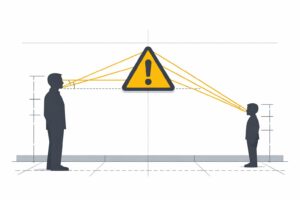
Hazard Sign Visibility Planner
Plan hazard sign placement for max visibility with our free tool. Ensure safety by finding the best spot, height, and angle—try it now!