How to Customise Pedestrian-Only Zone Signs
Pedestrian-only zone signs are among the essential safety signs for maintaining safety and compliance in Australia, especially in workplaces and high-traffic areas. Customising these signs helps address unique site needs, ensures visibility, and meets Australian Standards like AS 1742, AS 1743, and AS 1906. Key considerations include:
- Material Selection: Use durable options like Aluminium Composite Panels for permanent installations or lightweight Corflute for temporary sites. Reflective materials, such as Class 1 Reflective, are ideal for low-light conditions.
- Compliance: Adhere to standards such as AS 1319-1994 and AS 1742.10:2024, and check local regulations from agencies like Transport for NSW or VicRoads.
- Visibility: Ensure symbols and text are appropriately sized for viewing distances, and consider reflectivity for night-time visibility.
- Customisation: Tailor messages to specific site requirements, such as "Forklift Lane Only" or "Pedestrians Use Other Footpath", and include secondary information like operating hours.
- Installation: Place signs at eye level, ensure they’re unobstructed, and maintain them regularly to prevent fading or damage.
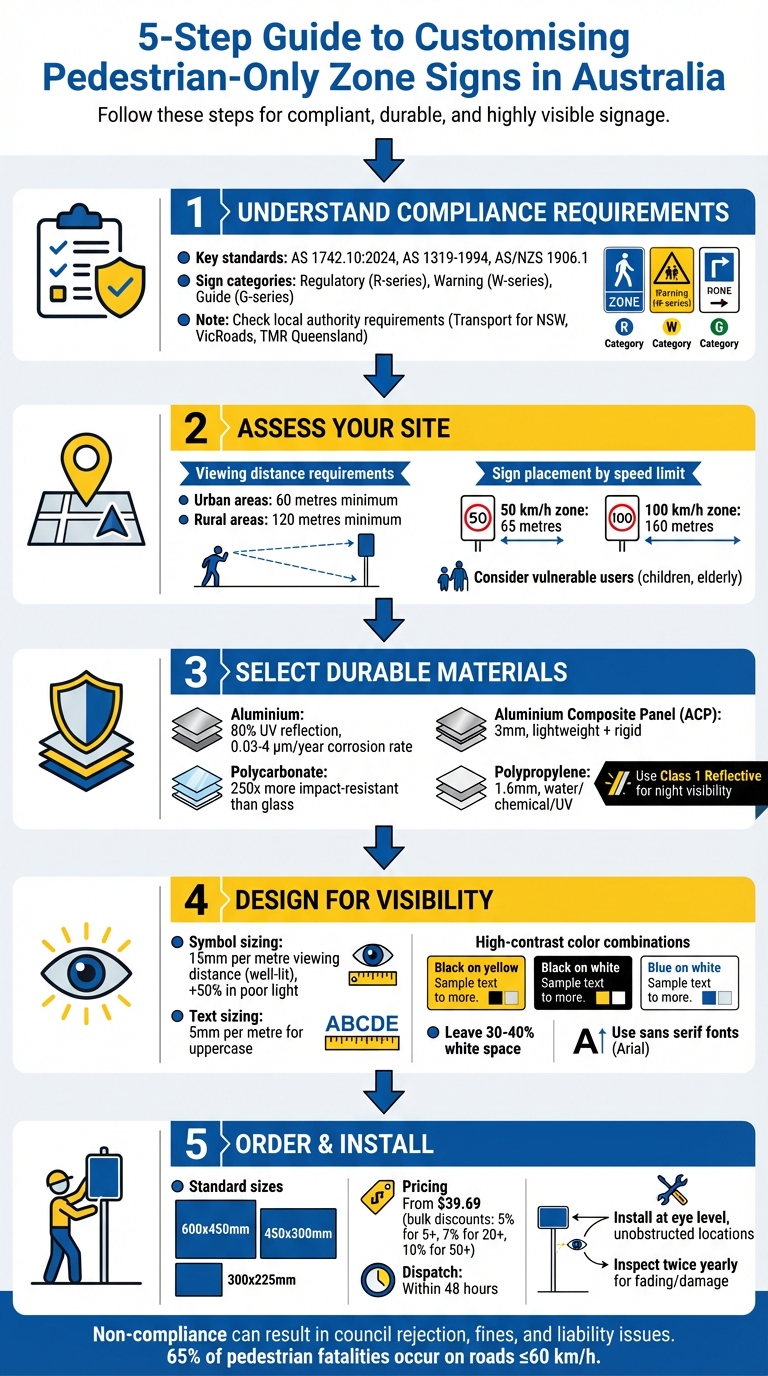
5-Step Guide to Customising Pedestrian-Only Zone Signs in Australia
Australian Standards for Pedestrian-Only Zone Signs
Regulations and Compliance Requirements
When customising pedestrian-only zone signs in Australia, it’s essential to follow specific standards to ensure legal compliance and workplace safety. The AS 1742.10:2024 standard, updated on 27 September 2024, outlines the rules for pedestrian control and protection. It applies to traffic control devices used in areas like malls, crossings, and pedestrian refuges [3]. For workplace settings, AS 1319-1994 governs the design, colour, and symbols of safety signs to maintain compliance and avoid penalties [4].
Pedestrian-related signs fall into distinct categories: Regulatory (R-series) for enforcing laws, Warning (W-series) for highlighting hazards, and Guide (G-series) for providing directions [5]. Within these categories, pedestrian signs are further divided into the R3 Pedestrian series, R8 Bicycle/pedestrian series, and G5 Pedestrian direction signs [5]. Regulatory signs, in particular, have strict rules regarding size and shape, which cannot be altered [7].
Visibility is a critical factor. Symbols on signs must be at least 15 mm per metre of viewing distance in well-lit areas. In poorly lit conditions, symbol sizes must increase by 50%, and uppercase text should be at least 5 mm per metre [4]. Additionally, all signs must comply with AS/NZS 1906.1, which sets standards for reflectivity, ensuring they remain visible at night or during adverse weather [7]. While these national standards provide a baseline, local requirements may also apply.
Following Local Guidelines
Beyond national standards, local authorities may enforce additional rules. For example, agencies like Transport for NSW, VicRoads, and TMR Queensland may have their own approval processes or specific requirements [7]. Before installing any signage, it’s a good idea to consult your local council or state road agency. In some states, pre-installation approval is mandatory to prevent zoning violations [7].
Non-compliant signs can lead to serious consequences, including rejection by the council, fines for contractors, and potential liability if an accident occurs in an area with improper signage [7]. To maximise visibility, signs should be placed at eye level against a contrasting background and kept unobstructed [4]. Regular maintenance is also crucial – inspect signs at least twice a year for fading or damage. Signs that are faded or damaged may lose their legal validity and fail to meet safety standards [7].
sbb-itb-9950c92
Assessing Your Site’s Requirements
Evaluating Site Layout and Foot Traffic
It’s essential to understand how pedestrians move through your site. Pay close attention to areas with high foot traffic, especially where there are no formal footpaths or crossings. This includes spots like road shoulders, recreational areas, or sections without defined pathways [8].
Drivers need a clear view of your signs – at least 60 metres in urban areas or 120 metres in rural settings. This means removing anything that could block their view, such as buildings, landscaping, or parked cars [8]. The exact placement of signs depends on the road’s speed limit. For example, signs should be 65 metres away in a 50 km/h zone and up to 160 metres away in a 100 km/h zone [8].
Think about who uses your site. If children or elderly pedestrians are common, include warning symbols like ‘School’ or ‘Aged’ to highlight potential risks [8]. This is crucial because older adults (over 70) account for 36% of pedestrian accident victims, and children often struggle to gauge vehicle speed accurately [11]. Alarmingly, 65% of pedestrian fatalities occur on roads with speed limits of 60 km/h or lower [11].
By considering these factors, you can tailor your signage to meet specific needs.
Identifying What to Customise
Customisation usually falls into two main categories: primary restrictions and secondary information [9]. Primary restrictions include messages like "Authorised Pedestrians Only" or "Private Property." Secondary information covers details such as operating hours, towing warnings, or contact numbers.
To ensure readability, match text size to the distance it needs to be read from. For example, signs placed over 23 metres away should use larger lettering, adding an extra inch for every 7.6 metres [9][10]. For visibility at night, consider retroreflective materials.
Additionally, address any site-specific hazards, such as narrow underpasses or steep grades. If signs are placed on the right-hand side of the road, adjust the orientation of pedestrian symbols so they appear to walk towards the road, enhancing clarity [8][9].
Selecting Materials for Durability
Material Options for Custom Signs
Once you’ve identified your site’s specific requirements, the next step is choosing materials that can handle Australia’s demanding weather conditions. Aluminium stands out thanks to its resistance to rust and corrosion, making it perfect for humid coastal environments. It reflects about 80% of UV radiation and has an impressively low corrosion rate of 0.03 to 4 µm per year, ensuring it holds up well even under intense sunlight [13].
For a lightweight yet sturdy option, Aluminium Composite Panel (ACP) is an excellent choice. This 3mm material combines two aluminium sheets with a polyethylene core, offering rigidity without added weight [1][12]. In more demanding environments, such as construction sites or industrial areas, Colorbond steel provides exceptional durability against harsh UV exposure, heavy rain, and other severe weather conditions [12].
In areas prone to vandalism or heavy impacts, polycarbonate is a smart pick. It’s 250 times more impact-resistant than glass and performs reliably across a wide temperature range, from -20°C to 140°C [13][16]. For industrial labelling, polypropylene is a practical choice. At 1.6mm thick, it resists water, chemicals, and UV exposure, all while being recyclable [12].
If your signage needs to remain visible at night, retroreflective sheeting is a must. Class 1 or prismatic reflective materials provide brighter visibility and last longer than basic engineering-grade alternatives [15]. These materials are designed to withstand Australia’s challenging conditions, ensuring your signs remain effective and durable.
Weather Resistance and Longevity
After selecting the right materials, it’s essential to focus on features that protect your signage from Australia’s harsh climate. The country’s intense UV levels can cause photodegradation, colour fading, and yellowing in unprotected materials. For example, Melbourne experiences about 15% more UV radiation than European cities at similar latitudes [16]. To combat this, opt for UV-stabilised materials or apply protective coatings to extend the life and appearance of your signage.
"In Australia’s harsh UV conditions, choosing the right materials isn’t just about aesthetics – it’s about protecting your brand investment for years to come." – James Wilson, Spectrum Sign Solutions [16]
Consider applying over-lamination to boost weather resistance and add anti-graffiti protection, particularly for vinyl and aluminium signs [1]. When it comes to colour selection, black, dark blue, and brown pigments are more resistant to UV fading, whereas reds, oranges, and bright yellows tend to fade quicker in outdoor settings [16].
Material thickness also plays a role in durability. For smaller signs (under 600mm), use aluminium that’s 1.2–1.6mm thick, while larger signs benefit from 2.5–3.0mm thickness [17]. In coastal regions, marine-grade aluminium or stainless steel mounting hardware can prevent rust streaks from staining your signage [17].
Regular maintenance is key to extending the life of your signs. Clean them quarterly with pH-neutral cleaners, avoiding ammonia-based products that can damage protective coatings [16]. For plastic signs, use floating mounting points that allow 3–5mm of thermal movement per metre, reducing the risk of cracking due to temperature changes [16].
Designing Your Pedestrian-Only Zone Signs
Once you’ve chosen durable materials, the next step is to refine your sign’s design to ensure clarity while incorporating elements of your brand identity.
Choosing Colours, Text, and Graphics
The design of your signs should strike a balance between visibility and compliance. High-contrast colour combinations are a must for easy readability. Options like black on yellow, black on white, blue on white, and green on white are particularly effective [18]. For prohibition signs, Australian Standard AS 1319 specifies a white background with a red annulus and backslash [20].
"Creating contrast is an effective method of ensuring people can read your sign quickly and easily" – Tristan LeBreton, Creative Director at 99designs by Vista [18]
To ensure the text is readable from a distance, adjust the letter height to match the viewing distance – for instance, letters should be at least 100mm tall for a 30-metre distance. Stick to sans serif fonts like Arial for better clarity over long distances and avoid using all-caps, as it can hinder readability [18].
Leave 30–40% of the sign as white space to emphasise your main message, and use size hierarchy to prioritise information [18]. For signs with symbolic designs, Transport for NSW provides specific design plans, such as the "Pedestrians Prohibited (Symbolic)" plan released on 15 June 2023, which can serve as a compliance reference [6].
Once you’ve finalised the essential design elements, you can incorporate branding while ensuring compliance with safety standards.
Adding Site Branding or Custom Messages
Your sign should combine safety and branding effectively, adhering to national standards while allowing for site-specific customisation. Consider adding your company logo or custom messages, but ensure they don’t compromise the safety message. Reserve dedicated areas for branding while maintaining the standard headers and colour schemes outlined in AS 1319 [19][20]. Multi-message sign formats are particularly helpful, enabling you to include your logo alongside mandatory safety symbols and text without overshadowing the primary safety message [19].
When adding branding, use defined Pantone or CMYK values to ensure colours remain distinct without interfering with high-contrast safety colours [19]. Logos can be placed on the front of signs for visibility or on the back of swing stands or boxed edge signs for asset identification [19]. Always request a digital proof to confirm that logo placement doesn’t obscure critical safety elements like pictograms or text [19].
For around-the-clock visibility, use Class 1 reflective materials – this is mandatory for signs near public roads [1][21]. Protect your branding with anti-graffiti film to maintain legibility and compliance [1][19]. Beyond logos, you can use custom sections to include essential site details like your address, contact numbers, or licence numbers to meet local regulatory requirements [19].
Ordering and Installing Custom Signs from PXP Safety
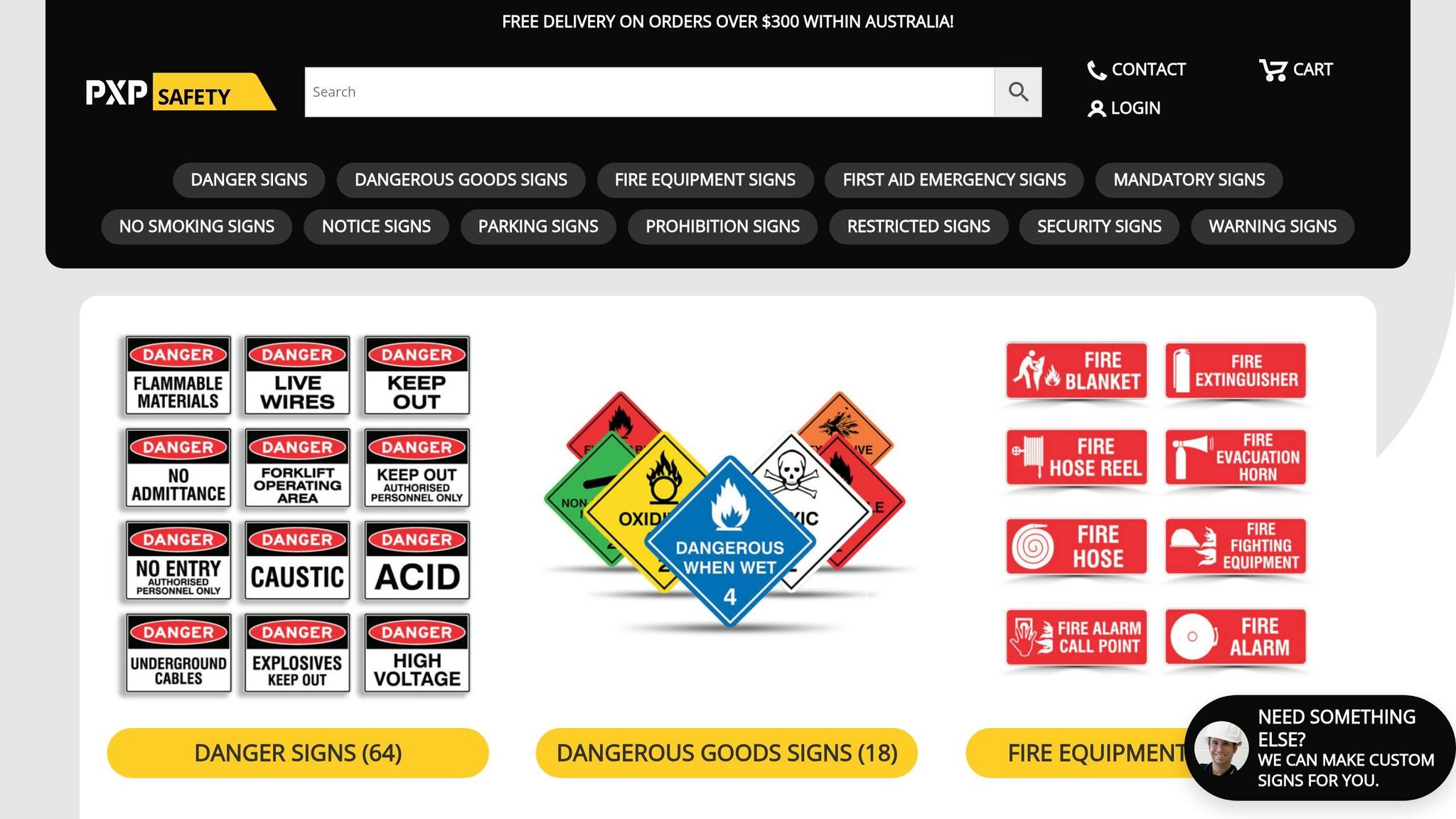
Finalise your design, place your order, and install your sign to ensure compliance with safety standards.
Customisation Options at PXP Safety
PXP Safety offers two material choices to suit different needs: durable Aluminium for long-term outdoor use and lightweight Polypropylene. All signs are pre-drilled with mounting holes, making them easy to secure on walls, posts, or fences.
You can choose from three standard sizes – 600 x 450mm, 450 x 300mm, and 300 x 225mm – designed to fit various site requirements. Standard messages include options like "No Pedestrian Access", "No Access", "No Thoroughfare", and "Forklift Access Only No Passageway." Each sign is manufactured in line with Australian Standard AS 1319. Pricing for the standard "No Pedestrian Access" sign starts at $39.69, with bulk discounts available: 5% off for 5 or more signs, 7% off for 20 or more, and 10% off for 50 or more.
How to Order and Receive Your Signs
PXP Safety’s online ordering system makes the process simple. Start by selecting your sign type, then pick your preferred material and size. Use the online design tool to customise text, headers, and pictograms, with a real-time preview to help you visualise your design. For larger projects or more specific needs, you can request a quote online in under 2 minutes. Once your design is finalised, add the signs to your cart and complete the checkout process. Shipping costs are calculated based on your location, and orders are typically dispatched within 48 hours.
After receiving your signs, proper installation is essential to ensure visibility and compliance.
Installation Tips
Once your custom signs arrive, follow these tips for effective installation. Start by reviewing your site assessment to determine the best locations and mounting methods.
Install signs well before restricted zones, ensuring they are placed at all entrances and at regular intervals throughout the area. Avoid placing signs where they could be blocked by trees, buildings, or other obstacles. Regular site inspections help maintain clear visibility. For secure mounting, use stainless steel banding, sign brackets, or specialised post bases like surface-mount concrete bases. To enhance safety further, consider adding slip-resistant floor decals or industrial floor tape to mark walkways and restricted areas clearly. For outdoor signs in low-light conditions, you may want to use flashing beacons or opt for Class 1 reflective materials when customising your order.
Ordering and installing pedestrian-only zone signs requires attention to both design and placement to ensure they are effective and compliant.
Conclusion
By applying the strategies for materials, design, and installation outlined earlier, creating effective pedestrian-only signage tailored to specific needs becomes achievable. Customising these signs not only ensures compliance with Australian Standards but also addresses the unique safety requirements of each site. Since every location has its own layout, foot traffic patterns, and potential risks, generic signage often falls short in meeting these demands.
The process begins with a thorough understanding of AS 1319-1994, which governs workplace safety signs, alongside any state-specific regulations in places like New South Wales, Victoria, or Queensland[2]. From ensuring compliance to selecting materials and installation, each step plays a crucial role in establishing safe pedestrian zones. Choosing materials suited to the environment and durability needs is key[2][22]. Additionally, proper sizing ensures the signs remain legible from the required distances[4].
Incorporating site-specific messages over generic warnings improves clarity and relevance[20]. Pair this with the right level of reflectivity – such as Class 1 Reflective material for public roads – and strategically placed signage to create zones that are both clear and enforceable, safeguarding workers and visitors alike[2][22].
Adhering to these standards not only reinforces Work Health and Safety but also provides clarity around pedestrian zones. Courts often consider compliance with Australian Standards when evaluating whether legal obligations have been met[14]. Thoughtfully designed and correctly installed pedestrian signage helps to minimise confusion, prevent accidents, and demonstrate a strong commitment to workplace safety. This final step of customisation completes the process of creating safe and compliant pedestrian zones.
FAQs
Which Australian Standards apply to pedestrian-only zone signs?
Australian Standards related to pedestrian-only zone signs include AS 1742.10:2024, which details the requirements for pedestrian facilities and signage. Additionally, the Supplement to AS 1742.10, released in June 2025, offers further guidance on compliance and design specifics for pedestrian signage. These standards ensure clear and consistent signage to enhance pedestrian safety.
What sign size do I need for my viewing distance?
The size of a sign plays a critical role in making sure it’s visible and easy to read from the intended viewing distance. Selecting the right size isn’t just about aesthetics – it’s essential to meet occupational health and safety standards. To get it right, refer to a legible viewing distance guide. This will help you determine the correct dimensions, ensuring the sign is large enough to convey its message clearly and effectively, while also promoting safety.
Should I choose aluminium, ACP, or corflute for my site?
The decision to use aluminium, aluminium composite panels (ACP), or corflute largely comes down to where and how long the signage will be used.
- Aluminium and ACP are tough, weather-resistant options, making them perfect for long-term outdoor signs. They can withstand harsh conditions and retain their appearance over time.
- Corflute, on the other hand, is lightweight and budget-friendly, which makes it a great choice for temporary signs or indoor use.
If you’re after something permanent for outdoor settings, aluminium or ACP is the smarter pick due to their lasting durability and ability to handle the elements.
Related Blog Posts
You may also be interested in
FAQs About Workplace Safety Signs in Australia
AS 1319 sign types, placement, materials and maintenance for workplace safety and WHS compliance in Australia.
Restricted Area Signs vs. No Entry Signs
Compare No Entry and Restricted Area signs in Australian workplaces — meanings, design differences and AS 1319 compliance.
How to Spot Workplace Signage Gaps
Audit your workplace for missing, faded or non‑compliant signs under AS 1319 to reduce incidents and avoid WHS fines.
Symbol Design: Global Standards Explained
Explains ISO 7010 and ISO 3864: standard symbols, colours and sizing for clear, language‑free safety signage and AU compliance.
Hazard Sign Visibility Planner
Plan hazard sign placement for max visibility with our free tool. Ensure safety by finding the best spot, height, and angle—try it now!